

Herbal capsules are defined as pre-measured, sealed units that deliver a fixed quantity of herbal extract or powder in every single dose. Understanding why herbal capsules beat raw powder starts with one fact: consistency. A capsule removes guesswork entirely. Raw powder measured by teaspoon varies wildly in weight and potency, making therapeutic outcomes unpredictable. Capsules also protect sensitive plant compounds from moisture and oxygen, two of the fastest routes to degradation. For anyone serious about getting results from natural supplements, the delivery format is not a minor detail. It is the difference between a supplement that works and one that does not.
Why herbal capsules beat raw powder on dosing accuracy
Raw powder dosing is inherently approximate. A teaspoon of burdock root powder can weigh anywhere from 2g to 5g depending on how finely it is milled and how tightly it is packed. That variability makes consistent therapeutic use almost impossible.
Encapsulation enables precise, consistent dosing that meets modern regulatory expectations and supports meaningful clinical evaluation. That matters because herbal supplements are increasingly scrutinised by regulatory bodies across the UK and EU, and standardised dosing is the baseline requirement for any credible product.
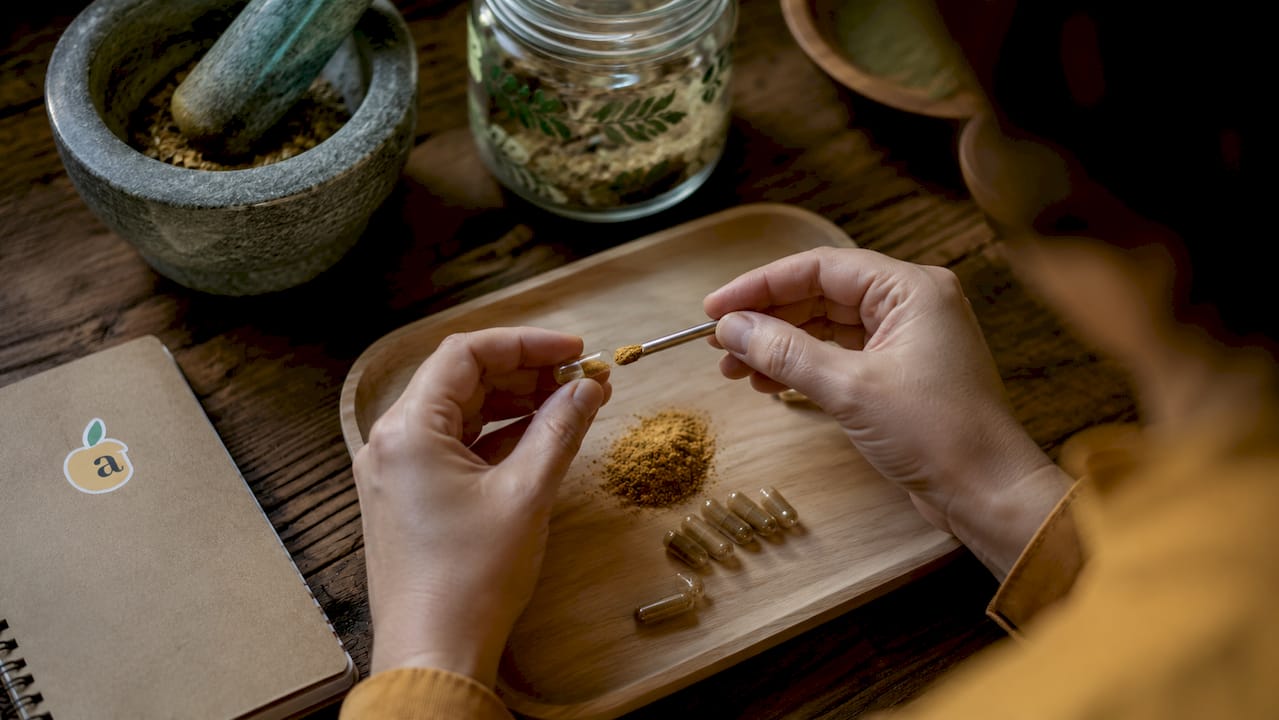
Standardised herbal extracts in capsule form also allow producers to specify the exact concentration of active compounds per unit. Vitaminb17’s Dandelion Root Capsules, for example, are formulated at a 5,000mg 10:1 extract, meaning each capsule delivers a defined potency that a loose powder simply cannot replicate at home.
Modern research validates standardised herbal extracts in capsule form for reliable dosing and effectiveness. This is not a marketing claim. It reflects the reality that clinical studies require fixed doses to produce reproducible results.
- Capsules eliminate “pinch or teaspoon” variability, delivering the same amount every time.
- Standardised extracts specify active compound concentration, not just raw herb weight.
- Regulatory compliance is far easier to demonstrate with capsules than with loose powder.
- Clinical evaluation of herbal efficacy depends on fixed, repeatable dosing.
Pro Tip: When buying herbal capsules, look for the extract ratio on the label, such as 10:1 or 20:1. This tells you how much raw herb was concentrated into each capsule, giving you a true measure of potency.
How capsules protect herbal stability and shelf life
Herbal compounds are fragile. Volatile oils, polyphenols, and glycosides all degrade when exposed to air, humidity, and light. Loose powder stored in an open jar loses potency within weeks, sometimes days, depending on the herb.
A sealed capsule prevents oxidation and moisture ingress, acting as a physical barrier between the active phytochemicals and the environment. This is particularly critical for antioxidant-rich herbs, where oxidation directly destroys the compounds responsible for the supplement’s benefit.
Manufacturing controls add another layer of protection. Hygroscopic herbal powders require facility humidity maintained at 40–55% to prevent capsule shell brittleness and powder clumping. That level of environmental control is not achievable in a home kitchen, which is one reason professionally encapsulated supplements consistently outperform self-measured powders in stability.
Here is why the encapsulation process protects your supplement from start to finish:
- Milling and blending are conducted in controlled environments to minimise oxidation before filling.
- Capsule filling seals the powder away from ambient air immediately after blending.
- Packaging in amber glass or foil-lined containers blocks light and further slows degradation.
- Sealed batch testing confirms potency at the point of manufacture, not just at source.
- Shelf life labelling reflects real stability data, not estimates based on raw herb behaviour.
The practical implication is straightforward. A capsule bought today retains its stated potency far longer than an equivalent quantity of loose powder stored under typical household conditions. For herbs like apricot kernels, where potency is the entire point, that stability is non-negotiable. Vitaminb17’s approach of using no fillers or binders means the capsule shell is doing the protective work, not synthetic additives.
Do capsules improve taste and daily compliance?
The answer is yes, and the effect on compliance is larger than most people expect. Bitter or pungent herbs are genuinely difficult to consume in powder form. Ashwagandha has a strong earthy bitterness. Neem is intensely astringent. Burdock root carries a sharp, mineral flavour that many people find unpleasant in water or food.
Capsules create a complete physical barrier, allowing unpalatable herbal ingredients to be swallowed comfortably without any taste contact. That is not a trivial benefit. Compliance, meaning whether you actually take your supplement every day, is the single biggest predictor of whether it works. A supplement you skip because it tastes unpleasant delivers zero benefit.
Capsules are superior for bitter herbs like ashwagandha and neem, directly enhancing adherence. Consistent daily intake is what produces the cumulative effects that herbal supplementation is known for, whether that is antioxidant support, anti-inflammatory action, or blood health benefits.
Convenience compounds this advantage. Capsules require no measuring, no mixing, and no preparation. For people with busy daily schedules, the ability to take a precise dose in seconds removes every practical barrier to consistency.
- No taste contact means even the most pungent herbs become easy to take.
- No preparation time removes a daily friction point that leads to skipped doses.
- Portable format means you can take your supplement at work, travelling, or away from home.
- Pre-measured doses eliminate the mental load of calculating amounts each day.
Pro Tip: If you are new to a potent herb like burdock root or apricot kernels, start with the lowest capsule dose and take it with food. This reduces any initial digestive adjustment and helps you build a consistent daily habit.
Powders vs capsules: absorption, flexibility, and cost
Capsules are not the right format for every situation. A fair comparison requires acknowledging where powders genuinely have the advantage.
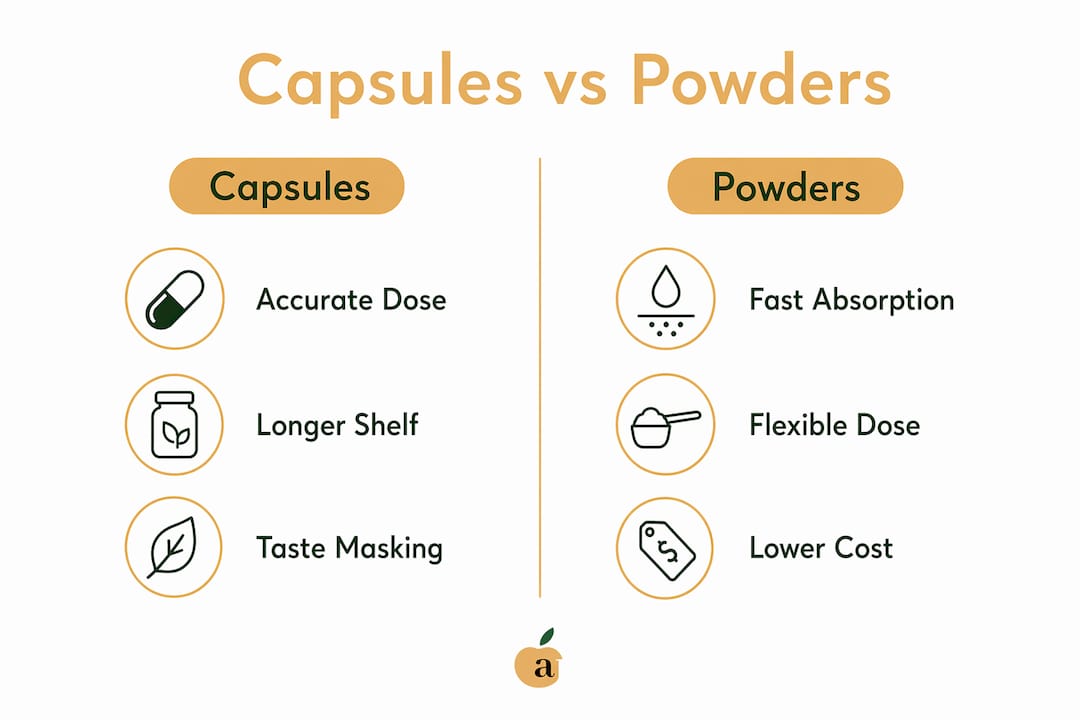
Powders absorb faster than capsules because they dissolve immediately without needing capsule shell disintegration. For someone seeking rapid onset, such as an athlete using a pre-workout herbal blend, powder can deliver active compounds to the bloodstream more quickly. This speed advantage is real, though for most daily wellness supplements the difference in onset time is clinically insignificant.
Powders also allow flexible dosing. You can adjust the amount precisely to your body weight, tolerance, or therapeutic goal. Some practitioners prefer this flexibility when working with clients whose needs change week to week. Powders can also be blended into food or drink, which suits people who prefer culinary integration over swallowing capsules.
Cost is another genuine consideration. Manufacturers select supplement format balancing absorption, cost, packaging, and consumer needs. Loose powder typically costs less per gram of herb than an equivalent capsule product, because encapsulation adds a manufacturing step. For high-volume users, that cost difference accumulates.
| Factor | Capsules | Loose powder |
|---|---|---|
| Dosing accuracy | Fixed, standardised per capsule | Variable, depends on measuring method |
| Taste | Fully masked by shell | Direct contact, often bitter or pungent |
| Absorption speed | Slightly slower, shell must dissolve | Faster, dissolves immediately |
| Shelf life | Longer, protected from air and moisture | Shorter, degrades faster when exposed |
| Cost per gram | Higher due to encapsulation process | Lower, minimal processing overhead |
| Convenience | High, no preparation needed | Moderate, requires measuring and mixing |
The conclusion from this comparison is not that one format is universally superior. It is that capsules win on consistency, protection, and compliance, while powders win on speed and flexibility. For potent, bitter herbs taken daily for sustained wellness, capsules are the stronger choice. For fast-acting blends or culinary use, powder has its place.
Key takeaways
Herbal capsules outperform raw powders on dosing accuracy, stability, and daily compliance, making them the preferred format for potent herbs taken consistently over time.
| Point | Details |
|---|---|
| Dosing accuracy | Capsules deliver a fixed, standardised dose every time, eliminating teaspoon variability. |
| Stability and shelf life | Sealed capsules protect active phytochemicals from moisture, oxygen, and light degradation. |
| Taste masking | Capsule shells create a physical barrier, making bitter herbs like ashwagandha easy to take. |
| Compliance advantage | Convenience and taste masking together produce consistent daily intake and better outcomes. |
| When powders win | Powders absorb faster and cost less, making them suitable for flexible or culinary use cases. |
The format question most people get wrong
I have spoken with a lot of health-conscious people who treat the capsule versus powder question as purely a cost calculation. They see a loose powder at a lower price per gram and assume they are getting better value. That logic misses the most important variable: how much of the stated dose actually reaches your system in a consistent, repeatable way.
Raw herb nutrient stability is a real consideration, and the science behind it matters. But stability in the herb at source is not the same as stability in your kitchen jar three weeks after opening. I have seen people spend money on high-quality loose powders and then store them in clear glass jars on a sunny windowsill. The potency loss in that scenario is substantial, and it happens silently.
The other thing people underestimate is the compliance gap. Skipping one dose a week because you cannot face the taste of neem powder sounds minor. Over three months, that is twelve missed doses. The cumulative effect of those gaps is measurable. Capsules close that gap by removing the sensory barrier entirely.
My honest view is that capsules are the right default for anyone using potent, bitter, or antioxidant-rich herbs as part of a daily wellness routine. Powders are a legitimate tool for specific contexts, particularly where speed of absorption matters or where culinary integration is the goal. But for the majority of people taking herbs like burdock root, apricot kernels, or sea kelp every day, the capsule format produces better real-world results because it gets taken, consistently, at the right dose.
— Jade
Vitaminb17’s herbal capsules: pure, potent, and ready
Vitaminb17 produces herbal capsules with no fillers, no binders, and no synthetic additives. Every product uses high-potency natural extracts, standardised for consistent dosing in every capsule.

If you want to know whether the capsules you are buying actually contain what the label claims, the underdosed supplement buyer’s guide from Vitaminb17 gives you the exact markers to check. Products like Burdock Root Capsules at 4,500mg extract and Dandelion Root at 5,000mg extract are formulated for people who want real potency, not filler-padded capsules that underdeliver. Pure. Strong. No compromise.
FAQ
What makes capsules more accurate than loose powder?
Capsules provide standardised dosing that eliminates the variability of approximate measures like teaspoons. Each capsule contains a fixed, pre-measured quantity of extract, so every dose is identical.
Do herbal capsules lose potency faster than powders?
No. A sealed capsule protects active compounds from moisture, oxygen, and light, giving capsules a longer effective shelf life than loose powder stored in typical household conditions.
Are capsules better for bitter herbs like ashwagandha?
Yes. Capsules mask unpleasant flavours completely, making potent herbs like ashwagandha and neem far easier to take consistently. Better compliance produces better outcomes.
When should you choose powder over capsules?
Powder is the better choice when faster absorption is the priority or when you need flexible dosing that changes week to week. It also suits culinary integration where the herb is blended into food or drink.
Are herbal capsules suitable for daily long-term use?
Yes, provided the capsules contain no synthetic additives or fillers. Vitaminb17’s capsules use pure extracts with no binders, making them suitable for consistent daily supplementation as part of a natural wellness routine.


