

Clean supplements are defined as nutritional products free from synthetic additives, fillers, binders, and contaminants, tested by independent laboratories to verify purity and potency. The question of why clean supplements outperform synthetics is not a matter of marketing preference. It comes down to three measurable factors: lower contaminant load, higher bioavailability of naturally derived nutrients, and manufacturing transparency that synthetic products rarely match. Organisations like the Clean Label Project have produced hard evidence showing widespread contamination in mainstream supplements. For health-conscious consumers, understanding these differences is the first step towards making genuinely effective choices.
What contaminant risks set clean supplements apart from synthetic ones?
Contamination is the most urgent reason to choose clean supplements over synthetic alternatives. A 2026 study of 165 protein powders found that 47% exceeded at least one safety threshold for contaminants, and 21% surpassed California Prop 65 limits by more than double. Those are not marginal exceedances. They represent a meaningful risk for anyone taking supplements daily.
The contaminants identified include heavy metals such as arsenic, cadmium, lead, and mercury, as well as industrial chemicals including BPA and BPS. These substances accumulate in the body over time. A single dose may appear harmless, but months of daily use with a contaminated product creates a very different picture.

One assumption worth correcting: organic certification does not equal clean. Certified organic supplements can carry higher heavy metal levels than non-organic alternatives, particularly plant-based protein powders, which tend to show elevated cadmium and lead. Organic status controls pesticide residues but does not address heavy metals absorbed from soil. Clean certification, by contrast, tests specifically for contaminant panels.
The Clean Label Project addresses this gap directly. Their certified products are tested in ISO/IEC 17025-accredited laboratories, with results benchmarked against EU and US regulatory thresholds. Chemists review each batch, and certification is not awarded on the basis of ingredient lists alone.
- Heavy metals tested: arsenic, cadmium, lead, mercury
- Industrial chemicals tested: BPA, BPS
- Certification standard: ISO/IEC 17025-accredited laboratory testing
- Benchmarks used: EU and US federal and state safety thresholds
- Organic certification does not cover heavy metal contamination
Pro Tip: When reading a supplement label, look for a third-party contaminant certification mark rather than a generic “natural” or “organic” claim. The certification should specify what was tested, not just that testing occurred.
How does bioavailability differ between natural and synthetic supplements?
Bioavailability is the proportion of a nutrient your body actually absorbs and uses. The gap between natural and synthetic forms is not uniform across all nutrients. It depends on molecular structure, and that detail matters more than most labels suggest.
The clearest example is vitamin E. Natural vitamin E (d-α-tocopherol) has roughly twice the biological activity of synthetic vitamin E (dl-α-tocopherol). The difference comes down to stereoisomers. Synthetic vitamin E contains eight stereoisomers, only one of which the body uses efficiently. Natural vitamin E contains that single active form exclusively. The NIH rates synthetic vitamin E at half the potency of the natural form for this reason.
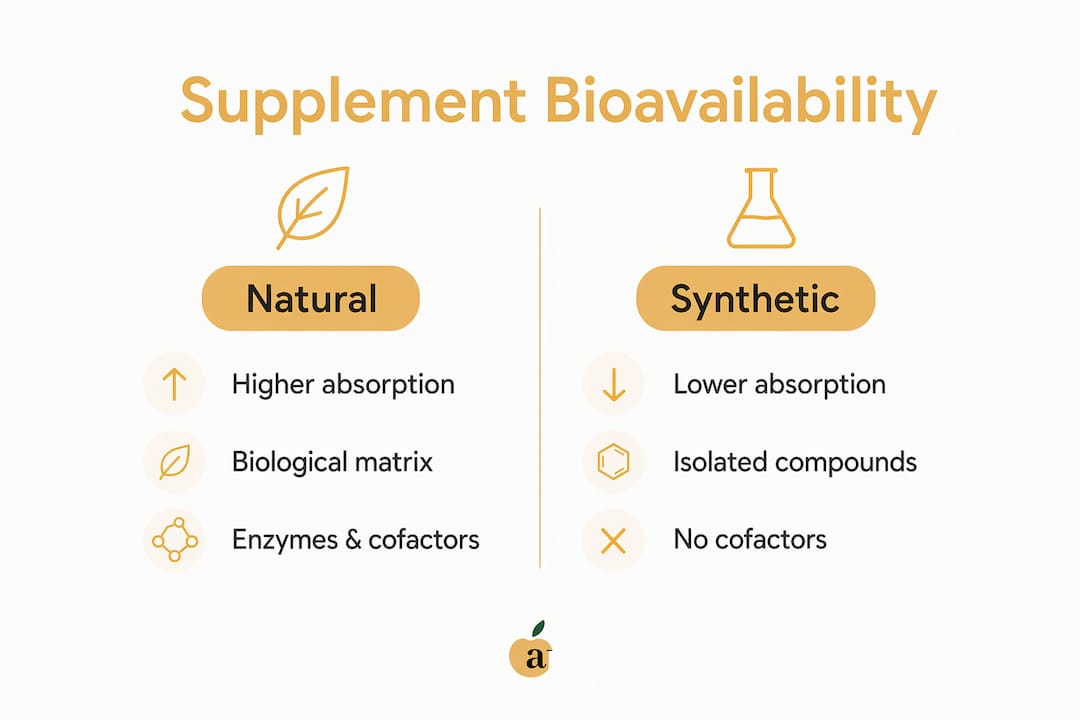
Vitamin D and vitamin K follow a similar pattern. Vitamin D3 outperforms D2 in raising and sustaining blood levels, and MK-7 (a form of vitamin K2) is superior to K1 for bone health. These are not interchangeable. Choosing the wrong form means paying for a supplement that delivers a fraction of the intended benefit.
Vitamin C is the notable exception. Synthetic ascorbic acid performs equivalently to the natural form in absorption and function. This shows that the natural versus synthetic debate requires nutrient-specific thinking rather than a blanket rule.
| Nutrient | Natural form | Synthetic form | Absorption advantage |
|---|---|---|---|
| Vitamin E | d-α-tocopherol | dl-α-tocopherol | Natural has ~2x biological activity |
| Vitamin D | D3 (cholecalciferol) | D2 (ergocalciferol) | D3 sustains blood levels more effectively |
| Vitamin K | MK-7 (K2) | K1 | MK-7 superior for bone health |
| Vitamin C | Ascorbic acid | Ascorbic acid | Equivalent absorption |
Beyond molecular form, whole-food supplements deliver nutrients within a biological matrix of enzymes and cofactors. That matrix influences how nutrients are absorbed and used. Isolated synthetic vitamins arrive without that supporting structure, which can reduce their practical effect even when the molecule itself is identical.
Pro Tip: Before buying any supplement, check which specific form of the nutrient it contains. “Vitamin E” on a label tells you very little. “d-α-tocopherol” tells you everything.
What manufacturing practices define a genuinely clean supplement?
Manufacturing quality is where the gap between clean and synthetic supplements becomes most visible. cGMP (current Good Manufacturing Practice) regulations set the baseline for identity, purity, strength, and contaminant limits. Reputable brands go further, adopting quality units, batch release protocols, and USP guidance. Many synthetic supplement manufacturers meet only the minimum cGMP floor.
The word “clean” on a label carries no legal definition. The FDA does not regulate it. This means a product can be marketed as clean while containing non-organic excipients such as magnesium stearate, silicon dioxide, or titanium dioxide as flow agents and fillers. Clean label claims can be undermined by these processing aids, which are often absent from the front-of-pack description but present in the ingredient list.
Genuinely clean supplement brands distinguish themselves through:
- No fillers, binders, or synthetic flow agents in the capsule
- Full ingredient transparency, including excipients
- Batch-level third-party contaminant testing, not just ingredient sourcing claims
- Label accuracy verification confirming the stated dose matches the actual content
- Sourcing documentation for raw materials
Vitaminb17 applies these principles directly. Products like Celery Seed Capsules and Burdock Root Capsules contain no fillers or binders. The formulation is raw extract, encapsulated. That is the manufacturing standard a clean supplement should meet.
Clinical practice supports a clear hierarchy: whole-food supplements first, hybrid formulations second, isolated synthetic nutrients last. That hierarchy exists because manufacturing complexity increases at each step, and so does the risk of quality compromise.
How to choose clean supplements for better health and natural healing
Choosing a genuinely clean supplement requires looking past the front of the label. The back panel and the brand’s testing documentation tell the real story.
Start with these indicators:
- Third-party contaminant certification. Look for Clean Label Project, NSF International, or USP certification. Confirm the certification covers contaminant testing, not just label accuracy.
- Ingredient list with no banned excipients. Titanium dioxide, artificial colours, and synthetic flow agents should not appear. If the ingredient list is longer than the active ingredients, ask why.
- Standardised extract ratios. A 10:1 extract ratio means ten parts of raw herb concentrated into one. This ensures consistent dosing and potency, unlike crude powders with variable active content.
- Manufacturing transparency. The brand should state where the product is manufactured and confirm cGMP compliance. Vague claims like “made in a certified facility” without specifics are a warning sign.
- Form of the active nutrient. As the bioavailability section shows, the specific molecular form determines efficacy. A clean supplement uses the most bioavailable form of each nutrient.
Synthetic supplements are not always the wrong choice. Short-term, high-dose therapeutic use sometimes requires isolated synthetic nutrients at concentrations impossible to achieve from food or whole-food extracts. A healthcare provider can advise on these cases. For daily wellness support and natural healing, clean supplements consistently deliver better results.
Pro Tip: Balance cost against testing evidence, not marketing claims. A cheaper supplement with no third-party contaminant data is not a saving. It is an unknown risk.
For those seeking clean herbal options, Fenugreek Capsules and Ginger Root Extract Capsules from Vitaminb17 offer standardised, filler-free formulations that meet these criteria directly.
Key takeaways
Clean supplements outperform synthetic alternatives because they combine lower contaminant risk, higher bioavailability in key nutrients, and manufacturing transparency that isolated synthetic products cannot match.
| Point | Details |
|---|---|
| Contaminant risk is real | A 2026 study found 47% of top-selling protein powders exceeded at least one safety threshold. |
| Organic does not mean clean | Certified organic supplements can carry higher heavy metal levels than non-organic alternatives. |
| Bioavailability depends on form | Natural vitamin E has roughly twice the biological activity of its synthetic equivalent. |
| Manufacturing transparency matters | Genuine clean supplements contain no fillers, binders, or unlisted excipients. |
| Certification must specify what was tested | Look for contaminant panel certification, not generic quality marks. |
Why I think most people are choosing supplements on the wrong criteria
The supplement aisle, whether physical or digital, is built around marketing language. “Natural.” “Pure.” “Advanced formula.” None of these phrases carry a legal definition. None of them tell you whether the product was tested for heavy metals, whether the dose on the label matches the dose in the capsule, or whether the form of the nutrient is one your body can actually use.
What I have observed, both in following clinical nutrition research and in watching consumer trends, is that people consistently overweight brand reputation and underweight testing evidence. A well-known brand with attractive packaging and no third-party contaminant data is treated as safer than a smaller brand with full ISO-accredited test results. That instinct is backwards.
The 2026 Clean Label Project findings are the clearest illustration of this problem. Nearly half of top-selling protein powders failed at least one safety threshold. These are not obscure products. They are bestsellers. Popularity and safety are not the same thing.
My practical advice: treat third-party contaminant certification as a non-negotiable baseline, not a bonus feature. Then look at the specific form of each active nutrient. Then check the excipient list. If a brand cannot provide clear answers to those three questions, move on. There are clean options available, and they are not difficult to find once you know what to look for. The supplement safety resources available through integrative medicine providers are a good starting point for building that knowledge.
— Jade
Pure supplements from Vitaminb17: no fillers, no compromise
Vitaminb17 produces clean, high-potency herbal supplements with no fillers, no binders, and no synthetic additives. Every product is a raw extract, encapsulated and nothing more.

The Dandelion Root Capsules 5000mg use a 10:1 extract ratio, delivering consistent potency in every capsule. The Vitamin B17 Apricot Kernels offer a natural, raw option for those seeking traditional herbal support. Both products reflect the clean supplement principles covered in this article: pure ingredients, standardised dosing, and full transparency. Browse the full range at Vitaminb17 to find clean herbal extracts built for real results.
FAQ
What makes a supplement “clean” by definition?
A clean supplement contains only active ingredients and no synthetic fillers, binders, or artificial additives, and is verified by third-party contaminant testing in an accredited laboratory.
Do clean supplements absorb better than synthetic ones?
Absorption depends on the specific nutrient. Natural vitamin E has roughly twice the biological activity of synthetic vitamin E, while natural and synthetic vitamin C perform equivalently.
Is organic certification the same as clean certification?
No. Certified organic supplements can contain higher heavy metal levels than non-organic products. Clean certification specifically tests for contaminant panels including heavy metals and industrial chemicals.
How do I verify a supplement’s contaminant testing?
Look for certification from organisations such as the Clean Label Project or NSF International, and confirm the certification covers a specific contaminant panel tested in an ISO/IEC 17025-accredited laboratory.
When are synthetic supplements the better choice?
Synthetic isolated nutrients are appropriate for short-term, high-dose therapeutic use where concentrations are not achievable from whole-food or herbal extracts. A qualified healthcare provider should guide these decisions.


