

An enteric-coated capsule is a dosage form wrapped in a pH-responsive polymer film that stays intact in stomach acid and dissolves only once it reaches the higher pH of the small intestine. That single design choice protects two things at once: the active ingredient inside, and the stomach lining outside. Standards bodies including the British Pharmacopoeia (BP), the European Pharmacopoeia (Ph. Eur.), and the United States Pharmacopeia (USP) all set formal dissolution criteria for this kind of delayed-release coating, and here at Vitaminb17, purity and consistent dosing matter just as much as how a capsule behaves once swallowed.
The mechanism is straightforward once you see it. The polymer contains acidic chemical groups that stay closed and insoluble in the strongly acidic stomach environment, then ionise and open up once they hit the more alkaline small intestine, releasing the contents where they’re meant to go.
Three things to remember before you take one:
- Swallow it whole. The coating only works if it stays intact.
- Never crush or chew it. Breaking the film destroys the acid barrier instantly.
- Ask a pharmacist first if you struggle to swallow capsules, take other medicines, or aren’t sure why a product is coated at all.
Key Takeaways
Enteric coating works by using pH-responsive polymers that stay closed in stomach acid and open once they reach the higher pH of the small intestine, protecting both the drug and the stomach.
| Point | Details |
|---|---|
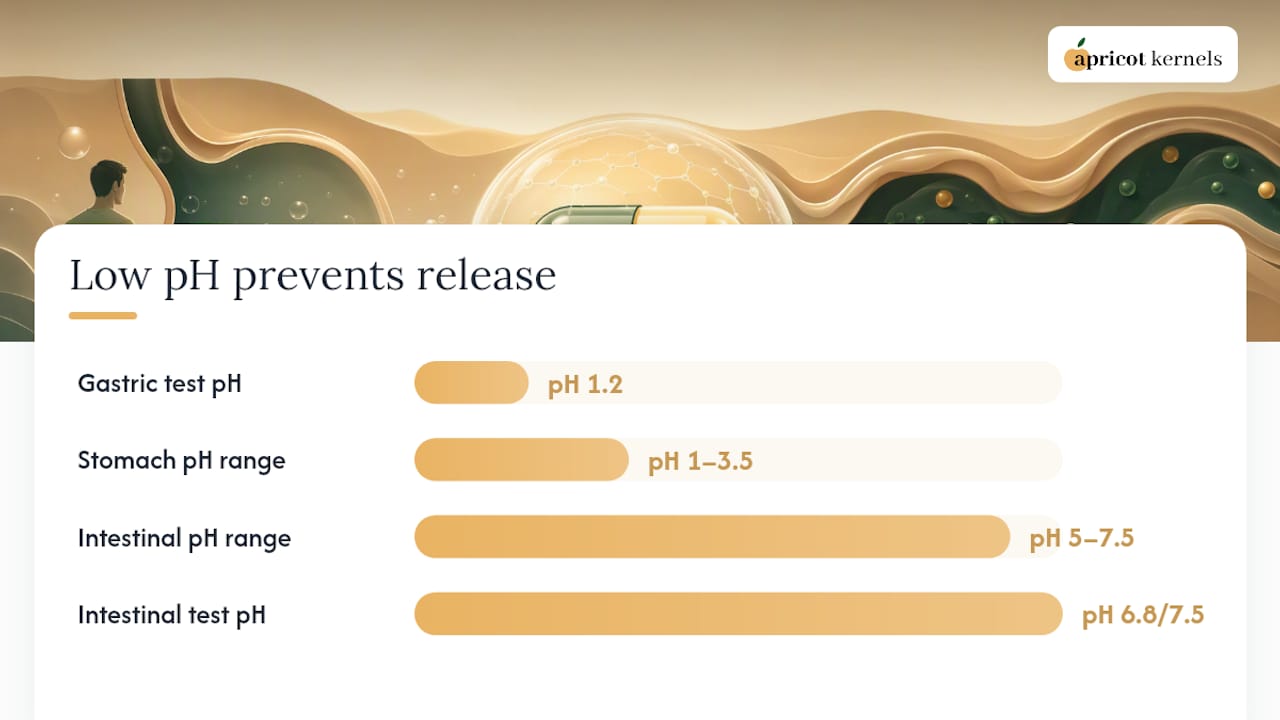
| Core mechanism | Polymers dissolve once pH rises from gastric levels (around 1 to 3.5) to intestinal levels (around 5 to 7.5). |
| Standard test | Dissolution testing checks negligible release at pH 1.2, then rapid release at pH 6.8 or 7.5. |
| Common polymers | Eudragit®, Acryl-EZE®, HPMCAS/HPMCP, Cellacefate, and PVAP each target different pH thresholds. |
| Safety rule | Never crush, break, or chew a coated capsule, as this destroys the protective barrier entirely. |
| Real-world variability | Food, gastric emptying, and individual transit time all affect exact release timing. |
If you’re evaluating supplement potency more broadly, Vitaminb17’s guide to spotting underdosed herbal supplements is worth reading before you choose a product, coated or otherwise. And if you’re after clean, high-potency herbal extracts without fillers or binders, from apricot kernel to burdock root, browse Vitaminb17’s full range to see standardised extracts formulated for consistent, dependable dosing.
Table of Contents
- What is an enteric-coated capsule’s coating actually made from and how does it work?
- Why do manufacturers and clinicians choose enteric coating?
- Which polymers and materials are used in enteric coatings?
- How are enteric coatings applied and tested during manufacturing?
- Do enteric coatings work the same way for everyone?
- What are the risks and downsides of enteric-coated capsules?
- How do regulators define a “pass” for enteric performance?
- Frequently asked questions about enteric-coated capsules
- Sources
What is an enteric-coated capsule’s coating actually made from and how does it work?
Enteric polymers are pH-responsive by design. They’re built to be insoluble in the acidic environment of the stomach and to dissolve only once they meet the higher pH further down the digestive tract. That’s the entire trick behind the technology, and it’s a well-established one in pharmaceutical science.
Here’s the rough pH map your digestive system runs on:
- Stomach: approximately pH 1 to 3.5, strongly acidic, hostile to acid-sensitive drugs.
- Duodenum and upper small intestine: approximately pH 5 to 6.5, rising steadily.
- Ileum (lower small intestine): approximately pH 6.5 to 7.5, the target zone for most enteric formulations.
As a capsule or tablet travels from the acidic stomach into this rising-pH environment, the polymer coating undergoes a chemical shift. Acidic functional groups within the film, typically carboxylic acid groups in methacrylate or cellulose-based polymers, remain protonated and closed in low pH. Once the surrounding fluid crosses the polymer’s specific solubility threshold, those groups ionise, the film becomes permeable, and it eventually disintegrates or dissolves outright. What was a solid, protective shell becomes a doorway. Colorcon’s overview of enteric coating chemistry describes this as a deliberately engineered pH threshold rather than a passive barrier.
Manufacturers and testing labs don’t just take this on faith. The standard way to prove a coating behaves as intended is a two-step in vitro dissolution test.
Statistic Callout: The standard pharmacopeial dissolution test exposes a dosage form to simulated gastric fluid at pH 1.2 first, checking for negligible drug release, then transfers it to a buffer at pH 6.8 or 7.5 to confirm the coating dissolves and releases its contents within a defined window, according to ScienceDirect’s pharmaceutical science reference on enteric coating.
There’s a real-world wrinkle worth knowing about. Laboratory pH values are fixed and predictable; your digestive system is not. Food in the stomach slows gastric emptying, which can delay how quickly a coated capsule even reaches the small intestine, regardless of how well the polymer performs once it gets there. A capsule taken on an empty stomach might clear the stomach in under an hour. The same capsule taken with a heavy meal could sit there for several hours before moving on. This is one reason instructions sometimes specify taking a coated product with or without food, and it’s part of why gastrointestinal pH and transit time variability genuinely affect how a drug performs, not just how it’s designed to perform, according to a PubMed review of enteric coating and bioavailability.
Understanding this timeline also helps explain why swallowing the capsule intact isn’t a minor instruction. It’s the entire mechanism working as intended.
Why do manufacturers and clinicians choose enteric coating?
There are four main reasons a formulator reaches for an enteric coating rather than a standard shell, and they’re not mutually exclusive. A single product often benefits from two or three at once.
- Protecting the active ingredient from stomach acid. Some compounds break down or lose potency when exposed to a highly acidic environment, so coating them preserves their integrity until they reach friendlier conditions.
- Protecting the stomach lining from irritant compounds. Certain drugs cause gastric irritation or ulceration if released directly in the stomach; coating delays that contact.
- Targeting a specific site in the intestine. Some conditions or drug actions require release further along the digestive tract, sometimes as far as the colon.
- Taste masking and stability. Coatings can also mask unpleasant flavours or improve shelf stability, a secondary but genuine benefit.
The IUPAC Goldbook’s definition of enteric coating frames these first two reasons, protecting the drug and protecting the gastric mucosa, as the core rationale behind the entire category, and it’s a definition that has held up well against decades of formulation practice.
In prescription medicine, the clearest example is aspirin and other NSAIDs, which are notorious for causing stomach irritation when released directly in the gastric environment. Certain acid-labile antibiotics, erythromycin among them, also lose effectiveness if exposed to stomach acid before they can be absorbed. Researchers working with peptide and biologic formulations rely on similar coating principles, since these delicate molecules are often destroyed outright by gastric enzymes and acidity.

Consumer supplements borrow the same logic, though the marketing angle differs slightly. Fish oil capsules are a familiar case: enteric coatings on fish oil are often promoted specifically to reduce the “fishy burp” reflux some people experience, rather than to protect the oil itself from degradation. It’s a comfort benefit as much as a chemical one.
Enteric coating shows up across several dosage formats, not just capsules:
- Standard tablets
- Mini-tablets
- Pellets and granules (often filled into a capsule shell)
- Coated hard capsules
If you’re weighing up capsule formats generally, Vitaminb17’s guide comparing herbal capsules with raw powder covers why encapsulation itself, coated or not, tends to outperform loose powder for consistency and convenience.
Which polymers and materials are used in enteric coatings?
Polymer choice comes down to one variable above all others: the pH at which the film needs to dissolve. A coating engineered for the duodenum behaves very differently from one built to survive all the way to the colon, and that difference is entirely down to chemistry.
- Eudragit® (Evonik) — a family of methacrylic acid copolymers. Eudragit L dissolves around pH 6, Eudragit S needs closer to pH 7, and Eudragit FS is formulated for even more distal, colon-targeted release.
- Acryl-EZE® (Colorcon) — a methacrylate-based enteric coating system designed for efficient large-scale application, popular in commercial tablet manufacturing.
- HPMCAS and HPMCP — cellulose derivatives (hydroxypropyl methylcellulose acetate succinate and hydroxypropyl methylcellulose phthalate) that offer a gentler, non-acrylate alternative with tuneable pH thresholds.
- Cellacefate (cellulose acetate phthalate) — one of the older enteric polymers still in use, with dissolution behaviour that can be pushed toward pH 7.5 for more distal targeting.
- PVAP (polyvinyl acetate phthalate) — another historical option, valued for consistent film-forming properties.
A 2015 review of enteric-coated capsule formulation lists these as the core materials still shaping enteric technology today, decades after several of them were first developed.
Capsule-specific innovation hasn’t stood still either. DRcaps™ are a capsule product designed from the outset for delayed release, and researchers have used them in small-batch, experimental enteric work. One study applying immersion coatings of Eudragit® S and Cellacefate to DRcaps™ found that dissolution timing could be shifted toward pH 6.8 or pH 7.5 depending on which polymer and concentration was used, according to research on acid-labile macromolecule delivery. That’s a useful reminder that enteric coating isn’t a single fixed recipe. It’s a spectrum of options tuned to where the payload needs to end up.
Formulators increasingly favour capsule shell technologies that are inherently gastro-resistant, bi-layer polymer capsules being one example, because they avoid a separate coating step entirely and reduce how much heat, solvent, and moisture a sensitive active ingredient has to survive during manufacturing.
That shift matters more than it might first appear, and the next section explains exactly why.
How are enteric coatings applied and tested during manufacturing?
Enteric coating is typically a post-filling step: the capsule or tablet is made first, then coated afterward as a separate manufacturing stage. That sequencing has consequences, both for how the coating is applied and for how vulnerable the active ingredient is during the process.
- Pan coating. Tablets or capsules tumble in a rotating drum while the polymer solution is sprayed on in controlled layers, drying between passes. This is the workhorse method for large commercial batches.
- Fluid-bed coating. Dosage units are suspended in a stream of warm air while coating solution is sprayed from below or the side, giving more even, scalable coverage, especially useful for pellets and granules.
- Immersion or dipping. Individual capsules are dipped directly into a polymer solution and dried, a method more common in research and small-batch settings than in industrial production.
Whichever method is used, the finished product still has to prove itself in the same standard test.
Statistic Callout: Pharmacopeial dissolution testing typically requires negligible drug release during exposure to simulated gastric fluid at pH 1.2, followed by rapid, near-complete release once the medium shifts to pH 6.8 or 7.5, a two-step protocol referenced across pharmaceutical standards, per ScienceDirect’s summary of enteric coating testing.
Getting a reliable coating onto a capsule isn’t as simple as spraying polymer and walking away. Several practical problems recur across the industry:
- Solvent and heat exposure. The coating process itself can degrade heat-sensitive or moisture-sensitive active ingredients before the film has even finished drying.
- Adhesion difficulties. Hard capsule shells are smoother than tablet surfaces, making even, consistent film adhesion genuinely harder to achieve.
- Plasticiser and mechanical properties. The coating needs enough flexibility to survive handling and transport without cracking, which means getting the plasticiser ratio right.
- Drying-induced embrittlement. Coatings dried too quickly or unevenly can become brittle and fail prematurely, undermining the entire acid barrier.
Small-batch immersion techniques, the kind used in DRcaps™ research, sidestep some industrial-scale equipment limitations, but they come with their own trade-offs: less uniform film thickness and lower reproducibility batch to batch, which is part of why they stay largely in the research and small-production space rather than mainstream manufacturing, according to the immersion coating study on acid-labile macromolecules. It’s also worth noting that some newer capsule shell technologies avoid this entire coating step by building acid resistance directly into a bi-layer polymer capsule, which sidesteps the solvent and heat exposure problem outright.
If you’re comparing capsule shell options more broadly, including how conventional gelatin shells stack up against newer alternatives, Just Move Supplements’ overview of capsule formats is a useful industry reference point.
Do enteric coatings work the same way for everyone?
Not quite. Enteric coating is a reliable design principle in the laboratory, but the release site and timing shift from person to person once you leave controlled lab conditions. That gap between engineered intent and lived reality is one of the most underappreciated facts about this entire category of medicine.
Individual gastric emptying rate, the amount and type of food present, and overall gut transit time all influence exactly when and where a coated dose finally releases, meaning the same product can behave somewhat differently in two different people, or even in the same person on two different days.
That variability plays out differently depending on the dosage form itself.
- Single-unit forms (one large tablet or capsule) either clear the stomach as a whole or stay put as a whole, meaning gastric emptying timing has an outsized effect on when release begins.
- Multiparticulate forms (pellets or granules inside a capsule) disperse more evenly once the shell dissolves, spreading transit through the stomach more gradually and tending to produce more consistent, reproducible release timing across a population, as Wikipedia’s overview of enteric coating notes when comparing the two formats.
What does this mean practically? For most supplements and over-the-counter products, the variability is a minor inconvenience at worst. But for prescription medicines with a narrow therapeutic window, that variability can genuinely matter, and it’s part of why clinicians sometimes switch a patient from a single large enteric tablet to a multiparticulate capsule formulation, or adjust dosing frequency, if the standard version isn’t performing consistently. It’s also a reminder that “release in the small intestine” describes a target zone rather than a guaranteed, identical point for every person who swallows the capsule.
Curious how digestion itself shapes how well any supplement gets absorbed in the first place? Vitaminb17’s explainer on digestion and supplement absorption goes deeper into that broader picture.
What are the risks and downsides of enteric-coated capsules?
Enteric coating solves real problems, but it introduces trade-offs too, and every one of them is worth knowing before you rely on a coated product.
- Delayed onset of action. Because release is intentionally postponed until the capsule reaches the intestine, coated products work more slowly than an uncoated equivalent, which matters if fast relief is the goal.
- Timing variability with food and gastric emptying. As covered above, a full stomach can delay when a coated dose even starts its journey toward release.
- Incomplete release. In rare cases, particularly with older or poorly manufactured coatings, a dose may not fully dissolve before passing through the target absorption zone, reducing effective dosing.
- Poor fit with acid-activated drugs. Some medicines actually need stomach acid to activate properly; coating a drug that depends on gastric conditions can work directly against its intended mechanism.
None of those downsides is a reason to avoid enteric-coated products outright. They’re reasons to respect the one rule that matters most.
Never crush, break, or chew an enteric-coated capsule or tablet. Doing so destroys the polymer film instantly, releasing the contents directly into the stomach exactly where the coating was designed to prevent that from happening. That can mean gastric irritation from a drug meant to bypass the stomach, degraded potency from an acid-sensitive compound, or both at once. Verywell Health’s patient guidance on enteric-coated medication is blunt about this, and rightly so.
Here’s a short checklist worth keeping in mind:
- Swallow the capsule whole, with a full glass of water.
- If swallowing capsules is genuinely difficult, speak to a pharmacist about an alternative formulation rather than crushing the one you have.
- If you miss a dose, follow the product’s specific guidance rather than doubling up.
- If you notice unusual stomach symptoms or a lack of expected effect, mention the exact product and coating type to a clinician or pharmacist.
Pro Tip: Pharmacists often have more flexibility than patients realise. If swallowing a coated capsule is a genuine barrier, ask specifically about liquid, multiparticulate, or uncoated alternatives, rather than assuming crushing is the only option. There’s almost always a formulation workaround that preserves the drug’s intended action.
How do regulators define a “pass” for enteric performance?
Pharmacopeial standards exist precisely so that “enteric coated” means something consistent, rather than being a marketing phrase applied loosely. Both the BP/Ph. Eur. and the USP include formal dissolution and disintegration methods specifically for delayed-release dosage forms, and manufacturers test against these criteria as a matter of routine quality control, not as an optional extra.
A pass typically looks like this:
- No significant drug release during the acid phase. The product must show negligible dissolution when exposed to simulated gastric fluid at pH 1.2 for a defined period, often around two hours.
- Rapid, near-complete release once pH rises. Once transferred to the intestinal-pH buffer stage, the majority of the drug content must dissolve within a set window.
Statistic Callout: The two-step gastric-then-intestinal dissolution protocol, pH 1.2 followed by pH 6.8 or 7.5, is the standard method pharmacopeias and manufacturers use to confirm enteric performance before a batch is released for sale, according to ScienceDirect’s overview of enteric coating standards.
Quality control doesn’t stop at a single test result. Manufacturers run dissolution profiles across multiple batches to check for consistency, since coating thickness, drying time, and polymer application can all introduce small variations from one production run to the next. That batch-to-batch checking is part of what separates a properly validated enteric product from one that merely claims the label.
A practical view on when enteric coating earns its place
Enteric coating is genuinely useful technology, not a marketing flourish. When a compound is acid-sensitive, or when a product is known to irritate the stomach lining, a well-made coating solves a real problem rather than an imagined one. Where I’d push back on the conventional framing is the assumption that coating always equals better absorption or stronger effect. It doesn’t. It changes where and when release happens, and that’s only an advantage if your particular situation calls for it.
The practical takeaway is simple: trust the coating to do its job by swallowing the capsule whole, and trust a pharmacist or clinician, rather than your own judgement, on whether a specific coated product suits your circumstances.

Frequently asked questions about enteric-coated capsules
What does enteric coating mean, exactly?
It means a capsule or tablet has been given a pH-responsive polymer film that resists stomach acid and dissolves only once it reaches the higher pH of the small intestine, protecting either the drug, the stomach, or both.
Are enteric capsules better than regular capsules?
Not universally. They’re better specifically when a drug is acid-sensitive or when it’s known to irritate the stomach lining. For compounds that don’t have either issue, a standard uncoated capsule works perfectly well and releases its contents faster.
How do enteric-coated capsules work compared with regular ones?
A regular capsule dissolves fairly quickly in the stomach, releasing its contents almost immediately. An enteric-coated capsule deliberately delays that release until it clears the stomach and reaches the intestine, which changes both the timing and the location of absorption.
Can I open an enteric-coated capsule and take the contents separately?
No. Doing so removes the protective film entirely, exposing the contents directly to stomach acid and defeating the entire purpose of the coating. Speak to a pharmacist if swallowing the capsule whole is a genuine problem.
Why use enteric-coated supplements rather than standard ones?
Some supplement manufacturers use enteric coating to reduce stomach discomfort, fish oil being the most common example, since delaying release past the stomach can reduce reflux and aftertaste for sensitive individuals.
This article is general information, not a substitute for advice from a qualified doctor. Consult a qualified healthcare professional about your own circumstances before acting on anything here.
Sources
- What are enteric coated tablets?
- Enteric coating of oral solid dosage forms as a tool to improve drug bioavailability – PubMed
- Enteric coating – ScienceDirect Topics


