

An allergen-free supplement is a dietary product formulated without the top nine allergens identified by the FDA: milk, eggs, fish, crustacean shellfish, tree nuts, peanuts, wheat, soy, and sesame. For anyone managing food allergies or intolerances, choosing the wrong supplement can trigger the same reactions as eating the wrong food. This guide explains what allergen-free supplements are, how they are regulated, what to watch for on labels, and how to choose products you can trust with confidence.
What is an allergen-free supplement and why does it matter?
An allergen-free supplement excludes common allergenic ingredients from both its active compounds and its inactive components, such as fillers, binders, and capsule coatings. The distinction matters because most people focus only on the active ingredient. A magnesium capsule, for example, may be free of peanuts in its core formula but still contain lactose as a filler or a gelatin shell derived from shellfish.

The FDA regulates dietary supplements as food products, not medicines. That means manufacturers carry responsibility for safety and accurate labelling across more than 100,000 products on the market. The FDA steps in only after a product is already sold, when safety issues or misleading claims are reported. This post-market model places the burden of vigilance squarely on the consumer.
For people with multiple allergies, the stakes are high. Allergen-free supplements improve adherence among allergy sufferers by reducing anxiety around daily supplement use. When you know a product is genuinely free from your triggers, you are far more likely to take it consistently and benefit from it.
What common allergens are found in supplements?
The nine allergens covered by the Food Allergen Labelling and Consumer Protection Act (FALCPA) are the most frequent culprits in supplement reactions. They do not only appear in food. They show up in supplements through excipients, coatings, and processing aids that most people never think to check.
| Allergen | Common supplement source |
|---|---|
| Milk / lactose | Filler in tablets and capsules |
| Wheat / gluten | Starch binder in pressed tablets |
| Soy | Lecithin used as an emulsifier |
| Shellfish | Glucosamine derived from crustacean shells |
| Tree nuts | Carrier oils in softgels |
| Eggs | Coating agents on tablets |
| Fish | Omega-3 capsules and gelatin shells |
| Peanuts | Flavouring agents in chewable supplements |
| Sesame | Carrier oils in herbal extracts |
Hidden allergens are the most dangerous category. Capsules with gelatin or fillers like lactose or starch can trigger reactions even when the headline ingredient is entirely plant-based. Glucosamine supplements are a well-known example: many are derived from crustacean shells, making them unsafe for people with shellfish allergies despite being marketed as joint support products.
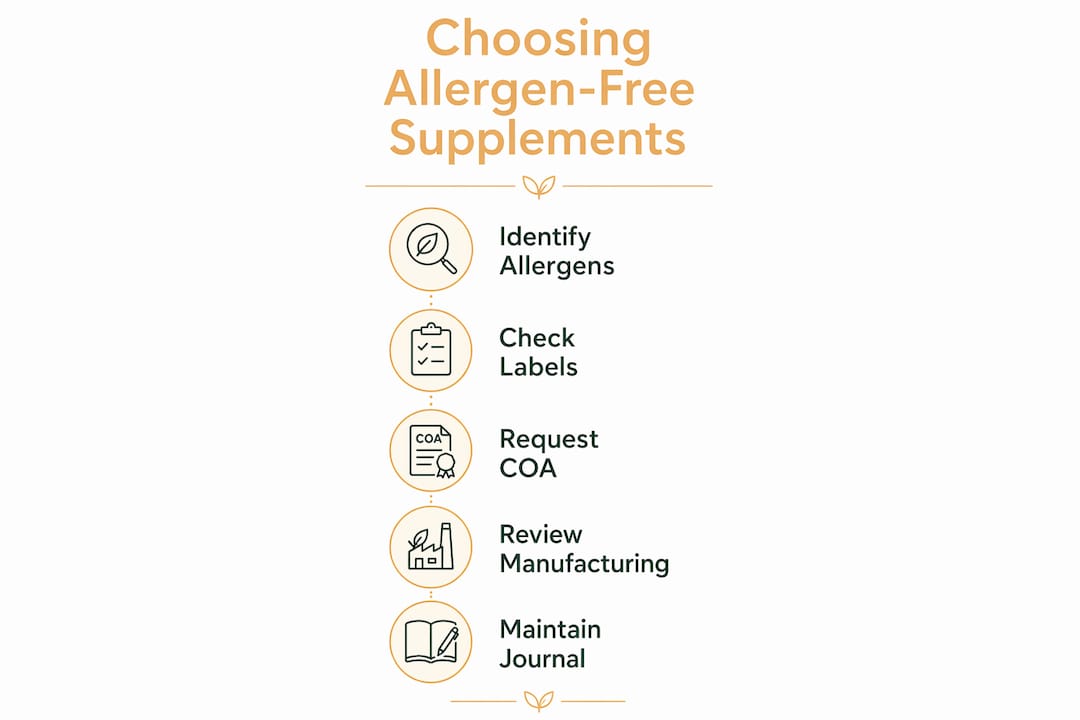
Cross-contact during manufacturing adds another layer of risk. A facility that processes whey protein on the same line as a “dairy-free” supplement may still deposit trace milk proteins on the final product. This is why the source of manufacture matters as much as the ingredient list itself.
How are allergen-free supplements regulated and verified?
FALCPA requires manufacturers to declare the presence of any of the nine major allergens on supplement labels. This applies to both intentional ingredients and any allergen introduced through shared equipment or facilities. The law covers “Contains” statements, which name allergens directly, and advisory statements such as “May contain traces of nuts.”
Third-party certifications go further than legal labelling requirements. USP, NSF Certified for Sport, and Informed Sport each test for ingredient accuracy and contamination. These bodies verify that what is on the label is actually in the capsule, and that banned or harmful substances are absent. For allergen-sensitive consumers, NSF and Informed Sport are particularly relevant because they test for a broader range of contaminants.
Understanding what certifications actually cover is critical:
- “Contains” statement: Confirms a named allergen is present as an ingredient.
- “Free from” claim: Indicates the allergen was not intentionally added, but does not guarantee zero cross-contact.
- Advisory statement: Warns of possible cross-contact but is voluntary, not mandatory.
- Third-party certification seal: Confirms testing was conducted on that batch or product line.
- Certificate of Analysis (COA): A batch-specific document showing test results for contaminants and ingredient levels.
Pro Tip: Ask the brand directly for a COA before purchasing if you have a severe allergy. A reputable company will provide one without hesitation. If they cannot, that tells you something important.
Batch testing and COAs are becoming a market differentiator. Brands that publish COAs build measurably greater trust among allergen-sensitive consumers. Transparency at this level signals that a company controls its manufacturing environment, not just its ingredient list.
What challenges exist with allergen-free supplement claims?
Allergen-free labelling focuses on intentional ingredient exclusion. Manufacturing cross-contact risks remain a common and underestimated issue among consumers. A product can be truthfully labelled allergen-free and still pose a risk if it is made in a shared facility without rigorous allergen control protocols.
Common misconceptions worth addressing:
- “Natural” does not mean allergen-free. Many natural supplements contain tree nut oils, soy lecithin, or shellfish-derived ingredients.
- “Clean label” is a marketing phrase, not a regulated term. No legal standard defines it.
- Vegan supplements are not automatically allergen-free. Soy, wheat, and sesame are all plant-based allergens.
- A certification seal does not cover every batch. Some certifications apply to a product formula, not every production run.
“Third-party certifications confirm ingredient presence and contamination absence, but they do not guarantee 100% safety or validate health claims.”
The interaction risk extends beyond allergies. Certain supplements can interfere with treatments such as chemotherapy, or cause increased sensitivity in people with specific conditions. “Natural” is not a synonym for safe. This is why consulting a healthcare professional before starting any supplement is not optional for people with complex health histories.
How to choose allergen-free supplements safely
Selecting a genuinely safe non-allergenic product requires more than reading the front of the label. The back panel, the manufacturer’s website, and third-party databases all carry information that the front label never will.
- Read the full ingredient list. Check both active and inactive ingredients. Look for lactose, starch, gelatin, soy lecithin, and shellfish-derived compounds in the “Other Ingredients” section.
- Look for third-party certification. USP, NSF, or Informed Sport seals confirm independent testing. Prefer brands that publish their COAs publicly.
- Check the manufacturing statement. Phrases like “manufactured in a facility that also processes tree nuts” indicate cross-contact risk regardless of the ingredient list.
- Contact the brand. Ask whether allergen control procedures are in place and whether batch testing is conducted. Transparent brands answer quickly and specifically.
- Consult your healthcare provider. Discuss supplement use with a professional to evaluate interactions with any medications or conditions you have.
- Start with single-ingredient products. Fewer ingredients mean fewer opportunities for hidden allergens. Consumers with multiple allergies benefit most from supplements that avoid all common allergens and excipients.
Pro Tip: Keep a personal supplement journal. Record the product name, batch number, ingredients, and any symptoms after taking it. This log becomes invaluable if you need to identify a reaction trigger or report an issue to a healthcare provider.
Allergy-friendly nutrition does not require sacrificing potency. Pure, single-extract supplements, such as dandelion root, mullein leaf, or pumpkin seed extract, are naturally free from the major allergens when formulated without fillers or binders. The key is choosing brands that make their formulation and manufacturing practices transparent.
Key takeaways
Allergen-free supplements are defined by what they exclude: the nine major allergens, hidden excipients, and cross-contact risks that standard labelling often fails to capture.
| Point | Details |
|---|---|
| Definition is precise | An allergen-free supplement excludes all nine FALCPA allergens from both active and inactive ingredients. |
| Labels can mislead | “Natural” and “clean label” are unregulated phrases; always check the full ingredient list and manufacturing statement. |
| Certifications have limits | USP, NSF, and Informed Sport verify testing but do not guarantee zero risk for every individual. |
| COAs build real trust | Batch-specific Certificates of Analysis are the strongest evidence of allergen control in manufacturing. |
| Professional advice is non-negotiable | Always consult a healthcare provider before starting supplements, particularly if you take medication or have complex health needs. |
Why I think most people underestimate label complexity
The supplement aisle looks straightforward until you have a serious allergy. I have spoken with people who reacted to a “dairy-free” protein powder because it contained lactose as a tablet filler, listed in tiny print under “Other Ingredients.” They had read the front label carefully and still got it wrong.
The market has improved. Brands are publishing COAs, third-party testing is more accessible, and FALCPA has tightened labelling obligations. But the gap between legal compliance and genuine safety for highly sensitive individuals remains wide. A product can meet every regulatory requirement and still be manufactured on shared equipment with no allergen flush between runs.
My honest view is that the most important shift is not regulatory. It is consumer behaviour. People with allergies need to treat supplement selection with the same rigour they apply to food shopping. That means reading every line of the label, asking manufacturers direct questions, and not assuming that a certification seal covers every scenario. Regulations are catching up, but they are not there yet. Your own vigilance is still the strongest protection you have.
— Andy
Pure, clean supplements with nothing to hide
If you are looking for allergen-free supplements with no fillers, no binders, and no synthetic additives, Vitaminb17 formulates every product around a single principle: purity. Each extract is raw, potent, and free from the excipients that create hidden allergen risks.
Vitaminb17’s range includes options like Dandelion Root Capsules 5000mg, a clean herbal extract with no unnecessary additions, and Vitamin B17 Apricot Kernels, sourced and encapsulated with full transparency. Every product is designed for people who need to know exactly what they are putting into their bodies. No guesswork. No hidden ingredients. Just strong, raw extracts you can trust.
FAQ
What is an allergen-free supplement?
An allergen-free supplement is a dietary product formulated without the nine major allergens defined by FALCPA: milk, eggs, fish, shellfish, tree nuts, peanuts, wheat, soy, and sesame. It also excludes allergenic excipients such as lactose fillers and gelatin capsules.
Are allergen-free supplements regulated by the FDA?
The FDA does not pre-approve dietary supplements. Manufacturers are responsible for safety and accurate labelling, and the FDA acts only after a product is on the market if issues arise.
What certifications should I look for on allergen-free supplements?
Look for USP, NSF Certified for Sport, or Informed Sport seals. These confirm independent testing for ingredient accuracy and contamination, and are the most credible third-party verifications available.
Can a supplement be labelled allergen-free but still cause a reaction?
Yes. Allergen-free labels refer to intentional ingredients, not manufacturing environments. Cross-contact during production can introduce trace allergens even when none were added deliberately.
How do I know if a supplement is truly safe for my allergy?
Request a Certificate of Analysis from the manufacturer, check for a third-party certification seal, read the full ingredient list including inactive ingredients, and consult your healthcare provider before use.


