

A whole-food supplement is a dietary product made from concentrated, minimally processed foods that deliver nutrients in their natural combinations rather than as isolated synthetic compounds. Unlike standard vitamins, these supplements retain the full food matrix with enzymes and cofactors that your body recognises and uses efficiently. The industry term for this category is “whole-food-based supplementation,” and it sits at the intersection of natural dietary supplements and functional nutrition. Vitaminb17 builds its entire product range around this principle: pure, raw ingredients with no fillers, no binders, and no synthetic additives.
What is a whole-food supplement and how does it differ from synthetic vitamins?
A whole-food supplement concentrates nutrients from real food sources while keeping the surrounding biological structures intact. Synthetic supplements, by contrast, isolate a single nutrient and manufacture it independently of its natural context. That distinction matters more than most people realise.
Nutrients in whole-food supplements exist within complex structures alongside fibres, phytonutrients, and cofactors. Your body evolved to process nutrients in exactly this form. Synthetic isolates strip that context away, which can affect how well the nutrient is absorbed and used.

The table below shows the core differences at a glance.
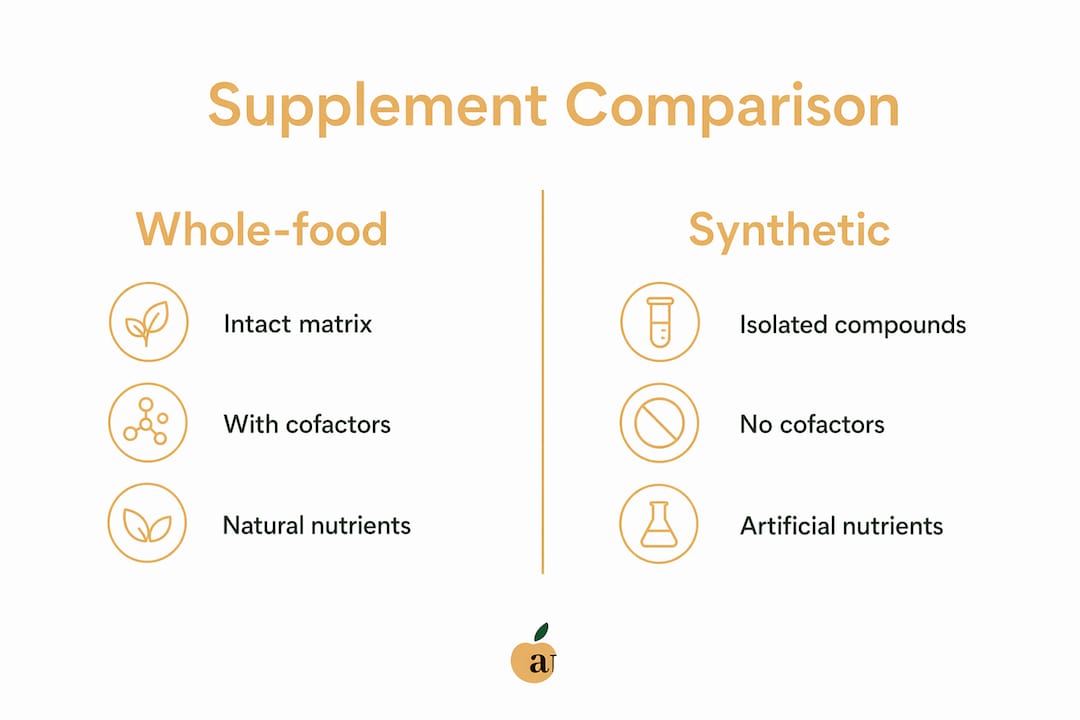
| Feature | Whole-food supplements | Synthetic supplements |
|---|---|---|
| Nutrient form | Intact food matrix | Isolated compound |
| Cofactors present | Yes | No |
| Phytonutrients | Yes | Rarely |
| Absorption context | Natural | Artificial |
| Best use | Long-term maintenance | Rapid deficiency correction |
Synthetic vitamins do have a place. Synthetic vitamins enable faster correction of acute deficiencies because isolated doses can be made far higher than anything found in food. For rapid therapeutic needs, that speed matters. For ongoing, day-to-day nutritional support, whole-food forms are the stronger choice.
Pro Tip: Check the ingredient list on any supplement. If you see “ascorbic acid” instead of “acerola cherry extract,” you are looking at a synthetic isolate, not a whole-food form.
What are the benefits of whole-food supplements for health and nutrition?
Whole-food supplements deliver nutrients as a collective package rather than as individual compounds. Nutrients work collectively as a system, treating the body as an integrated whole rather than a collection of separate deficiencies. Functional medicine practitioners endorse this approach specifically for long-term health maintenance.
The benefits extend well beyond simple vitamin delivery:
- Nutrient synergy. Vitamins, minerals, and phytonutrients in whole-food supplements interact with each other. That interaction produces effects that no single isolated compound can replicate.
- Better bioavailability. The food matrix improves nutrient bioavailability by presenting nutrients in forms the digestive system already knows how to process.
- Phytochemical support. Whole foods provide phytochemicals and antioxidants that isolated supplements simply do not contain. These compounds contribute to immune support and long-term disease prevention.
- Reduced risk of imbalance. High-dose synthetic isolates can create nutrient competition. Whole-food forms deliver balanced ratios that reduce this risk.
- Alignment with natural diet patterns. Whole-food supplements extend your diet rather than replacing it, which makes them far easier to sustain long-term.
Vitaminb17’s approach reflects this directly. Ingredients like Burdock Root, Sea Kelp, and Celery Seed are encapsulated as standardised extracts, preserving the natural cofactors that make each ingredient effective. No synthetic additives interfere with that natural profile.
Supplement formulations that mimic whole-food matrices produce more biologically relevant nutrient delivery than isolated compounds. That is not a marketing claim. It reflects how synergistic compound interactions produce integrated physiological effects that single-ingredient synthetics cannot match.
When should you consider a transition to whole-food supplements?
The right time to switch depends on your health goals and current nutritional status. Whole-food supplements suit people focused on long-term maintenance, general wellbeing, and filling dietary gaps without high-dose interventions. They are not always the fastest route to correcting a clinically diagnosed deficiency.
Practitioners recommend a tiered supplementation strategy that prioritises whole-food forms for foundational health and reserves synthetics for rapid therapeutic needs. That framework gives you a clear decision rule: if your goal is maintenance, choose whole-food; if your goal is rapid correction under clinical supervision, synthetic isolates may be appropriate first.
A structured transition works better than switching overnight. Follow these steps:
- Track your baseline for 2–4 weeks. Record energy levels, digestion, and sleep before changing anything. This gives you an objective reference point.
- Identify your dietary gaps. Note which food groups you consistently under-eat. Whole-food supplements work best when they complement real dietary patterns.
- Introduce one supplement at a time. Starting with multiple products simultaneously makes it impossible to identify what is working.
- Reassess after 4–6 weeks. Compare your tracked metrics against your baseline. Look for changes in energy, digestion, and sleep quality.
- Consult a healthcare provider. If you have a diagnosed condition or take prescription medication, get professional guidance before switching.
Pro Tip: Keep a simple daily log in a notes app. Track three things only: energy (1–10), digestion (comfortable or not), and sleep quality (1–10). Four weeks of data tells you more than any marketing claim.
How to choose high-quality whole-food supplements
Quality varies enormously across the supplement market. The label “natural” carries no legal definition in the UK, so you need specific markers to assess what you are actually buying.
What to look for on the label
- Whole-food or food-matrix source listed. The ingredient should name the plant or food source, not just the isolated nutrient.
- Minimal processing. Look for terms like “raw extract” or “standardised whole-food extract.” Avoid products that list synthetic binders or fillers.
- Natural cofactors present. A quality product will note the presence of supporting compounds, not just the headline nutrient.
- No fillers or binders. Magnesium stearate, silicon dioxide, and talc are common fillers that add nothing nutritionally.
Why sourcing and soil health matter
Shifts in agricultural nutrient density have made sourcing a critical quality factor. Crops grown in depleted soils contain fewer minerals and phytonutrients than crops grown in nutrient-rich conditions. A supplement is only as good as the raw material it starts with. Vitaminb17 sources ingredients specifically for potency, which is why products like Burdock Root Capsules carry a standardised extract strength rather than a generic dose.
Capsules versus powders
Capsules and powders each have practical advantages. Capsules protect sensitive compounds from oxidation and make dosing consistent. Powders offer flexibility for mixing into food or drink, but they degrade faster once opened. For most people, herbal capsules preserve potency more reliably than loose powders over a standard supplement cycle.
| Quality criterion | Why it matters |
|---|---|
| Named whole-food source | Confirms nutrient origin and natural cofactor context |
| Standardised extract strength | Guarantees consistent dosing across batches |
| No synthetic fillers | Prevents interference with nutrient absorption |
| Minimal processing method | Preserves enzymes and phytonutrients |
| Reputable sourcing | Reflects soil health and crop nutrient density |
Incorporating whole-food supplements alongside a balanced diet produces the best results. They are designed to extend your nutritional intake, not replace meals. Take them consistently, at the same time each day, to build a stable nutrient baseline.
Key takeaways
Whole-food supplements deliver nutrients within their natural food matrix, making them the most effective choice for long-term nutritional maintenance over isolated synthetic compounds.
| Point | Details |
|---|---|
| Definition is specific | Whole-food supplements concentrate nutrients from minimally processed foods, retaining enzymes and cofactors. |
| Food matrix drives absorption | Nutrients delivered within their natural matrix are more bioavailable than isolated synthetic equivalents. |
| Best for long-term use | Practitioners prioritise whole-food forms for ongoing health and reserve synthetics for rapid deficiency correction. |
| Track before you switch | A 2–4 week baseline of energy, digestion, and sleep makes any transition measurable and informed. |
| Quality markers are non-negotiable | Look for named food sources, standardised extracts, and zero synthetic fillers when selecting a product. |
Why I think most people are using supplements backwards
Most people I speak to treat supplements as a rescue plan. They eat poorly for months, feel run-down, and then reach for a high-dose synthetic vitamin to fix it quickly. That approach works in the short term, but it misses the point entirely.
Nutrients are not isolated actors. They function as part of a system, and the body responds to them as such. When you take a whole-food supplement, you are not just adding a nutrient. You are adding a nutrient in context, with the cofactors, enzymes, and phytonutrients that allow it to do its job properly.
The food-first mindset is not a soft preference. It is the correct starting position. Whole-food supplements work best when they sit on top of a reasonably balanced diet, not underneath a poor one. I have seen people spend significant money on premium supplements while eating in ways that actively undermine absorption.
My honest recommendation: track your diet for two weeks before buying anything. You will almost certainly find that a few consistent dietary changes reduce your supplement needs considerably. Then use whole-food supplements to fill the genuine gaps that remain. That is a sustainable approach. It is also the one that actually works.
— Jade
Vitaminb17’s whole-food supplement range
Vitaminb17 builds every product around one principle: pure, raw, and potent. No fillers. No binders. No synthetic additives. Just concentrated whole-food extracts that deliver what they promise.

If you are ready to move beyond generic vitamins, the buyer’s guide to underdosed supplements is the right place to start. It shows you exactly what to look for and what to avoid. For those exploring plant-based options, the plant-based supplement guide covers the full range of benefits with 2026 guidance. Every product in the Vitaminb17 range is formulated to meet the quality standards this article describes: named sources, standardised extracts, and nothing unnecessary.
FAQ
What is the whole food vitamins definition?
Whole food vitamins are nutrients derived from concentrated, minimally processed food sources rather than synthesised in a laboratory. They retain the natural cofactors, enzymes, and phytonutrients present in the original food.
Are whole-food supplements more effective than synthetic vitamins?
For long-term nutritional maintenance, whole-food supplements are the stronger choice because nutrients work better in their natural matrix. Synthetic vitamins can correct acute deficiencies faster due to higher isolated doses.
What is a list of whole-food supplements worth considering?
Common whole-food supplements include spirulina, wheatgrass, acerola cherry, burdock root, dandelion root, sea kelp, and pumpkin seed extract. Each delivers nutrients within their natural food context rather than as isolated compounds.
How do I use whole-food supplements effectively?
Take them consistently at the same time each day alongside food to support absorption. Track energy, digestion, and sleep for 4–6 weeks to assess whether they are producing the expected benefits.
Do whole-food supplements replace a balanced diet?
No. Supplements are not replacements for a balanced diet and work best when they complement consistent, nutritious eating. They fill genuine dietary gaps rather than compensating for poor food choices.


