

Freeze-drying preserves an herb’s volatile aroma compounds, colour and much of its chemical potency better than heat-based drying, but the outcome depends heavily on the species and the process settings used. A peer-reviewed review of freeze-drying’s physical mechanics confirms that sublimation protects heat-sensitive structures far more reliably than convection ovens or sun-drying, and food science research on volatile protection backs this with direct measurements of aroma retention.
That said, freeze-drying is not magic. Results vary by species, by how the leaves were handled before freezing, and by the pressure and temperature settings used during the cycle. Basil retains its antioxidant markers and reaches very low residual moisture under freeze-drying, according to a cryo-drying study on basil leaves, while other herbs show mixed or even reduced essential oil yields depending on how the process was run.
Here is what to expect in practice:
- Shelf life: Properly freeze-dried and packaged herbs can last many years when kept in vacuum-sealed, light-blocking containers, though flavour intensity fades gradually well before that.
- Residual moisture target: Aim for below 2 to 4% moisture content for leafy herbs, low enough to halt most microbial and enzymatic activity.
- Immediate storage practice: Vacuum-seal or use an oxygen absorber straight after drying. Freeze-dried material is porous and absorbs moisture and odours from the air within hours if left exposed.
Freeze-drying, or lyophilisation, works by freezing plant material solid and then removing the water as vapour under vacuum, skipping the liquid phase entirely. That single mechanical detail is why it outperforms most other herb drying techniques for flavour and aroma, and it is worth understanding properly before you decide whether it suits your herbs, your budget and your goals.
Table of Contents
- The role of freeze-drying in herb preservation: how the process actually works
- Why freeze-drying protects flavour, aroma and quality better than heat
- Freeze-drying versus air-drying, freezing and refrigeration
- Which herbs respond best to freeze-drying?
- How to freeze-dry and store herbs step by step
- Choosing a freeze dryer suited to herb work
- The real limitations of freeze-drying herbs
- What the research actually agrees on
- Key takeaways for herb preservation
- A grounded view on when freeze-drying earns its cost
- Sources
The role of freeze-drying in herb preservation: how the process actually works
Lyophilisation happens in three distinct stages, and each one does a different job. Understanding them explains why the technique protects flavour so much better than a dehydrator or an airing cupboard.
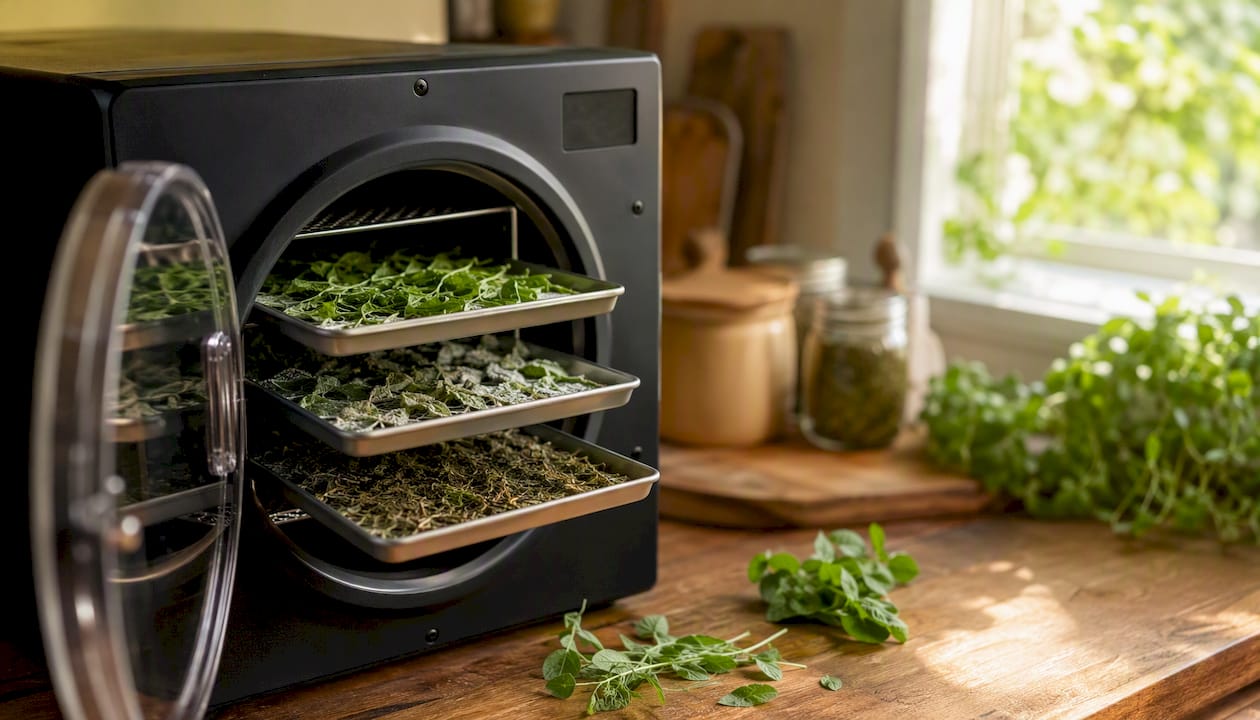
Freezing comes first. Herbs are cooled, usually to somewhere between negative 40°C and negative 50°C, until all the water inside the plant tissue turns to ice. The speed of this freeze matters more than most home preservers realise. Fast freezing produces small ice crystals that cause minimal damage to cell walls, while slow freezing forms large crystals that rupture cell membranes and glandular structures where essential oils are stored. Rupture isn’t automatically a bad thing (it can occasionally aid extraction later), but for whole-leaf culinary herbs it usually means more volatile compounds escape during the following stages.
Primary drying, or sublimation, is the stage that gives freeze-drying its name and its advantage. Once the herb is frozen solid, the chamber pressure drops dramatically, often into the range of 100 to 300 pascals, and gentle heat is applied to the shelves. Under that low pressure, ice converts directly to water vapour without ever passing through a liquid state. A very cold condenser then captures that vapour as it leaves the herb, pulling it out of the chamber entirely. This stage removes roughly 90 to 95% of the water in the material, according to practical freeze-drying guidance, and for leafy herbs it typically runs for one to two days depending on load size and leaf thickness.
Secondary drying, or desorption, mops up what is left. This is the bound water, molecules held more tightly within the plant’s cellular structure rather than sitting as free ice. Shelf temperature is raised slightly during this phase, sometimes up to 20 to 30°C, to encourage that last stubborn moisture to leave without damaging the now fragile, freeze-dried tissue. This is the stage that determines final water activity, the figure that actually predicts shelf stability far better than moisture percentage alone.
| Stage | What happens | Typical parameters | Why it matters for herbs |
|---|---|---|---|
| Freezing | Water converts to ice crystals | Negative 40°C to negative 50°C | Fast freezing protects cell structure and glands |
| Primary drying (sublimation) | Ice converts directly to vapour under vacuum | 100 to 300 Pa chamber pressure; condenser at negative 50°C to negative 80°C | Removes ~90 to 95% of water without heat damage |
| Secondary drying (desorption) | Bound water is released | Shelf temperature raised to ~20 to 30°C | Achieves low water activity for long-term storage |
A few operational realities are worth flagging before you assume every cycle looks the same:
- Leafy, thin herbs like basil and mint dry faster than woody-stemmed herbs like rosemary or thyme sprigs.
- Overloading trays slows vapour transport and extends cycle time significantly.
- A cycle that finishes too early leaves bound water behind, which shortens shelf life even if the herb looks and feels dry.
Why freeze-drying protects flavour, aroma and quality better than heat
The science behind this comes down to temperature, phase, and oxygen exposure, three variables that heat-based drying methods struggle to control simultaneously.
Low temperature is the first lever. Volatile aroma compounds, the terpenes and esters responsible for a herb’s characteristic smell, are chemically fragile and degrade under heat. Convection drying at 40 to 60°C accelerates their evaporation and chemical breakdown. Freeze-drying keeps the material below freezing for most of the cycle, which food science studies confirm minimises thermal degradation of these compounds compared with heat-based methods.
Sublimation itself is the second mechanism, and it is easy to underestimate. Because water never becomes liquid during primary drying, the hydrolytic reactions and non-enzymatic browning that plague air-dried and oven-dried herbs (the Maillard-type reactions responsible for dulled colour and flat flavour) simply do not get the chance to occur. There is no wet, warm window for enzymes to keep working or for sugars and amino acids to react.
Reduced oxygen exposure during the vacuum cycle is the third factor, though it comes with a catch. Vacuum conditions limit oxidative losses while the herb is inside the chamber. But the same low pressure that dries the material efficiently also leaves it with a highly porous, sponge-like structure once it comes out. That porosity is a double-edged result: it makes rehydration fast and complete, but it also means the dried herb has an enormous surface area exposed to air, moisture and light the moment it leaves the chamber.
Process variables change outcomes measurably. Research on chamber pressure and freezing temperature shows some herbs retain more essential oil content at higher primary-drying pressures, around 250 to 300 pascals, than at very low pressures where increased porosity lets more volatile compound escape, according to a review on process parameter effects. Get the pressure wrong and you can freeze-dry a herb “correctly” by the book and still lose more of its scent than a careful air-drying method would have kept.
Species dependence is the caveat that runs through nearly every study on this topic. A review of lyophilisation’s effects on essential oils found that outcomes are frequently contradictory between species and even between studies of the same species. Some experimental work found freeze-drying actually increased measured essential oil yield in certain basil landraces, likely because the process ruptures glandular trichomes in a way that makes oil easier to extract afterwards, according to research on lyophilisation and herb composition. Other trials recorded yield losses in different species, probably because porosity-driven volatile escape outweighed any extraction benefit. There is no universal rule, only a strong general tendency towards better retention than heat drying.
| Mechanism | Effect on herb quality | Key risk if mismanaged |
|---|---|---|
| Low-temperature processing | Preserves heat-sensitive volatiles, vitamins, phenolics | None if temperature control is maintained |
| Sublimation (no liquid phase) | Avoids browning and hydrolytic degradation | Minimal, main advantage of the method |
| Vacuum/reduced oxygen | Lowers oxidation during drying | Post-dry porosity increases oxidation risk if unpackaged |
| Pressure and freezing rate | Alters volatile retention, species-dependent | Wrong pressure can cause more loss than heat drying |
Pro Tip: Package freeze-dried herbs within minutes of the cycle finishing, not hours. That porous structure starts pulling in ambient moisture and oxygen the second the chamber door opens, and the volatile losses in the first hour of exposure can undo much of what the freeze-drying process just achieved.
Freeze-drying versus air-drying, freezing and refrigeration
No single herb preservation method wins on every measure, and the right choice depends on what you value most: flavour fidelity, cost, speed, or shelf life.
Freeze-drying wins decisively on flavour and aroma retention and on shelf life, commonly reaching over a decade of stable storage. It is the most expensive option by a wide margin, both in equipment cost and in electricity, since running a freeze-drying cycle is more energy intensive than conventional drying methods, and a full cycle for leafy herbs can take one to two days.
Air-drying (hanging bunches or using a dehydrator) is cheap, simple and requires no specialist equipment, but it degrades volatile aroma compounds through prolonged heat exposure and light contact. Herbs dried this way typically lose noticeably more of their fragrance within the first six months of storage than freeze-dried equivalents.
Freezing whole or chopped herbs, without lyophilisation, keeps flavour reasonably well for a few months but changes texture completely on thawing. It’s a fine short-term method for herbs you’ll use in cooked dishes within a season, but it doesn’t offer the multi-year stability freeze-drying does, and freezer space is finite.
Refrigeration is not really a preservation method at all in the long-term sense. It buys you a week or two of freshness for cut herbs, useful for kitchen use, irrelevant for anyone thinking about stockpiling or medicinal supply.
A few misconceptions are worth correcting directly:
- Faster drying is not automatically better drying. A rushed freeze-drying cycle that skips adequate secondary drying leaves bound moisture behind and shortens shelf life, even though the herb looks finished.
- Freeze-drying does not preserve everything equally. Some bioactive compounds and certain essential oil fractions can be reduced depending on the species and settings used.
- Cost scales with value, not effort. Freeze-drying makes sense for high-value culinary herbs, medicinal plants, or anything you plan to store for years. It is overkill for a bunch of parsley you’ll use this week.
Pro Tip: If you only have freezer space and no lyophiliser, flash-freezing herbs on a tray before bagging them (rather than bagging fresh) prevents them clumping into a solid mass and slows ice-crystal growth, giving you a reasonable middle ground between full freeze-drying and standard freezing.
Which herbs respond best to freeze-drying?
Not every herb behaves the same way under vacuum and low temperature, and knowing which ones reward the investment saves you wasted cycles and disappointing results.
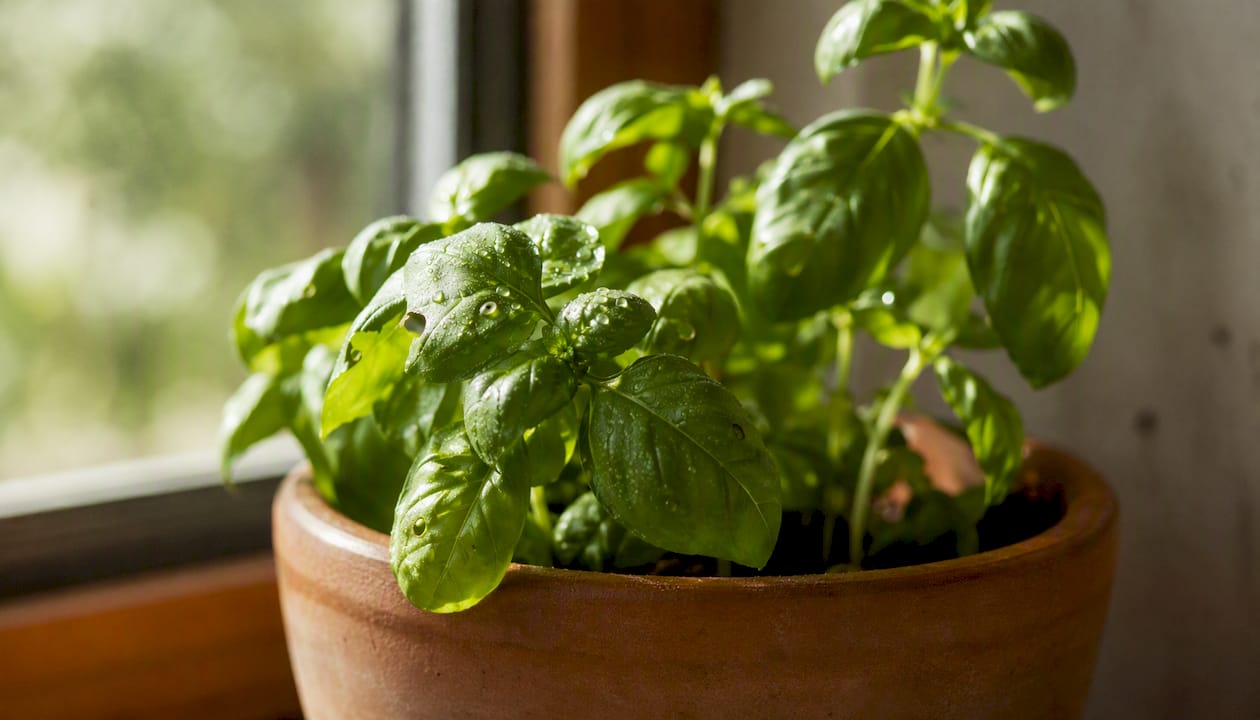
Basil freeze-dries exceptionally well. Its high moisture content and delicate leaf structure mean heat drying destroys much of its characteristic aroma, whereas freeze-drying preserves antioxidant markers and reaches low residual moisture reliably, as shown in cryo-drying research on basil leaves.
Mint holds onto its menthol-rich aroma remarkably well through lyophilisation. The compounds responsible for that sharp, cooling scent are exactly the volatile terpenes that heat drying tends to strip away first.
Rosemary and thyme, despite their woodier structure, respond well too. Their essential oils are held in more robust glandular structures than softer-leaved herbs, which gives them some natural resilience during freezing and sublimation.
Lemon balm is another strong candidate. Its citrus-like aroma compounds are notoriously volatile and disappear quickly under heat, making it one of the herbs where the difference between freeze-dried and oven-dried product is obvious even to an untrained nose.
The picture is less consistent for a handful of others. Bay leaf, perilla, and some varieties of parsley have shown mixed or occasionally poor outcomes in comparative studies, likely tied to where their essential oils sit within the leaf. Herbs with volatile oils concentrated near the surface in fragile glandular trichomes seem more prone to losing compounds when cell structures rupture during freezing or when the porous post-dry structure lets oils escape before packaging, an effect noted in reviews of species-dependent lyophilisation outcomes.
The practical lesson: don’t assume a technique that works beautifully on basil will work identically on every herb in your garden. If you’re trying a species for the first time, freeze-dry a small trial batch, taste and smell it against a fresh or conventionally dried control, and only scale up once you’ve confirmed the result is worth the cost and effort.
How to freeze-dry and store herbs step by step
Getting good results starts well before the herb ever reaches the freeze-dryer.
Harvest herbs in the morning after the dew has dried but before the day’s heat builds, when essential oil concentration in the leaves tends to be highest. Avoid harvesting wet foliage, since surface moisture extends freezing time and can encourage ice crystal formation exactly where you don’t want it, inside delicate glandular cells. Handle the leaves gently. Bruising ruptures the same oil glands you’re trying to protect.
Prepare the herbs by deciding whether to freeze-dry them whole or chopped. Whole leaves generally retain more aroma because you’re exposing less surface area, but chopped herbs dry faster and more evenly, which matters if you’re working with a small home unit. For medicinal herbs, some practitioners recommend a brief steam blanch beforehand to inactivate enzymes that would otherwise continue degrading active compounds even at low temperature, though this trades off some heat-sensitive volatile content, so weigh the two against your priority for that particular batch.
Load the trays in a single layer with the herbs spread flat, not piled. Flash-freezing the trays in a standard freezer for a few hours before transferring to the lyophiliser helps lock in smaller ice crystals if your freeze-dryer’s own freezing stage is slow.

Run the cycle, watching for the standard checkpoints: freezing complete when product temperature stabilises well below zero, primary drying pressure held in the 100 to 300 pascal range, and shelf temperature raised gradually during secondary drying. Most home and small commercial units display product temperature directly, and when it converges with shelf temperature, that’s a strong signal the cycle is finished. Check for any visible ice remaining on the condenser coil as a secondary indicator that sublimation is still ongoing.
Handle the finished product immediately. Freeze-dried herbs feel bone dry and crumble easily, but don’t let that fool you into thinking packaging can wait. Vacuum-seal within minutes if possible, or use an oxygen absorber sachet in an airtight jar. Some practitioners prefer inert gas flushing (nitrogen or argon) for larger commercial batches, since it displaces oxygen without the mechanical strain vacuum sealing puts on delicate, brittle leaves.
Store the sealed containers somewhere cool, dark and dry. A cupboard away from an oven or window works better than most people expect; light and heat are the two enemies of stored aroma compounds, more so than time itself. Under good packaging conditions, expect flavour-relevant shelf life measured in years rather than months, though intensity will slowly taper even under ideal storage.
Pro Tip: Before committing a whole harvest to a lyophiliser, run a small test batch and do a side-by-side sensory comparison against a fresh sample; crush a pinch of each and smell them together. If you have access to gas chromatography through a local lab or university partnership, a GC trace of volatile compounds gives you an objective retention figure, but a trained nose catches most of what matters for culinary and everyday medicinal use.
Choosing a freeze dryer suited to herb work
Equipment choice determines whether you get consistent, high-quality dried herbs or a machine that frustrates you within a few cycles.
Capacity and shelf area dictate how much you can process per run. A hobbyist unit might offer three to four trays, sufficient for modest kitchen garden harvests, while small commercial units offer stacked shelving suited to regular batches. Condenser capacity matters just as much as tray count; a small condenser reaches its ice capacity limit before a full load has finished sublimating, stalling the cycle.
Control features separate good units from frustrating ones. Look for programmable shelf temperature ramps rather than a single fixed setting, since herbs benefit from a gentler ramp during secondary drying than a bulkier food item would need. A vacuum controller with clear pressure readouts, ideally with moisture-endpoint sensing, takes the guesswork out of knowing when a cycle is genuinely finished rather than just “probably done.”
Condenser temperature in the negative 50°C to negative 80°C range is worth prioritising, along with an oil-free vacuum pump. Oil-free pumps cost more upfront but avoid the risk of oil vapour contaminating botanical material, a real concern for anything intended for eating or medicinal use. For more detail on how the mechanical side of these machines fits together, a technical overview of freeze-dryer operation covers the engineering in more depth.
Maintenance is a recurring cost people underestimate. Botanical material sheds fine particulate that can clog trays and gaskets over time, so a unit that disassembles easily for cleaning saves considerable frustration down the line.
Cost expectations vary widely. Home units suited to occasional herb batches sit at the lower end of the consumer freeze-dryer market, while small commercial machines with larger condensers and stainless trays cost substantially more, before accounting for electricity, which is not trivial given multi-day cycle times. For anyone processing modest quantities occasionally, outsourcing to a co-packer with commercial freeze-drying capacity can work out cheaper than owning a machine that sits idle most of the year.
By user profile: hobbyists processing a small garden’s worth of herbs a few times a year are usually better served by outsourcing or by a compact home unit. Serious home preservers running regular batches justify a mid-range machine with better condenser capacity. Small producers selling freeze-dried herb products commercially need to think about throughput, food safety certification and consistent moisture testing as core requirements, not afterthoughts.
The real limitations of freeze-drying herbs
None of this makes freeze-drying a flawless technique, and it’s worth being honest about where it falls short.
Cost is the most obvious barrier. Between equipment purchase and the electricity a multi-day cycle consumes, freeze-drying carries a meaningfully higher energy footprint than conventional drying, which is precisely why it remains uncommon for low-value bulk herbs and stays concentrated among high-value culinary, medicinal and specialty products.
Essential oil composition can shift in ways that aren’t always favourable. While many species show excellent retention, some studies report reduced levels of specific volatile fractions after freeze-drying, tied to the interplay between chamber pressure, freezing rate and each species’ particular gland structure, as documented in research on lyophilisation’s variable effects. This is not a flaw you can engineer away entirely; it is inherent to how different plants store their oils.
Post-process porosity is the risk most beginners overlook. The same vacuum-driven sublimation that makes freeze-drying so effective leaves the finished herb riddled with microscopic pores, dramatically increasing surface area exposed to oxygen and ambient moisture. Left unpackaged even briefly, that porous structure works against you, according to analysis of lyophilisation’s structural effects. Immediate, airtight, light-blocking packaging isn’t optional; it’s the step that determines whether the freeze-drying investment pays off or is quietly undone within days.
Food safety still needs attention even at very low moisture. Low water activity greatly reduces microbial risk, but it doesn’t eliminate the need for basic hygiene during harvest, handling and packaging, particularly for herbs intended for tea, tincture or supplement use where any contamination carries through the final product.
Pro Tip: Run a genuinely small pilot batch, no more than a single tray, before committing a full harvest to any new herb species. The cost of one wasted small trial is negligible compared with discovering three days into a full-scale run that a particular herb loses more aroma than a simple air-drying method would have kept.
What the research actually agrees on
The evidence base for freeze-drying herbs is stronger than for most home preservation methods, but it isn’t uniform, and pretending otherwise does readers a disservice.
The peer-reviewed review of freeze-drying mechanics and food science research on volatile protection both support the central claim clearly: low-temperature, vacuum-based drying protects heat-sensitive compounds better than heat-based alternatives, and this holds across a wide range of food and botanical materials, not just herbs specifically.
Where the picture gets genuinely mixed is at the species level. A review of essential oil retention across herbs and spices found outcomes that contradicted each other between studies, sometimes even for the same species under different processing conditions. Reported metrics vary considerably: residual moisture figures, water activity readings, and essential oil retention percentages differ from paper to paper depending on the exact chamber pressure, freezing rate and cultivar tested, a variability also flagged in research on drying effects across constituent profiles.
Open questions remain around exactly how much chamber pressure and freezing rate interact for any given species. Some findings suggest higher primary-drying pressures around 250 to 300 pascals preserve more volatile content in certain herbs than very low pressures, which increase porosity and let more compound escape, per analysis of process parameter effects. But this relationship hasn’t been mapped comprehensively across the range of herbs a home preserver or small producer might want to process, which is exactly why small-scale pilot testing matters as much as the published literature.
Key takeaways for herb preservation
Freeze-drying preserves flavour, aroma and structural quality in most herbs better than heat-based drying, but the gain only holds if packaging and process settings are handled correctly.
| Point | Details |
|---|---|
| Choose freeze-drying for high-value herbs | Prioritise it for culinary staples like basil and mint, or medicinal herbs where potency retention matters most. |
| Package immediately | Vacuum-seal or use oxygen absorbers within minutes of the cycle finishing to prevent post-dry porosity losses. |
| Test before scaling | Run a single-tray pilot batch on any new herb species before committing a full harvest. |
| Track moisture and water activity | Aim for below 4% residual moisture for whole leafy herbs. |
| Weigh cost against value | Energy and equipment costs make freeze-drying better suited to specialty herbs than bulk, low-value crops. |
A grounded view on when freeze-drying earns its cost
Freeze-drying deserves its reputation, but not the unconditional one it often gets online. The evidence is genuinely strong that it beats heat-based drying for flavour, aroma and colour retention in most culinary herbs, and the mechanism behind that (sublimation avoiding the liquid phase entirely) is one of the more elegant pieces of applied food chemistry you’ll come across in home preservation. That part isn’t in serious dispute.
What gets glossed over is how much the outcome depends on decisions made before and after the machine ever runs. A herb harvested wet, bruised in handling, or left unpackaged for even a few hours after drying can end up worse off than a carefully air-dried batch of the same species. The equipment does the hard chemistry; the person operating it still decides whether that chemistry actually pays off.
For hobbyists, the sensible path is small, deliberate pilot batches rather than committing a full harvest to an unfamiliar process. For small producers, and for anyone using herbs medicinally where potency consistency genuinely matters, the calculus shifts. Consistent water activity, tracked residual moisture, and immediate airtight packaging aren’t nice extras, they’re what separates a freeze-dried herb that still smells like something six months later from one that has quietly lost most of what made it worth drying in the first place.
That same logic, standardised process and consistent potency, is exactly what drives Vitaminb17’s approach to herbal extracts more broadly. Freeze-drying and careful preservation matter for raw herbs, but for anyone wanting guaranteed, consistent dosing without relying on their own home process going right every time, standardised extract capsules offer a complementary route to the same goal: getting a herb’s genuine potency reliably, batch after batch.
If you’re going to invest in freeze-drying, treat packaging and testing as part of the process, not an afterthought once the machine stops.
Sources
For readers who want to go deeper into the technical mechanics or the species-specific research behind these recommendations, the following sources cover different angles of the topic.
- The Freeze‑Drying of Foods—The Characteristic of the Process Course and the Effect of Its Parameters on the Physical Properties of Food Materials
- PubMed entry related to freeze‑drying protecting volatiles (food science research)
- MACTA: review on lyophilization effects on herbs and spices (food.actapol PDF)
- Application of the Cryo‑Drying Technique in Maintaining Bioactive and Antioxidant Properties in Basil Leaves (Ocimum basilicum)


