

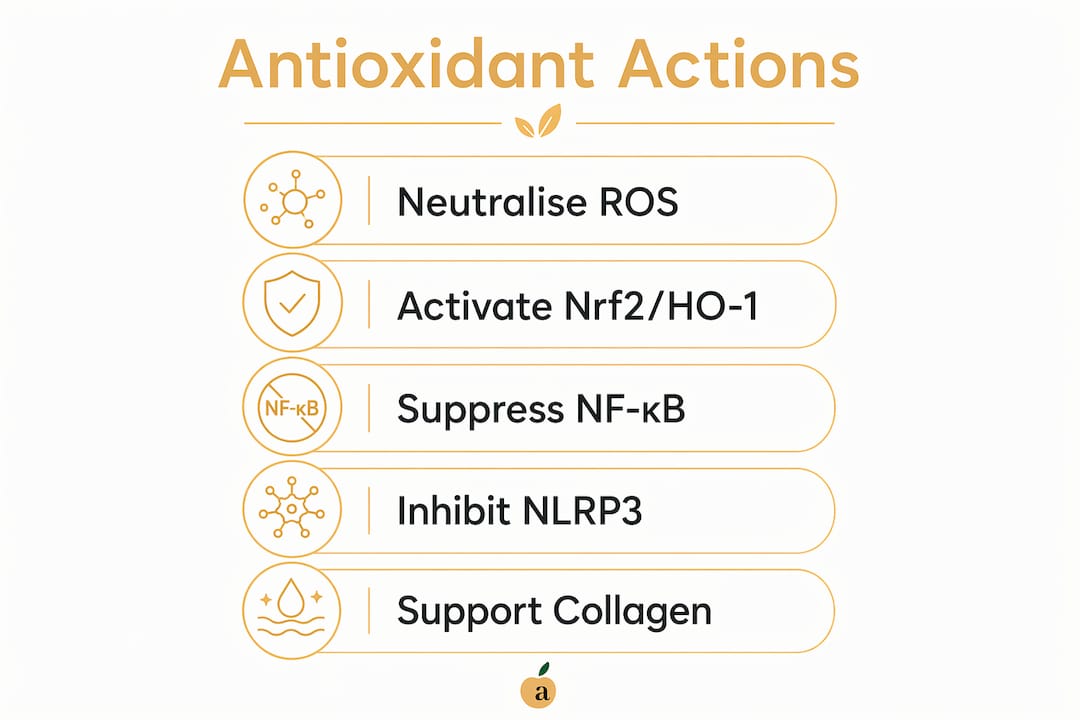
Antioxidants are defined as compounds that neutralise reactive oxygen species (ROS), protecting joint tissues from oxidative damage and regulating the inflammatory pathways that drive joint degeneration. The role of antioxidants in joint health extends well beyond simple free radical scavenging. Research published in 2026 confirms they act as complex regulators of immune and inflammatory cascades, influencing signalling pathways such as Nrf2/HO-1 and suppressing destructive cytokine activity. For anyone managing joint discomfort, stiffness, or conditions like osteoarthritis, understanding how antioxidants work at the molecular level is the first step towards making genuinely informed choices about diet and supplementation.
How do antioxidants regulate oxidative stress and inflammation in joints?
Oxidative stress occurs when ROS accumulate faster than the body can neutralise them. In joint tissues, this imbalance damages chondrocytes, degrades cartilage matrix proteins, and triggers a cascade of inflammatory signals that accelerate joint breakdown.
The Nrf2/HO-1 signalling pathway is the body’s primary antioxidant defence mechanism in joint tissue. Activating Nrf2 reduces joint pathology significantly, while inhibiting it worsens joint damage in arthritis models. HO-1, an enzyme produced through this pathway, generates anti-inflammatory metabolites including carbon monoxide, which modulate immune responses and reduce local inflammation.
Antioxidants also suppress two other destructive pathways: NF-κB and the NLRP3 inflammasome. NF-κB drives the production of pro-inflammatory cytokines like interleukin-1 beta (IL-1β), which directly erodes cartilage. The NLRP3 inflammasome amplifies this process by triggering cell death in joint tissue. Blocking both pathways is central to how antioxidants reduce joint pain and swelling.
A newer concept worth understanding is disulfidptosis. Oxidative stress triggers disulfidptosis, a form of chondrocyte cell death that amplifies joint inflammation and accelerates cartilage destruction. Targeting the metabolic and redox imbalances behind this process can break the cycle of damage. This is why antioxidants are now viewed as regulatory checkpoints, not just passive scavengers.
Key molecular roles antioxidants play in joint tissue:
- Nrf2 activation: Reduces oxidative damage and promotes anti-inflammatory gene expression
- NF-κB suppression: Lowers production of IL-1β and TNF-α, two cytokines central to joint erosion
- NLRP3 inhibition: Prevents inflammatory cell death that releases damage-associated molecular patterns (DAMPs)
- Macrophage polarisation: Shifts immune cells from a pro-inflammatory (M1) to an anti-inflammatory (M2) state
- Osteoclast regulation: Reduces bone resorption activity that worsens joint structural damage
Pro Tip: If you are reading supplement labels, look for ingredients with confirmed Nrf2-activating properties, such as curcumin or resveratrol. These work at the pathway level, not just as general antioxidants.
What does the evidence say about antioxidants for joint pain?
The clinical evidence for antioxidants in joint disorders is substantial and growing. A systematic review of 13 trials, including randomised controlled trials and animal studies, found antioxidants effective in treating knee osteoarthritis compared to placebo. The review identified dosage and supplement quality as the two most critical factors for achieving positive outcomes. This finding matters because it confirms that not all antioxidant supplements deliver the same results.
“Phytochemicals like curcumin and resveratrol show great potential but require achieving specific local joint concentrations for efficacy. Bioavailability remains the primary challenge limiting their direct therapeutic impact in severe inflammation.”
Animal model studies reinforce this picture. Antioxidant supplementation consistently reduces cartilage degradation markers and lowers synovial inflammation scores in arthritis models. The challenge is translating these results to human joints, where achieving therapeutic concentrations in the joint microenvironment is harder than in systemic circulation.
| Antioxidant | Primary mechanism | Evidence level |
|---|---|---|
| Curcumin | NF-κB suppression, Nrf2 activation | Multiple RCTs, systematic reviews |
| Resveratrol | SIRT1 activation, IL-1β reduction | Animal models, early clinical trials |
| Vitamin C | Collagen synthesis, ROS neutralisation | Observational studies, clinical trials |
| Quercetin | NLRP3 inhibition, macrophage modulation | Animal models, in vitro studies |
| Green tea polyphenols | Nrf2 activation, MMP inhibition | Clinical trials, animal studies |
Vitamin C deserves particular attention. It is directly involved in collagen synthesis, the structural protein that gives cartilage its strength and resilience. Low vitamin C status correlates with faster cartilage loss in osteoarthritis. This makes it one of the most practical and accessible antioxidants for joint care.
Which foods and supplements best support joint health?
Diet is the most reliable way to maintain consistent antioxidant intake for joint protection. Fatty fish, berries, and green tea are among the most evidence-backed dietary sources. These foods contain polyphenols and antioxidants that neutralise free radicals before they damage DNA and joint tissues.
Top antioxidant foods for joint inflammation:
- Fatty fish (salmon, mackerel, sardines): Omega-3 fatty acids reduce prostaglandin-driven inflammation
- Blueberries and cherries: Anthocyanins inhibit NF-κB and lower uric acid, relevant for gout-related joint pain
- Green tea: Epigallocatechin gallate (EGCG) suppresses matrix metalloproteinases that degrade cartilage
- Turmeric: Curcumin activates Nrf2 and blocks IL-1β production directly
- Spinach and kale: High vitamin C and carotenoid content supports collagen integrity
- Walnuts: Ellagic acid and alpha-linolenic acid combine antioxidant and anti-inflammatory effects
For supplementation, plant-based extracts offer concentrated, consistent doses that diet alone rarely achieves. Burdock root, for example, contains inulin and phenolic acids with confirmed antioxidant and anti-inflammatory properties. Vitaminb17 offers a 4,500mg burdock root capsule with no fillers or binders, delivering a pure, standardised dose.
An emerging area worth watching is extremophilic-derived antioxidants. These compounds, sourced from microorganisms that survive extreme temperatures, pH levels, and salinity, maintain their antioxidant function under harsh biological conditions. That stability makes them particularly promising for therapeutic products targeting the demanding environment inside inflamed joints.
Pro Tip: Pair curcumin supplements with black pepper extract (piperine). Piperine increases curcumin absorption by up to a significant margin, making the difference between a supplement that works and one that passes through without effect.
When choosing a supplement, prioritise three things: standardised extract concentration, absence of synthetic additives, and single-ingredient formulations. Single-ingredient supplements allow you to track what is working and adjust doses precisely. Blended products make it nearly impossible to identify which compound is delivering results.
What are the limitations of using antioxidants for joint health?
Antioxidants are not a complete solution for joint disorders. Understanding their limitations helps you use them more effectively rather than abandoning them when results are slower than expected.
Bioavailability is the central challenge. Most orally consumed antioxidants are metabolised before reaching joint tissue in therapeutic concentrations. Achieving effective joint microenvironment concentrations requires careful attention to dosing and delivery methods. Hydrogel-based and localised delivery systems are being developed to address this, but they are not yet widely available as consumer products.
The joint microenvironment itself adds complexity. Inflamed joints generate an acidic, hypoxic environment that can alter how antioxidants behave. A compound that performs well in laboratory conditions may behave differently inside a chronically inflamed knee. Inflammation in joints follows a vicious cycle fuelled by DAMPs released from dying cells. Antioxidants help disrupt this cycle, but they cannot reverse structural damage that has already occurred.
Key limitations to keep in mind:
- Bioavailability gaps: Systemic absorption does not guarantee joint-level therapeutic concentrations
- Timing sensitivity: Antioxidants are most effective in early to moderate inflammation; they have limited impact on end-stage joint degeneration
- Dosage precision: Too little produces no measurable effect; excessive doses of fat-soluble antioxidants like vitamin E can cause harm
- Individual variation: Genetic differences in Nrf2 pathway activity mean responses to the same supplement vary between people
- Interaction risks: High-dose antioxidant supplements can interact with anticoagulants and immunosuppressants
The future of antioxidant joint therapy lies in microenvironment-targeted interventions rather than broad systemic supplementation. Researchers are exploring nanoparticle delivery, intra-articular injections, and bone transport techniques to place antioxidants precisely where they are needed. For now, consistent dietary intake combined with quality supplementation remains the most practical approach.
Key takeaways
Antioxidants protect joint health by neutralising ROS, activating the Nrf2/HO-1 pathway, and suppressing inflammatory cascades that drive cartilage destruction and joint pain.
| Point | Details |
|---|---|
| Nrf2/HO-1 is central | Activating this pathway reduces joint pathology; inhibiting it worsens arthritis damage. |
| Dosage and quality determine outcomes | A systematic review of 13 trials confirmed these as the two critical variables for antioxidant efficacy. |
| Bioavailability limits impact | Oral antioxidants often fail to reach therapeutic concentrations inside joint tissue without targeted delivery. |
| Diet provides the foundation | Fatty fish, berries, green tea, and turmeric deliver polyphenols that neutralise free radicals in joint tissues. |
| Single-ingredient supplements work best | They allow precise dosing and clear attribution of results, unlike blended formulations. |
Why I think most people are using antioxidants for joints the wrong way
Most people reach for a general antioxidant supplement after a diagnosis, take it inconsistently, and conclude it does not work. That conclusion is usually correct, but for the wrong reason.
The problem is not antioxidants. The problem is treating them like painkillers. Antioxidants work upstream. They interrupt the oxidative and inflammatory signals that cause damage over weeks and months. You will not feel a curcumin capsule working the way you feel an ibuprofen tablet. That does not mean it is doing nothing.
What I have found is that consistency and quality matter far more than the specific compound chosen. A standardised, pure extract taken daily for eight to twelve weeks produces measurable changes in inflammatory markers. A cheap, underdosed blend taken sporadically produces nothing. The research backs this up clearly.
I also think the dietary foundation is underestimated. People spend money on supplements while eating a diet that constantly generates oxidative stress. Processed foods, refined sugars, and seed oils all increase ROS production. No supplement corrects that upstream problem. Food comes first.
The most promising development I am watching is targeted delivery. Once antioxidants can be reliably placed inside the joint microenvironment rather than relying on systemic circulation, the clinical results will improve dramatically. Until then, the practical advice is simple: eat well, choose pure supplements, dose consistently, and work with a healthcare professional who understands the molecular picture.
— Jade
Choosing the right antioxidant supplement for joint care
Joint health supplements vary enormously in quality, and the difference between an effective product and a waste of money often comes down to purity and potency.

Vitaminb17 produces single-ingredient, filler-free herbal extracts designed for people who want clean, potent supplementation without guesswork about what is in the capsule. Before buying any antioxidant supplement, read the buyer’s guide to underdosed herbal supplements to understand what to look for on a label. For those building a broader supplement routine, the guide on stacking herbal supplements explains how to combine antioxidant compounds safely and effectively. Pure. Raw. No fillers. That is the standard your joints deserve.
FAQ
What is the role of antioxidants in joint health?
Antioxidants neutralise reactive oxygen species that damage cartilage and activate the Nrf2/HO-1 pathway, which reduces inflammation and protects joint tissue from further degeneration.
Which antioxidants are most effective for joint pain?
Curcumin, resveratrol, vitamin C, quercetin, and green tea polyphenols have the strongest evidence for reducing joint inflammation and supporting cartilage integrity.
Can diet alone provide enough antioxidants for joint health?
Diet provides the foundation through foods like fatty fish, berries, and turmeric, but supplementation with standardised extracts is often needed to reach the concentrations required for therapeutic effect in inflamed joints.
Are there risks to taking antioxidant supplements for joints?
High doses of fat-soluble antioxidants like vitamin E carry toxicity risks, and some compounds interact with anticoagulants or immunosuppressants. Always consult a healthcare professional before starting a new supplement regimen.
Why does bioavailability matter for antioxidant joint supplements?
Most antioxidants are metabolised before reaching joint tissue in effective concentrations. Choosing standardised, high-potency extracts and pairing compounds like curcumin with piperine improves absorption and increases the likelihood of achieving a therapeutic effect.


