

The six-step plan: pause, inventory, prioritise, quality-check, dose correctly, then trial and review. Start right now by gathering every bottle you own and writing one line next to each explaining why you take it. If you cannot write that line, that product is a candidate to cut. Always check with your GP or registered dietitian before stopping any supplement a clinician has prescribed.
- Pause — stop buying anything new until the audit is complete
- Inventory — list every product, its active ingredients, and its monthly cost
- Prioritise — keep items with a confirmed deficiency or clear evidence; pause the rest
- Quality-check — verify third-party seals (NSF, USP, Informed-Sport, ConsumerLab) and read labels carefully
- Dose correctly — match form and timing to the nutrient
- Trial and review — test one supplement at a time over 4–8 weeks, then retest
Pro Tip: Before your next appointment, write: “I take supplements and I’d like a blood test to confirm which ones I actually need.” That single sentence gets you a productive conversation rather than a vague reassurance.
Key takeaways
A six-step audit, safety check, and single-variable trial is the most reliable method to reduce supplement overwhelm and build a smaller, safer stack.
| Point | Details |
|---|---|
| Start with a blood test | Ask your GP for vitamin D, B12, and iron tests before buying anything new. |
| Audit in 30 minutes | List every product, its ingredients, and its cost; sum repeated nutrients to spot overlap. |
| One supplement per goal | Test one product at a time over 4–8 weeks; retest blood markers at 8–12 weeks. |
| Check third-party seals | NSF, USP, Informed-Sport, and ConsumerLab each verify different things; confirm what a seal covers. |
| Vitaminb17 for herbal needs | Single-ingredient, filler-free standardised extracts with transparent dosing match the Step 4 checklist. |
Table of Contents
- Do you actually need supplements right now?
- Step 2: do a quick inventory of everything you take
- Step 3: which supplements are worth keeping?
- Step 4: run a safety and quality check before you continue
- Step 5: pick the right form, dose, and timing
- Step 6: trial one supplement at a time and set review points
- When should you stop a supplement immediately?
- Practical templates: audit worksheet and two sample stacks
- Why does the step-by-step approach actually work?
- How to make your simplified regimen stick day to day
- Where to buy supplements safely in the UK
- Why simplicity matters more than most people realise
- Vitaminb17’s pure herbal range fits the checklist
- Sources
Do you actually need supplements right now?
The rule of thumb: start only when you have a confirmed deficiency or a clear, evidence-backed goal. Stanford Lifestyle Medicine notes that the supplement sector operates with minimal external oversight, so clinician confirmation of need is the safest starting point.
Questions to ask your GP or registered dietitian:
- Is a blood test available for this nutrient on the NHS (vitamin D, iron, B12, folate)?
- Could a dietary change solve this without a supplement?
- Does my medication interact with what I am considering?
- Is there a peer-reviewed trial in humans supporting this supplement for my goal?
The NHS offers blood tests for vitamin D, iron, and B12 through your GP. Vitamin D deficiency is common in the UK during certain months. B12 supplementation is well-supported for those following a strict vegan diet. Diagnosed iron-deficiency anaemia warrants prescribed iron, not an over-the-counter guess.
Pro Tip: Ask your GP specifically: “Can I have a serum 25-hydroxyvitamin D test and a full blood count?” Named tests get ordered; vague requests often do not.
Step 2: do a quick inventory of everything you take
You cannot simplify what you cannot see. A low-tech audit that lists every product and sums repeated nutrients catches overlap in about 30 minutes with pen and paper.
Copy this table into your phone’s notes app or print it:
| Product name | Why I take it | Key active ingredients and amounts | Frequency | Monthly cost (£) |
|---|---|---|---|---|
| Example: Vitamin D3 1000 IU | Low vitamin D on blood test | Vitamin D3 25 mcg | Daily | £3 |
Common overlaps to watch for: B vitamins appearing in a multivitamin and a separate B-complex; zinc in a multivitamin and an immune formula; vitamin D in a fish oil and a standalone capsule.
Pro Tip: UK labels must list amounts per serving. If a label says “proprietary blend” with no individual milligram amounts, treat that as a red flag. Check how to verify no artificial ingredients before continuing with that product.
Step 3: which supplements are worth keeping?
Keep items that meet at least one of these criteria:
- A clinician confirmed the deficiency with a blood test
- A single, well-studied ingredient addresses a single, specific goal
- No unsafe overlap exists with other products or medicines you take
Pause or cut items that:
- Address vague “general wellness” with no measurable marker
- Duplicate a nutrient already covered by another product in your stack
- Carry claims that no large randomised controlled trial supports
A bottleneck-first framework helps here: identify one outcome, choose one tool that plausibly addresses it, test it cleanly, then decide. Group your current products by goal (sleep, energy, joints, digestion, immunity) and you will quickly see where one product can replace three.
Pro Tip: The benefits of single-ingredient supplements are straightforward: one ingredient means one variable, one dose to track, and one clear decision at review time.
Step 4: run a safety and quality check before you continue
Always check for third-party verification and label red flags before continuing or buying. Harvard Health notes that USP and NSF are relatively reliable verifiers and points readers to government-level resources for checking ingredients.
Seven-question safety checklist:
- Does the label carry an NSF, USP, Informed-Sport, or ConsumerLab seal?
- Are all active ingredient amounts listed in milligrams or micrograms per serving?
- Are there fewer than six active ingredients?
- Is there a batch number and a clear expiry date?
- Does the label avoid unsubstantiated disease claims?
- Is the product free of proprietary blends?
- Has the manufacturer published batch-testing records?
What each seal actually covers: NSF Certified for Sport tests for banned substances and label accuracy. USP verifies label accuracy, purity, and dissolution. Informed-Sport batch-tests every production run. ConsumerLab independently purchases and tests products. Consumer Reports found that many certification stamps differ significantly in sampling scope and retesting frequency, so check what a specific seal actually guarantees before relying on it.
Weight-loss, sexual-enhancement, and bodybuilding products carry the highest contamination risk. If you suspect a tainted product, stop taking it, keep the packaging, photograph the label, and contact NHS 111 or your GP. For herbal supplement purity standards, batch-testing records are the clearest signal of a trustworthy manufacturer.
Step 5: pick the right form, dose, and timing
Dose and form matter. Fat-soluble vitamins (A, D, E, K) absorb best taken with a meal containing fat. Water-soluble vitamins (C, B-group) can be taken at any time but are often better tolerated with food. Iron absorbs better away from calcium-rich foods and dairy; take it with water or a small amount of vitamin C.
Common interactions to know:
- Zinc and copper compete for absorption; high-dose zinc long-term can deplete copper
- Iron and calcium block each other; separate by at least two hours
- Omega-3 capsules that smell strongly fishy or rancid have oxidised and should be discarded
Upper intake limits for nutrients such as vitamin B6, zinc, and iron mean that stacking multiple products can push total intake near unsafe levels without you realising it. Add up your totals across every product in your inventory.
For personalised dosing, consult your GP or a registered dietitian. These figures are reference points, not prescriptions. Read more on natural supplement absorption to get the most from the products you keep.

Pro Tip: Store omega-3 and probiotic capsules in the fridge after opening. A fishy or sour smell on opening a new bottle is a sign of oxidation or spoilage — return or discard immediately.
Step 6: trial one supplement at a time and set review points
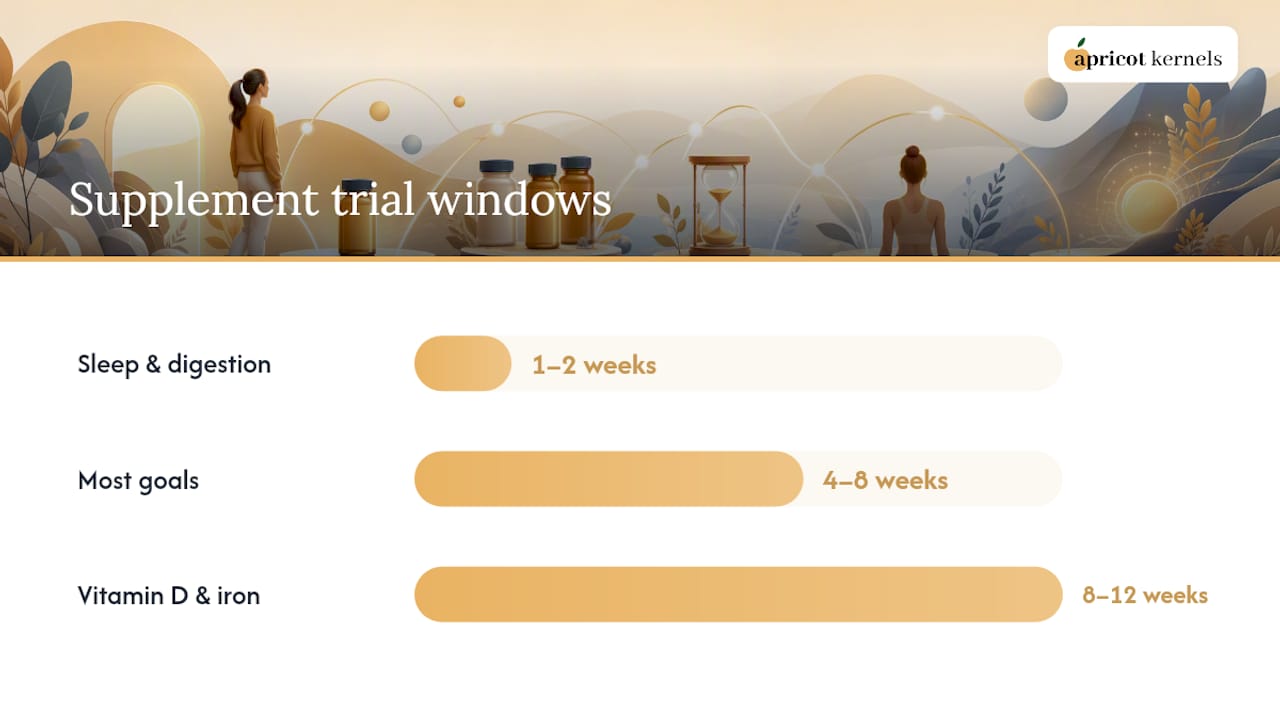
Test one supplement at a time with a simple baseline and a scheduled review. For most goals, a clean trial window of 4–8 weeks gives enough signal. Sleep and digestion may show change within 7–14 days; vitamin D and iron levels need 8–12 weeks and a retest blood draw to confirm.
Trial timeline template:
- Start date — note baseline: symptom score, energy level, or the specific marker you are tracking
- Week 2 check-in — any side effects? Any early change?
- Week 4–8 review — compare to baseline; decide keep, adjust, or stop
- Retest — if a blood marker was the reason you started, retest at 8–12 weeks
Monitoring checklist:
- Track the specific symptom or marker that justified the supplement
- Note any new GI upset, skin changes, tingling, or fatigue
- Contact your GP or pharmacist if symptoms worsen or a new side effect appears
- Stop spending on any item that shows no measurable change after a full trial window
A calm review process that removes one product at a time avoids unsafe abrupt discontinuation and keeps your decisions clear.
Pro Tip: Keep your trial notes in the same document as your inventory audit. One living document beats scattered reminders.
When should you stop a supplement immediately?
Stop and seek help if you experience a severe allergic reaction, neurological symptoms, unexplained bleeding, or sudden cardiac symptoms. These require urgent attention.
Other signs a supplement may be causing harm:
- Tingling or numbness in hands or feet (possible B6 toxicity at high doses)
- Unexplained new GI upset starting within days of a new product
- Hair loss (associated with excess selenium intake)
- Unusual fatigue or weakness after starting an iron supplement
- Skin yellowing or darkening
Practical steps:
- Stop the supplement immediately
- Keep the packaging and photograph the label
- Call NHS 111 for urgent advice or book a GP appointment for non-urgent concerns
- Ask your pharmacist first for interaction checks — they are the fastest first-line resource in the UK
Practical templates: audit worksheet and two sample stacks
Here are two ready-to-use assets you can copy now.
Audit worksheet columns: Product name | Reason for taking | Active ingredients and amounts | Daily dose | Monthly cost (£) | Keep / Pause / Ask clinician
Sample stack 1 — general maintenance (UK adult, no confirmed deficiency):
- Vitamin D3 25 mcg (1,000 IU) — October to March, per NHS guidance
- Review at 12 weeks with a blood test
Sample stack 2 — targeted deficiency (confirmed low B12, vegan diet):
- Methylcobalamin B12 1,000 mcg — daily
- Review at 8 weeks with a serum B12 retest
Copy-to-GP script: “I take [number] supplements. I’d like to discuss which ones are supported by a blood test result and whether any interact with my current medication. Can we review my vitamin D, B12, and iron levels?”
Update your audit every time you add, change, or stop a product. Keep it on your phone so it is with you at every appointment.
Pro Tip: A plant-based supplement guide can help you identify which herbal options have the clearest evidence base before you add anything new to your stack.
Why does the step-by-step approach actually work?
Stepping down complexity and testing one variable at a time gives clearer signals and reduces wasted spend and risk. Audits catch overlap; safety checks reduce exposure to tainted products; single-variable trials produce cleaner causal signals than stacking several changes at once.
The behaviour design principle is simple: a routine that is easy to follow and easy to stop is more likely to stick. Pair each supplement with an existing daily cue — breakfast, brushing your teeth — and record it in one place.
- Audits surface hidden nutrient duplication that drives both cost and risk
- Single-variable testing is the most reliable method for knowing whether a supplement helps
- Removing one product at a time prevents confusion about what caused any change
- Short trial windows (7–14 days for digestion, 8–12 weeks for blood markers) match the biology of each nutrient
How to make your simplified regimen stick day to day
A simplified stack only works if you actually take it. Pair each supplement with a fixed daily cue: vitamin D with breakfast, magnesium with your evening meal. One format (capsule only, not a mix of powders, gummies, and tablets) cuts the friction of a complicated routine.
Keep your supplements visible but stored correctly. A weekly pill organiser on the kitchen counter removes the daily decision. Reduce the number of separate products to the minimum your audit supports, and your adherence will follow naturally.
Where to buy supplements safely in the UK
Buy from registered UK pharmacies, established health retailers, or directly from manufacturers who publish batch-testing records. The MHRA (Medicines and Healthcare products Regulatory Agency) maintains a list of registered supplement businesses and issues alerts on unsafe products.
Avoid marketplace listings from unknown third-party sellers, particularly for weight-loss, bodybuilding, or sexual-enhancement products. Counterfeit supplements are most common in these categories. Check the MHRA Yellow Card scheme if you suspect an adverse reaction to a product.
For herbal extracts specifically, look for products with standardised extract ratios, clear milligram amounts per capsule, and no proprietary blends. Vitaminb17 publishes transparent ingredient amounts with no fillers, binders, or synthetic additives across its full range, making label verification straightforward.
Why simplicity matters more than most people realise
The conventional wisdom says more supplements equal better coverage. The evidence says the opposite. Every product you add introduces a new variable, a new interaction risk, and a new cost. The readers who benefit most from supplements are those who take the fewest, chosen for the clearest reasons, verified by a clinician.
The audit-first approach is not about deprivation. It is about precision. One pure, well-dosed product addressing a confirmed need will outperform six vague ones every time. The anxiety that comes with a crowded supplement shelf is not a sign you need more information. It is a sign you need fewer products.
Vitaminb17’s pure herbal range fits the checklist
If your audit points to a single-ingredient herbal option, Vitaminb17’s range is built around exactly that principle. No fillers. No binders. No synthetic additives. Each capsule contains one standardised herbal extract at a clearly labelled dose, making it straightforward to verify against the safety checklist in Step 4.

Products such as Burdock Root Capsules and Pumpkin Seed Extract Capsules carry transparent milligram amounts per serving, no proprietary blends, and are suitable for vegans. That is the short checklist from Step 4 met in a single product. For anyone whose audit identifies a targeted herbal need, the raw herbal extract capsule guide explains exactly what to look for before you buy.
Consult your GP or registered dietitian before starting any new supplement. This is general information, not personalised medical advice.
Sources
- Start vetting your supplements
- Considerations when choosing supplements
- How to choose supplements wisely
- Do I take too many supplements? A calm, step‑by‑step way to audit your stack
- How to build a simple supplement routine
- Choose supplements effectively: a simple framework
- How to review your supplement stack (without panicking)
This article is general information, not a substitute for advice from a qualified doctor. Consult a qualified healthcare professional about your own circumstances before acting on anything here.


