

An underdosed herbal supplement is one that contains less active ingredient than the clinically validated level needed to produce a measurable effect. This is not a fringe problem. 42% of products underdosed in a 2026 IngredientMD analysis of 278 supplements, with at least one active ingredient falling below effective levels. That figure means nearly half the bottles on shelves are delivering little more than expensive placebo. Learning to recognise underdosed herbal supplements before you buy protects both your health and your money. The tools to do it are already available: third-party certifications from USP, NSF, and ConsumerLab, plus published clinical dose ranges for herbs like turmeric, valerian root, and ashwagandha.
How to recognise underdosed herbal supplements from the label
The Supplement Facts panel is the most reliable place to start. It lists ingredient amounts per serving, and it is legally required to be accurate. The front of the bottle is not held to the same standard. A product can claim “maximum strength turmeric” on the front while the Supplement Facts panel reveals only 50 mg of turmeric root powder per capsule, far below any clinically studied dose.
Standardisation percentages are the clearest signal of potency. A label reading “ashwagandha extract standardised to 5% withanolides” tells you the active constituent has been measured and guaranteed. A label reading simply “ashwagandha root powder” tells you nothing about how much withanolide you are actually getting. Knowing active constituent amounts such as withanolides in ashwagandha or curcuminoids in turmeric is more critical than total herb weight when assessing dosing adequacy.

Proprietary blends are the biggest red flag on any label. They list multiple ingredients under a single combined weight, without disclosing how much of each ingredient is present. Proprietary blends mask true dosing and may list ingredients in descending order by weight, but the individual amounts remain completely unknown. A blend listing turmeric, ginger, and black pepper at a combined 500 mg could contain 490 mg of black pepper and 5 mg of turmeric. You have no way to verify otherwise.
Third-party certification logos cut through the uncertainty. Look for these on the label:
- USP Verified: The gold standard. USP is considered gold standard for identity, strength, and purity verification.
- NSF Certified: Rigorous testing for label accuracy and contaminants.
- ConsumerLab Approved: Independent testing confirming ingredient amounts match label claims.
- GMP Certified: Good Manufacturing Practice compliance. The lowest tier of the four, confirming process standards but not necessarily ingredient accuracy.
Pro Tip: If a supplement carries no third-party seal at all, treat the label claims as unverified. The cost of certification is low for reputable manufacturers. Absence of a seal is a deliberate choice.
Does your supplement dose match clinical research?
Effective dose, not just ingredient presence, determines whether a supplement delivers results. A product containing turmeric is not the same as a product delivering a clinically effective dose of curcuminoids. This distinction is the most commonly missed point in supplement buying.
Published clinical research establishes minimum effective doses for common herbs. Clinical research sets minimum effective doses that supplement products should meet to produce the studied effects. The table below shows typical adult dose ranges for frequently underdosed herbs.
| Herb | Typical effective dose range | Key active constituent |
|---|---|---|
| Valerian root | 400–900 mg | Valerenic acid |
| Turmeric extract | 500–2,000 mg | Curcuminoids (95%) |
| Ashwagandha extract | 300–600 mg | Withanolides (5%) |
| Ginger root extract | 500–2,000 mg | Gingerols |
| Fenugreek extract | 500–1,000 mg | Saponins |
The distinction between total compound weight and active ingredient content is where most buyers get misled. Active ingredient content is often much lower than the total compound weight stated on the label. A 400 mg magnesium glycinate capsule, for example, contains approximately 60 mg of elemental magnesium. The 400 mg figure refers to the weight of the entire magnesium glycinate compound, not the magnesium you absorb.
Serving size is the second variable buyers overlook. A product might list 1,000 mg of valerian root per serving, which looks adequate. But if the serving size is four capsules and the bottle contains 30 servings, you are buying a 30-day supply only if you take four capsules daily. Serving size affects true dosage, and price per serving is a far more honest economic comparison than price per bottle.
Pro Tip: Use the National Institutes of Health Office of Dietary Supplements database to cross-reference the dose on your supplement label against published clinical ranges. It is free, peer-reviewed, and takes under two minutes per ingredient.
What label traps signal a weak or underdosed product?
Weak supplements share recognisable patterns. Knowing them lets you filter out low-dose herbal products before you spend a penny.
- Proprietary blends with no individual amounts. Any product listing a “herbal complex” or “botanical matrix” without per-ingredient weights is hiding something. The blend weight may look impressive, but the individual doses are unverifiable.
- Overly long ingredient lists. A capsule containing 20 herbs at a combined weight of 500 mg cannot deliver an effective dose of any single ingredient. The dose per herb is mathematically too small. Products with three to five well-dosed ingredients consistently outperform those with 15 underdosed ones.
- Small serving sizes paired with multi-ingredient claims. A single capsule claiming to deliver turmeric, black pepper, ginger, and boswellia at effective doses is almost certainly underdosed across the board. Check the total capsule weight against the sum of what is claimed.
- Front-label claims that outrun the Supplement Facts panel. Phrases like “ultra-potent,” “maximum strength,” or “clinical formula” on the front label mean nothing without corresponding standardisation percentages and adequate per-serving amounts in the Supplement Facts panel.
- Turmeric root powder versus turmeric extract. Turmeric root powder contains roughly 2–5% curcuminoids naturally. A 500 mg dose of root powder delivers approximately 10–25 mg of curcuminoids. A turmeric extract standardised to 95% curcuminoids delivers 475 mg of curcuminoids from the same 500 mg dose. Consumers often confuse total plant weight with active constituent content, and manufacturers rely on this confusion.
Magnesium glycinate is another frequent offender. Products labelled “500 mg magnesium glycinate” routinely deliver only 75–80 mg of elemental magnesium. If you are supplementing for a specific physiological effect, the elemental amount is the only number that matters.
How to validate herbal supplement dosing before you buy
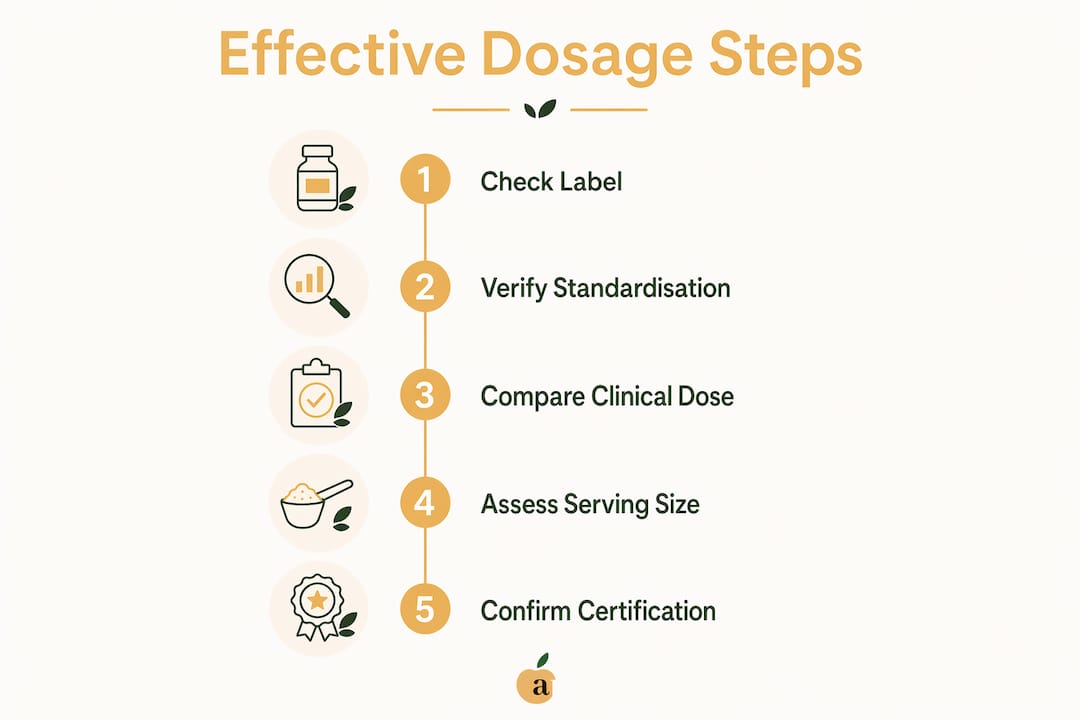
A five-step check takes less than five minutes and eliminates most underdosed products from consideration.
- Read the Supplement Facts panel, not the front label. Locate the per-serving amount for each active ingredient. Ignore front-of-bottle claims entirely until you have verified the panel.
- Confirm standardisation. Look for a percentage next to the extract, such as “standardised to 95% curcuminoids” or “10:1 extract ratio.” A 10:1 extract ratio means 10 kg of raw herb was concentrated into 1 kg of extract, indicating meaningful potency. Products from Vitaminb17, such as their Dandelion Root 5000mg extract, use a 10:1 standardisation to make this transparent.
- Calculate your actual daily intake. Multiply the per-serving amount by the number of servings you will take daily. Then check that figure against a clinical reference. Serving size and servings per container are the two numbers needed to calculate your real daily intake.
- Check for a third-party seal. USP Verified, NSF Certified, or ConsumerLab Approved on the label confirms that an independent body has tested the product. Third-party testing logos indicate verified label accuracy, which can vary widely without independent verification.
- Compare cost per effective dose, not cost per bottle. A £10 bottle delivering a full clinical dose per serving is better value than a £7 bottle requiring double the serving to reach the same intake.
“The minimum effective dose is the starting point, not the ceiling. Verify that your supplement reaches it before considering anything else.”
Avoid products that promise unusually high potency without a standardisation percentage to back it up. High numbers on the front label without corresponding active constituent data in the Supplement Facts panel are a marketing claim, not a dosing guarantee. For herbal dosage and safety guidance, peer-reviewed resources and qualified practitioners are the most reliable references.
Key takeaways
Recognising underdosed herbal supplements requires reading the Supplement Facts panel for standardised active constituent amounts, verifying third-party certification, and comparing doses against published clinical ranges before purchasing.
| Point | Details |
|---|---|
| Check standardisation percentages | Labels showing active constituent percentages confirm potency; plain root powder does not. |
| Avoid proprietary blends | Blends hide individual ingredient amounts, making dose verification impossible. |
| Use clinical dose benchmarks | Compare label amounts against published ranges, such as 400–900 mg for valerian root. |
| Prioritise third-party seals | USP Verified is the gold standard; NSF and ConsumerLab are also reliable indicators. |
| Calculate cost per effective dose | Price per bottle is misleading; cost per clinically adequate serving is the honest comparison. |
Why I stopped trusting “maximum strength” labels
I have spent years reviewing supplement labels, and the single most reliable predictor of a weak product is an impressive front label paired with a vague Supplement Facts panel. The phrase “maximum strength” appears on products with 50 mg of turmeric root powder. That is not maximum strength. That is marketing.
The habit that changed everything for me was treating the front of the bottle as irrelevant until I had read the Supplement Facts panel. Starting with the minimum effective dose and monitoring your response is the safest and most informative approach, but you cannot do that if the product never reaches the minimum in the first place.
I also keep a running list of every supplement I take, including the dose, the standardisation percentage, and the third-party certification status. That list has saved me from doubling up on ingredients and from continuing with products that were delivering nothing measurable. Share it with your GP or pharmacist. They will ask better questions if they can see exactly what you are taking and at what dose.
The herbal supplement market rewards scepticism. Certified products with transparent labelling are not harder to find than uncertified ones. They are just easier to overlook when a cheaper, bolder-labelled alternative sits next to them on the shelf. Trust the panel. Trust the seal. Be sceptical of everything else.
— Jade
Vitaminb17: supplements with nothing to hide
Dosing confidence starts with knowing exactly what is in each capsule. Vitaminb17 products list standardisation ratios and extract concentrations clearly, with no fillers, no binders, and no proprietary blends obscuring the amounts.

The Dandelion Root Capsules 5000mg use a 10:1 extract ratio, meaning the potency equivalent of 5,000 mg of raw dandelion root is concentrated into each serving. The Mullein Leaf Extract Capsules 5000mg and Fenugreek Capsules 10:1 5000mg follow the same principle: pure, raw, standardised, and clearly labelled. No guesswork. No hidden blends. Just the dose you can verify before you buy.
FAQ
What does “underdosed” mean in herbal supplements?
An underdosed supplement contains less active ingredient per serving than the clinically validated minimum needed to produce a measurable effect. Ingredient presence on a label does not guarantee an effective dose.
How do proprietary blends hide underdosing?
Proprietary blends list a combined weight for multiple ingredients without disclosing individual amounts. This makes it impossible to verify whether any single ingredient reaches its effective dose.
Which third-party certification is most reliable?
USP Verified is the gold standard for supplement certification, confirming identity, strength, and purity. NSF Certified and ConsumerLab Approved are also credible independent verifications.
What is the difference between turmeric root powder and turmeric extract?
Turmeric root powder contains roughly 2–5% curcuminoids naturally. Turmeric extract standardised to 95% curcuminoids delivers far more active ingredient per milligram, making it significantly more potent at the same serving weight.
How do I calculate whether a supplement dose is adequate?
Locate the per-serving amount in the Supplement Facts panel, multiply by your daily serving count, and compare the result against published clinical dose ranges from sources such as the National Institutes of Health Office of Dietary Supplements.


