

Supplement absorption, known formally as bioavailability, is the measure of how much of a nutrient your body actually uses after you swallow it. Most people focus on which supplements to take. Far fewer focus on whether those supplements are actually reaching their cells. This natural supplement absorption maximising guide covers the four factors that matter most: formulation, timing, diet, and gut health. Get these right, and you get full value from every capsule. Get them wrong, and you are paying for nutrients that pass straight through.
What are the key factors in natural supplement absorption?
Effective supplement absorption depends more on chemical form and gut condition than on dose size alone. This is the single most important insight in this guide. Two supplements can contain the same nutrient at the same dose and deliver completely different results, purely because of how they are made.

Formulation type matters enormously. Magnesium glycinate, for example, is absorbed at 50–80%, while magnesium oxide absorbs at roughly 4%. That difference is not marginal. It means you could be taking twenty times more magnesium oxide than glycinate and still fall short.
The fat-soluble versus water-soluble distinction is equally critical:
- Fat-soluble vitamins (A, D, E, K) require dietary fat to be absorbed. Without fat present, they pass through largely unused.
- Water-soluble vitamins (B vitamins, vitamin C) dissolve in water and do not require fat. They are generally absorbed more readily but are not stored, so consistency matters.
- Delivery method affects absorption too. Enteric-coated capsules protect nutrients from stomach acid. Soft gels improve fat-soluble vitamin uptake. Liquid forms often absorb faster than compressed tablets.
- Mineral competition is a real issue. Calcium and iron compete for the same absorption pathways. Taking them together reduces effectiveness for both.
Pro Tip: Check the specific form of each mineral in your supplement. “Magnesium” on a label tells you very little. “Magnesium glycinate” tells you it will actually absorb.
How can meal timing improve supplement uptake?
Timing your supplements with the right meals is one of the simplest and most effective ways to improve nutrient uptake. The rules are not complicated, but they are specific.
- Take fat-soluble vitamins with a fat-containing meal. A 2015 study found that vitamin D absorption increased by 50% when taken with a fat-containing meal. Avocado, olive oil, eggs, or nuts all work well.
- Take iron on an empty stomach with vitamin C. Iron absorption improves significantly when taken fasting, paired with vitamin C, and away from calcium and caffeine. A glass of orange juice alongside your iron capsule is a practical habit.
- Separate calcium and iron by at least 2 hours. Calcium can inhibit iron absorption by 50–60%. Taking them together is one of the most common and costly absorption mistakes.
- Avoid coffee or tea near iron supplementation. Tannins in coffee and tea reduce iron uptake by up to 60% if consumed within 30–60 minutes of your dose. This applies to green tea as well as black.
- Take magnesium and zinc in the evening. Both support sleep and muscle recovery. Evening dosing also avoids competition with calcium-rich foods common at breakfast.
Pro Tip: Pair your supplement schedule with fixed meal times rather than the clock. “With breakfast” is a more reliable cue than “at 8am” because meals are harder to forget.
The practical upshot is straightforward. Fat-soluble vitamins go with your largest meal of the day. Iron goes first thing in the morning, away from dairy and coffee. Minerals that compete get split across morning and evening.
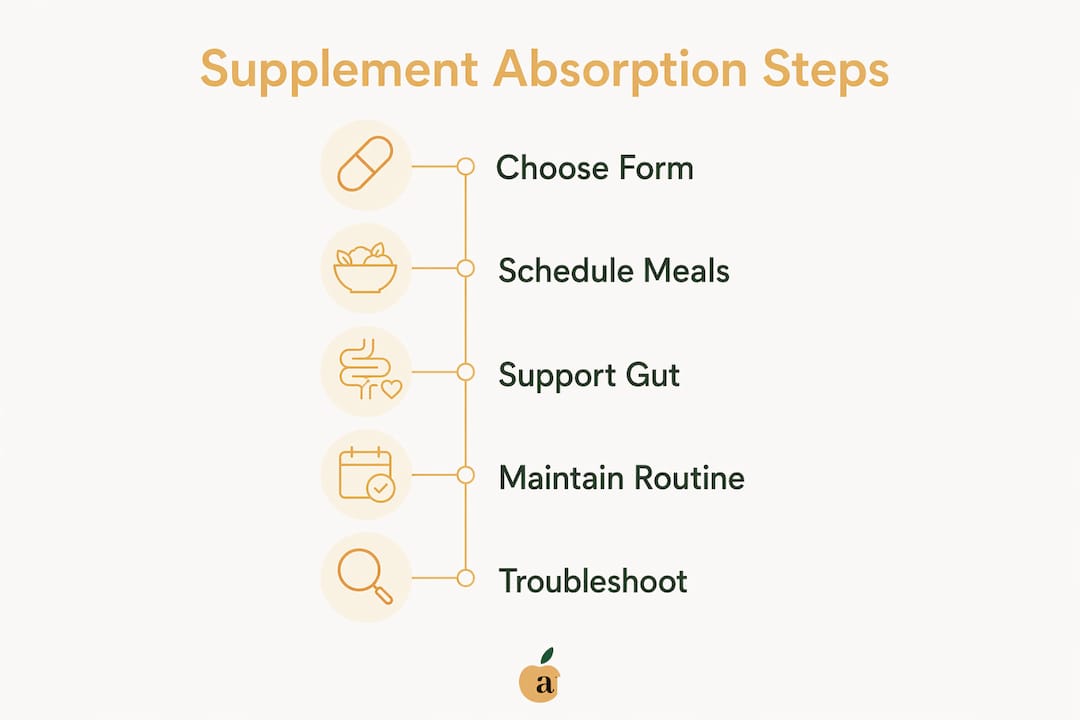
What lifestyle habits support optimal absorption?
No amount of timing precision compensates for poor gut health. Gut inflammation and low stomach acid reduce the surface area available for absorption. This is not a minor inconvenience. It is the difference between a supplement working and not working.
The lifestyle factors that most directly affect absorption are:
- Gut microbiome balance. A diverse microbiome supports the production of short-chain fatty acids, which maintain gut lining integrity. Fermented foods like kefir, sauerkraut, and live-culture yoghurt all support microbial diversity.
- Stomach acid levels. Chronic stress and long-term use of proton pump inhibitors both lower stomach acid. Low stomach acid impedes absorption of B12, iron, and calcium, all of which need an acidic environment to be released from food and supplements.
- Sleep and exercise. Regular physical activity improves gut motility and circulation, both of which support nutrient delivery. Poor sleep raises cortisol, which suppresses digestive function.
- Alcohol intake. Alcohol damages the gut lining and depletes B vitamins, zinc, and magnesium directly. Even moderate regular intake reduces absorption efficiency over time.
- Supplement quality. Third-party certifications from bodies like USP or NSF verify that a supplement contains what it claims and nothing it does not. “Natural” has no formal legal definition and does not guarantee safety or potency.
The gut is not just a delivery mechanism. It is the primary determinant of how much of any supplement you actually absorb. Prioritise gut health before adding more supplements.
How to build a sustainable supplement routine
Consistency in supplement intake is more critical than perfect timing for most supplements. This is the finding that most supplement guides bury. Over-obsessing on timing rules leads to supplement fatigue, missed doses, and abandoned routines.
The goal is a schedule you will actually follow for months, not one that is theoretically perfect but practically unsustainable.
Simple rules that work:
- Take fat-soluble vitamins (A, D, E, K) with your main meal every day. Do not stress about which meal.
- Space calcium and iron by at least 2 hours. Morning and evening is the easiest split.
- Take water-soluble vitamins at any consistent time. Morning works well because it anchors the habit.
- Use herbal supplement stacking principles to group compatible supplements and reduce the number of separate doses.
Routine vs. precision: a comparison
| Approach | Benefit | Risk |
|---|---|---|
| Precision timing only | Maximises individual nutrient uptake | High dropout rate, supplement fatigue |
| Consistent routine only | High adherence, sustainable long-term | Misses some absorption gains |
| Routine with basic rules | Balances adherence and absorption | Requires initial setup |
The third approach wins. Set up a simple routine that respects the key rules (fat with fat-soluble vitamins, iron away from calcium), then stop adjusting. Sustainable supplement protocols avoid overcomplicated schedules and prioritise consistency above all else.
What are common absorption issues and how do you fix them?
Poor absorption often goes unnoticed because the symptoms are non-specific. Persistent fatigue, brain fog, slow recovery from illness, and bloating after supplements are all signals worth investigating.
Common signs of poor absorption:
- Bloating or nausea after taking supplements, which may indicate low stomach acid or an incompatible formulation
- Persistent fatigue despite supplementing with iron or B12
- Brain fog that does not improve with magnesium or omega-3 supplementation
- Loose stools after magnesium, suggesting the oxide form rather than glycinate
Practical troubleshooting steps:
- Switch to a higher-bioavailability form first. Replace magnesium oxide with glycinate. Replace ferrous sulphate with ferrous bisglycinate.
- Check for signs of poor gut health before adding more supplements. Gut issues are the root cause in many cases.
- Add a broad-spectrum probiotic for 4–6 weeks and reassess. Digestive enzyme supplements can also help if low stomach acid is suspected.
- Adjust timing based on personal tolerance. Some people absorb iron better with a small amount of food despite the general advice to take it fasting.
Pro Tip: Keep a simple log for the first 30 days of a new supplement. Note the time, what you ate, and how you felt. Patterns emerge quickly and help you adjust without guesswork.
Absorption troubleshooting reference
| Symptom | Likely cause | Fix |
|---|---|---|
| Nausea after iron | Taken with food or calcium | Take fasting with vitamin C |
| Poor energy despite B12 | Low stomach acid | Check gut health, consider sublingual B12 |
| Bloating after magnesium | Oxide form | Switch to glycinate |
| No effect from vitamin D | Taken without fat | Take with a fat-containing meal |
Key takeaways
Supplement absorption depends on formulation quality, meal timing, gut health, and consistent routine, not on dose size alone.
| Point | Details |
|---|---|
| Formulation determines bioavailability | Magnesium glycinate absorbs at 50–80%; magnesium oxide absorbs at roughly 4%. |
| Fat-soluble vitamins need fat | Vitamin D absorption increases by 50% when taken with a fat-containing meal. |
| Separate competing minerals | Calcium inhibits iron absorption by 50–60%; space them by at least 2 hours. |
| Gut health is foundational | No timing strategy compensates for gut inflammation or low stomach acid. |
| Consistency beats perfection | A sustainable routine with basic rules delivers better results than a complex schedule you abandon. |
Why I think most people are solving the wrong problem
Most people who ask about supplement absorption are looking for a better timing chart. What they actually need is a better gut. I have seen this pattern repeatedly. Someone switches from magnesium oxide to glycinate, adds vitamin C to their iron dose, and separates their calcium. They do everything right on paper. But if their gut lining is compromised or their stomach acid is low, the gains are modest at best.
The supplement industry has a commercial interest in selling more products and more complex protocols. The science points in a different direction. Fix the gut first. Then worry about timing. Then worry about formulation. In that order.
The other thing I have noticed is that people abandon good habits because the schedule becomes too demanding. Three separate dosing windows, specific food pairings, avoiding coffee for an hour. It adds up. The people who get the best long-term results are not the ones with the most precise protocols. They are the ones who take their supplements every single day without thinking about it. Simplicity is the most underrated absorption strategy.
The science on supplement formulations is also evolving quickly. Liposomal delivery, for example, is showing genuine promise for nutrients like vitamin C and glutathione. Staying curious about formulation advances is worthwhile. But the fundamentals, gut health, consistent routine, and quality third-party tested products, will not change.
— Jade
Pure supplements, clear results: Vitaminb17
Vitaminb17 produces high-potency natural extracts with no fillers, no binders, and no synthetic additives. Every product is formulated for clean, consistent absorption. Pure. Raw. Strong.

If you are building a supplement routine from scratch, the morning supplement guide covers which supplement types work best at the start of the day and why. For those focused on purity and safety, the allergen-free supplement guide explains what third-party certifications actually mean and how to read a label with confidence. Vitaminb17’s customer service team is available for personalised advice on which extracts suit your specific health goals.
FAQ
What does bioavailability mean for supplements?
Bioavailability is the proportion of a supplement that your body actually absorbs and uses. A supplement with low bioavailability delivers far less of its active nutrient than the label dose suggests.
Which vitamins should be taken with food?
Fat-soluble vitamins A, D, E, and K must be taken with a fat-containing meal. Studies show vitamin D absorption increases by 50% when paired with dietary fat.
Can you take calcium and iron at the same time?
Calcium and iron should not be taken together. Calcium inhibits iron absorption by 50–60%, so separate them by at least 2 hours.
How does gut health affect supplement absorption?
A damaged gut lining and low stomach acid both reduce the surface area available for nutrient uptake. Gut health is the single most important factor in how well any supplement absorbs.
Does the form of a mineral supplement matter?
Yes, significantly. Magnesium glycinate absorbs at 50–80%, while magnesium oxide absorbs at roughly 4%. Always check the specific chemical form listed on the label, not just the mineral name.


