

You can usually tell whether a capsule supplement contains binders or fillers before you buy. Check the “Other ingredients” or “Inactive ingredients” section on the label or product page. If that list is missing or vague, request a Certificate of Analysis (COA) from the manufacturer. Vitaminb17 publishes full ingredient lists and supports UKAS-accredited lab testing, making it a useful benchmark for what transparency looks like in practice.
Quick steps:
- Find the “Other ingredients” panel on the label or product page
- Look up any unfamiliar names against the catalogue below
- Request a COA with a batch number if the listing is incomplete
- Check for GMP, vegan, or allergen-free certification as supporting proof
Key takeaways
Checking the “Other ingredients” panel and requesting a batch COA are the two most reliable ways to confirm whether a capsule supplement contains binders or fillers before purchasing.
| Point | Details |
|---|---|
| Check “Other ingredients” first | This panel lists all excipients; a missing or vague panel is a red flag requiring follow-up. |
| Request a batch COA | A COA with a matching batch number and a UKAS-accredited lab is the strongest proof of purity. |
| Calculate the purity ratio | Divide the active dose (mg) by the total capsule fill weight (mg); a ratio below 50% suggests significant filler content. |
| Prefer single-ingredient products | Fewer ingredients mean less to verify and less room to hide dilution with fillers. |
| Use Vitaminb17 as a benchmark | Vitaminb17 products list ingredients fully, state capsule material, and carry GMP and vegan certification. |
Table of Contents
- How to identify binders in capsule formulas: your quick checklist
- Common binders, fillers and excipients: what the label names actually mean
- How manufacturers list inactive ingredients and what vague wording hides
- Dietary and allergy flags: which excipients matter for your needs
- When small amounts of excipients are fine and when to act
- How to verify “no fillers” claims with COAs and certifications
- Exact questions to send a manufacturer before you buy
- Practical rules for choosing genuinely binder-free capsules
- Why Vitaminb17 favours binder-free, high-potency herbal capsules
- Vitaminb17’s pure herbal capsules: no fillers, full transparency
- Sources
How to identify binders in capsule formulas: your quick checklist
Use this list before you click “buy.” It takes under a minute.
- Find the “Other ingredients” panel. On physical packaging, it sits below the Supplement Facts box. On a product page, scroll past the dosage table or check a downloadable PDF.
- Read the capsule shell description. It often appears as “capsule (hydroxypropyl methylcellulose)” or “capsule (gelatin)” — this tells you the shell material separately from the fill.
- Search the page for key terms. Try “silicon dioxide,” “magnesium stearate,” “maltodextrin,” and “microcrystalline cellulose.” Their presence confirms excipients are used.
- Red flags to watch for: no “Other ingredients” listed at all; terms like “natural components,” “proprietary blend,” or “capsule blend” with no breakdown; a total capsule weight far above the stated active dose.
- Request the COA. Ask for the batch-specific Certificate of Analysis. A credible COA names the testing lab, carries a batch number, and shows identity and assay results.
- Check lab accreditation. UKAS accreditation (or an equivalent national body) on the testing lab means the results are independently verified, not self-certified.
Pro Tip: Barcode-scanning apps such as Open Food Facts can surface the ingredient list quickly, but you still need to interpret what you find. The checklist above is the interpretation layer.
Common binders, fillers and excipients: what the label names actually mean
Inactive ingredients in supplements fall into several functional groups. Knowing the group tells you why an ingredient is there.
| Label name | Common synonyms / chemical name | Typical function |
|---|---|---|
| Microcrystalline cellulose | Microcrystalline cellulose | Binder and filler; adds bulk and holds the fill together |
| Maltodextrin | Glucose polymer, corn dextrin | Filler/diluent; cheap bulking agent derived from starch |
| Dicalcium phosphate | DCP, calcium hydrogen phosphate | Filler/diluent; adds weight and aids flow |
| Silicon dioxide | Silicon dioxide | Flow agent; prevents clumping during manufacture |
| Magnesium stearate | Magnesium stearate | Lubricant; stops powder sticking to machinery |
| Gelatin | Bovine or porcine gelatin | Capsule shell; animal-derived |
| Hydroxypropyl methylcellulose | HPMC, hypromellose, vegetable cellulose | Capsule shell; plant-derived, vegan-suitable |
| Stearic acid | Octadecanoic acid | Lubricant; similar role to magnesium stearate |
| Croscarmellose sodium | Ac-Di-Sol, modified cellulose | Disintegrant; helps the capsule break down in the gut |
| Talc | Magnesium silicate, E553b | Flow agent / coating; flagged by some consumers as undesirable |
Excipients serve real manufacturing purposes — silicon dioxide prevents powder clumping, magnesium stearate stops fill sticking to capsule-filling machinery. Without them, consistent dosing at scale is difficult. The concern is not their presence per se, but their proportion and grade.
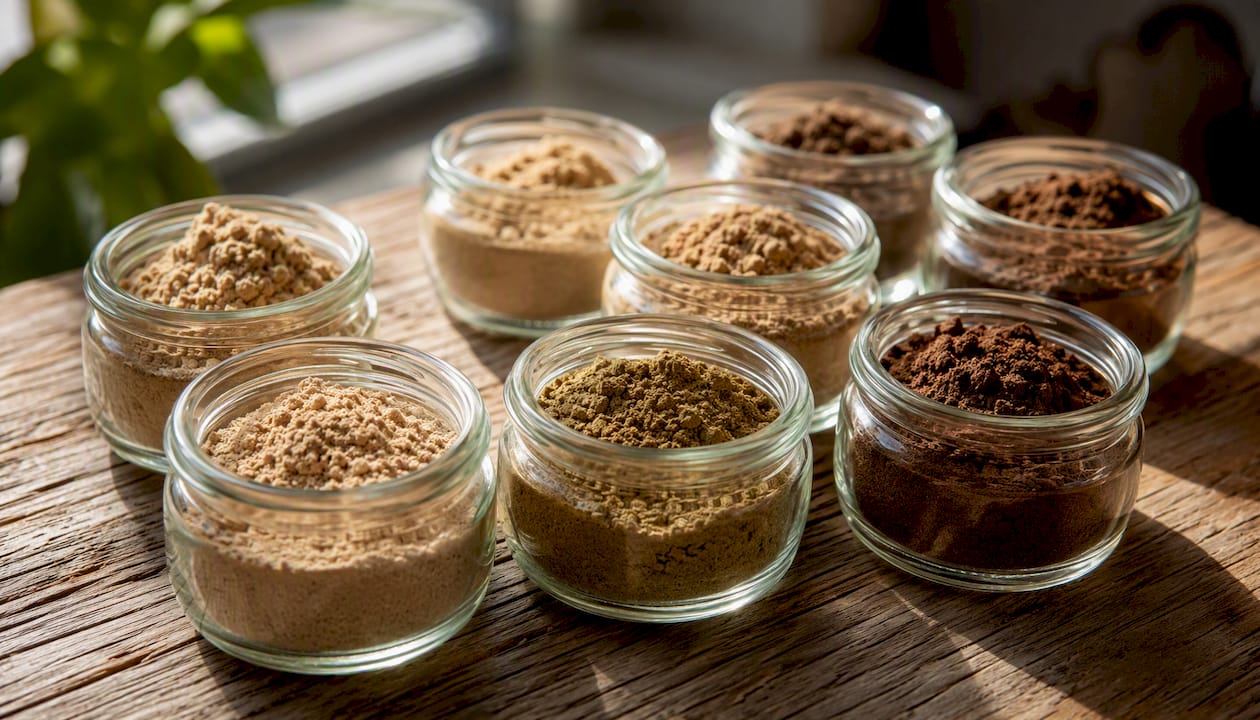
Pro Tip: “Vegetable cellulose” on a capsule description almost always means HPMC — the plant-based shell material. It is not the same as microcrystalline cellulose inside the fill, even though both come from cellulose.
How manufacturers list inactive ingredients and what vague wording hides
Label layout follows a loose convention. The Supplement Facts panel lists active ingredients with doses. Everything else — excipients, capsule shell, flow agents — appears under “Other ingredients” or “Inactive ingredients” below that panel.
The problem is what manufacturers put in that space. The “Other ingredients” list commonly reveals excipients such as silicon dioxide, magnesium stearate, and microcrystalline cellulose, but some brands obscure them:
- “Vegetable capsule” with no further detail: acceptable shorthand for HPMC, but ask for confirmation.
- “Natural flavour” or “natural components”: catch-all terms that can cover a range of additives.
- “Proprietary blend” in the inactive section: no legal basis for secrecy here — push back and ask for the full list.
- No “Other ingredients” line at all: either the product genuinely contains nothing beyond the active and the capsule shell, or the label is incomplete. Request the COA to confirm.
A product page that links directly to a COA PDF, states the capsule material explicitly, and lists every ingredient by name offers far greater transparency than one that relies on marketing copy alone.
Pro Tip: A full ingredient breakdown by weight or percentage per capsule is the gold standard. If a brand offers it, that alone separates them from most of the market.
Dietary and allergy flags: which excipients matter for your needs
Some binder and filler ingredients carry genuine allergen or dietary risks. Knowing which ones to screen for saves time.
Ingredients to flag by dietary need:
- Vegans: gelatin (bovine or porcine capsule shell), lactose, milk-derived carriers, beeswax coatings.
- Gluten-free: wheat starch, certain maltodextrin sources (check origin), pregelatinised starch.
- Lactose-intolerant: lactose, milk powder, whey-derived excipients.
- Nut-allergic: nut oils used as lubricants or carriers (rare but present in some formulations).
- Soy-sensitive: soy lecithin (used as an emulsifier in some softgels).
Safer alternatives to look for:
- HPMC capsule shell instead of gelatin
- Silicon dioxide instead of talc as a flow agent
- Microcrystalline cellulose instead of lactose as a filler
Which? advises that most inactive ingredients are food-grade and harmless at the doses used in supplements, but consumers with specific allergies should always check labels carefully. For coeliac disease or a severe nut allergy, even trace cross-contact matters — request the manufacturer’s allergen cross-contact controls in writing.
When small amounts of excipients are fine and when to act
Most excipients are safe. Which? confirms that the dose makes the poison — a few milligrams of magnesium stearate or silicon dioxide per capsule poses no meaningful risk to most people. The situations that merit action are different:
- Excipient listed first or second in the “Other ingredients” panel: ingredients appear in descending order by weight, so a high-ranking filler suggests significant dilution.
- Capsule total weight far exceeds the active dose. If a capsule weighs 700mg and the active is stated as 200mg, roughly 500mg is unaccounted for. That gap is worth investigating.
- Controversial additives present: talc (E553b), certain synthetic colorants, polyethylene glycols (PEGs) — these attract more scrutiny than standard excipients.
- No COA available: without third-party testing, a “no fillers” claim is unverifiable.
Pro Tip: *Divide the stated active dose (mg) by the total capsule fill weight (mg) to get a rough purity ratio.
How to verify “no fillers” claims with COAs and certifications
Responsible manufacturers use pharmacopeial or food-grade excipients and publish testing data — identity, assay, heavy metals, microbial counts — as the most credible way to support purity claims.
| Proof type | What it verifies | How to request or check |
|---|---|---|
| Certificate of Analysis (COA) | Identity, assay, heavy metals, microbial limits for that batch | Ask for the PDF by batch number; check the lab name and accreditation |
| UKAS-accredited lab report | Results are independently verified to UKAS-accredited standards | Confirm the lab’s UKAS number on the UKAS website |
| GMP certificate | Manufacturing follows Good Manufacturing Practice | Ask for the certificate number and issuing body |
| Vegan certification | No animal-derived ingredients, including capsule shell | Look for the Vegan Society trademark or equivalent |
| Allergen-free declaration | Absence of major allergens confirmed by testing | Request a written allergen cross-contact statement |
Pro Tip: To verify a COA is genuine, match the batch number on the COA to the batch number printed on your product. Then search the lab’s name on the UKAS register. A real lab will appear; a fabricated one will not.
Exact questions to send a manufacturer before you buy
Copy and adapt these. Send them via the brand’s contact form or email.
- “Please provide the full ‘Other ingredients’ list for, including the capsule shell material, listed in descending order by weight per capsule.”
- Root Extracts
Burdock Root Capsules 4500mg 10:1 Extract Pure Antioxidant Blood Health
Price range: £11.99 through £146.99 Select options This product has multiple variants. The options may be chosen on the product page
- “Can you share the batch COA for the current batch of? Please include the batch number, testing lab name, and accreditation details.”
- Root Extracts
Burdock Root Capsules 4500mg 10:1 Extract Pure Antioxidant Blood Health
Price range: £11.99 through £146.99 Select options This product has multiple variants. The options may be chosen on the product page
- “Are your excipients pharmacopeial grade (e.g., BP, USP, or food-grade)? Can you confirm the supplier grade?”
- “What allergen cross-contact controls are in place during manufacturing? Is the facility free from [specific allergen]?”
- “Which third-party lab conducts your testing, and is it UKAS-accredited or equivalent? What is the typical turnaround for a COA request?”

If a manufacturer cannot answer questions 1 and 2 within a few working days, treat that as a transparency gap. A credible brand holds this documentation routinely and shares it on request.
Practical rules for choosing genuinely binder-free capsules
Single-ingredient, high-dose products are the easiest to verify. With only one active and a capsule shell, the arithmetic is simple and there is little room to hide dilution.
- Prefer products where the active dose accounts for the majority of the capsule fill weight.
- Check that the “Other ingredients” list is short — ideally just the capsule shell material.
- Look for a COA link directly on the product page, not buried in a FAQ.
- Favour HPMC capsule shells over gelatin if you are vegan or prefer plant-based options.
- Treat independent testing badges (GMP, vegan certification, allergen-free) as supporting evidence, not primary proof. The COA is primary.
Pro Tip: Vitaminb17’s product pages for Sea Kelp Extract Capsules and Pumpkin Seed Extract Capsules are worth using as a transparency benchmark. Both list ingredients clearly, state the capsule material, and carry no-filler claims backed by the brand’s manufacturing standards. Compare any product you are considering against that level of detail.
Why Vitaminb17 favours binder-free, high-potency herbal capsules
Pure. No fillers. No binders. That is the standard Vitaminb17 holds every product to. The preference for binder-free formulations is not a marketing position — it reflects a straightforward belief that a supplement should contain what it says and nothing it does not. Every Vitaminb17 product carries a full ingredient list, states the capsule material explicitly, and is manufactured to GMP standards. Vegan certification and allergen-free status are confirmed, not assumed. When a COA is requested, the batch number, lab name, and test results are available. That combination of full ingredient transparency, independent testing, and clean formulation is what Vitaminb17 considers the minimum acceptable standard for any herbal extract capsule.
Vitaminb17’s pure herbal capsules: no fillers, full transparency

Vitaminb17 offers food-grade herbal supplement capsules with no fillers, no binders, and no synthetic additives. Every product in the range — from Sea Kelp Extract to Pumpkin Seed Extract — contains a single high-potency herbal extract and an HPMC vegan capsule shell. Nothing else. The ingredient list is short because it is honest.
Each formulation is manufactured to GMP standards, suitable for vegans, and free from common allergens. Full ingredient transparency is on every product page. If you want to choose raw herbal extract capsules with confidence, Vitaminb17 products give you the detail you need to verify the claim before you buy.
Browse the full range at Vitaminb17 and check the ingredient list and capsule material for any product before adding it to your basket.
Sources
- Do you need to worry about fillers and bulkers in supplements? – Which?
- Consumerlab
- Silicon Dioxide, Magnesium Stearate, and the Truth About Fillers and Flow Agents in Supplements
- Filler Ingredients in Supplements: The Additives You Didn’t Sign Up Fo – Low Tox Gear
- What Are Excipients? A Guide For Supplement Brand Owners
This article is general information, not a substitute for advice from a qualified doctor. Consult a qualified healthcare professional about your own circumstances before acting on anything here.


