

Supplements without artificial ingredients are defined as products containing only naturally derived active compounds and excipients, with no synthetic dyes, sweeteners, fillers, or binders added during manufacturing. Verifying this claim matters more than ever. Over 80% of supplement buyers cite ingredient transparency as a top concern, yet the term “clean label” carries no standard legal definition. Manufacturers self-define it freely. That gap between marketing language and actual product content is exactly where most consumers get misled. This guide gives you the tools to verify no artificial ingredients supplements with confidence, using label analysis, certification checks, and practical home methods.
What does “verify no artificial ingredients supplements” actually mean?
The phrase “clean label” is a marketing term, not a regulated standard. A product labelled clean may still contain excipients like magnesium stearate or silicon dioxide, which some consumers consider synthetic additives. Healthy supplement verification, in practical terms, means confirming that no artificial colours, sweeteners, or unnecessary fillers appear anywhere in the product. It requires reading beyond the front of the pack.
The supplement market is projected to reach $430 billion by 2035, with limited regulatory oversight on how brands use terms like “pure” or “natural.” That scale creates enormous incentive for misleading labelling. Knowing what to look for protects your health and your money.
How to read supplement labels to spot artificial ingredients
The most reliable first step is reading the full ingredient panel, not just the front label claim. Every supplement sold in the UK and US must list all ingredients, including inactive ones, in the “Other Ingredients” section beneath the Supplement Facts panel.
Look specifically for these artificial additives:
- Artificial colours: FD&C Red 40, FD&C Blue 1, and similar dye codes signal synthetic colouring with no nutritional value.
- Artificial sweeteners: Sucralose and acesulfame potassium are common in flavoured powders and chewables. Neither is natural.
- Synthetic fillers and binders: Polyethylene glycol, hydrogenated oils, and carboxymethylcellulose are processing aids that indicate cost-cutting.
- Proprietary blends: These list a group of ingredients under one umbrella name with a single combined weight. You cannot tell how much of each ingredient is present. This is a significant transparency problem.
- Allergen and additive statements: Phrases like “may contain traces of” or “processed in a facility with” reveal cross-contamination risks that matter for purity-focused consumers.
Ingredient form also matters. Magnesium glycinate and magnesium citrate are both natural, but they absorb differently. A label listing only “magnesium” without specifying the form tells you very little about quality. Brands committed to supplement purity name the exact compound.
Pro Tip: Scan the “Other Ingredients” list from bottom to top. Manufacturers often bury artificial additives at the end of the list where fewer people look.
How does third-party certification verify supplement authenticity?
Third-party certification is the most credible external check available to consumers. Organisations including USP (United States Pharmacopeia), NSF International, and Informed Sport conduct independent laboratory testing on finished products. They check whether label claims match actual contents, screen for contaminants such as heavy metals and pesticides, and confirm Good Manufacturing Practice (GMP) compliance.
The verification process typically works as follows:
- Submit product samples. The brand sends batches to the certifying body’s laboratory.
- Test for label accuracy. The lab confirms that active ingredient quantities match what the label states.
- Screen for contaminants. Tests cover heavy metals, microbial contamination, and banned substances.
- Audit manufacturing. GMP compliance checks confirm the facility meets production standards.
- Issue the seal. Only products passing all stages receive the certification mark.
NSF and USP verify products against databases including the NIH Dietary Supplement Label Database, which holds records for over 207,000 products. That database is publicly searchable, which means you can cross-reference a product’s label claims independently.
A critical point: third-party certification confirms that the bottle contains what the label says. It does not certify that the product is free of all artificial ingredients. You must still check the “Other Ingredients” list yourself. Certification and label reading work together, not as substitutes for each other.
Fake certifications are a documented issue in the supplement industry. Always verify a seal by searching the certifying body’s official database using the product name or batch number. A seal printed on a label proves nothing on its own.
Pro Tip: Go directly to NSF.org or USP.org and search the product by name. If it does not appear in the database, the certification claim is unverified.
Red flags that signal artificial ingredients or poor purity
Certain label and marketing patterns reliably indicate lower quality or hidden artificial content. Recognising them quickly protects you from wasting money on supplements that do not meet clean standards.
- Proprietary blends with vague names. A blend labelled “Herbal Matrix” or “Performance Complex” hides individual dosages. Apps analyse over 500 clinical studies to check whether products match clinically effective doses. Proprietary blends almost never do.
- Disease cure or treatment claims. Supplements are not medicines. Any label claiming to “cure,” “treat,” or “prevent” a named disease violates regulatory rules in both the UK and US. This signals a brand willing to mislead.
- Suspiciously low prices. Certified, additive-free supplements cost more to produce. A product priced significantly below comparable certified options almost always reflects cheaper raw materials or undisclosed fillers.
- Long additive chains. A label listing ten or more “Other Ingredients” beyond the active compound is a warning sign. Pure supplements need very few processing aids.
- Missing lot numbers or expiry dates. These are required by law. Their absence suggests poor manufacturing controls or a product that has bypassed standard quality checks.
- Vague testing claims. Phrases like “laboratory tested” or “quality assured” without naming the certifying body or providing a Certificate of Analysis (COA) are meaningless. Any brand can print them.
Understanding how to spot underdosed or impure products goes hand in hand with reading these red flags. The two skills reinforce each other.
Practical ways to check supplement quality at home and online
Label reading and certification checks cover most of the verification process. Several additional methods let you go further, especially when a brand’s transparency is unclear.
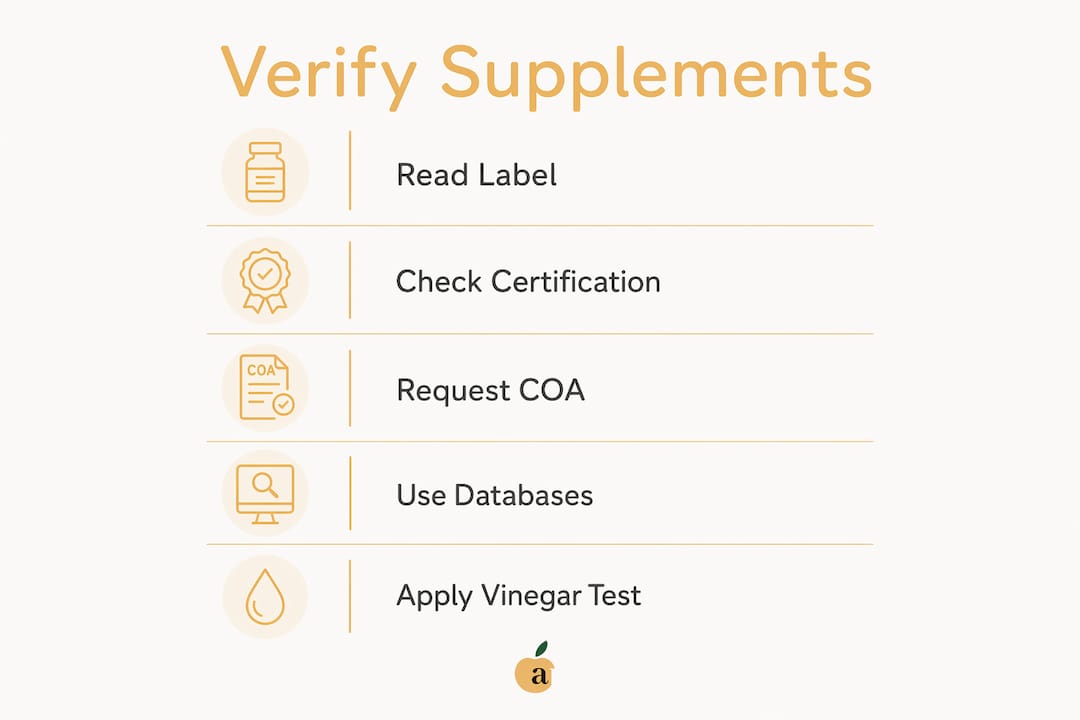
Request a batch-specific Certificate of Analysis
A Certificate of Analysis (COA) is a laboratory document confirming the test results for a specific production batch. Finished product COA testing is more reliable than raw material testing because contamination can be introduced during manufacturing. Always request the COA for the exact lot number on your bottle, not a generic document covering a different batch.
Use reputable supplement databases
The NIH Dietary Supplement Label Database (DSLD) is a free, publicly searchable resource listing label information for thousands of products. Cross-referencing a product’s ingredient list against the DSLD confirms whether the label is consistent with what the brand has officially registered.
Apply the vinegar dissolution test
A tablet left unchanged in vinegar after several hours likely lacks the solubility needed to be absorbed effectively. Place a tablet in a small glass of white vinegar and check it after 30 minutes. A quality tablet should begin to break down. This test does not confirm ingredient purity, but it does reveal manufacturing quality.
Cross-reference doses with clinical research
Check whether the active ingredient dose on the label matches the amounts used in published clinical studies. Many supplements contain unlisted ingredients or doses far below therapeutic levels. PubMed, the NIH’s free research database, lets you search ingredient names and review the evidence base quickly.
| Verification method | What it confirms | Time required |
|---|---|---|
| Label “Other Ingredients” check | Presence or absence of artificial additives | 2–3 minutes |
| Certifier database search | Whether the certification seal is genuine | 5 minutes |
| Batch-specific COA request | Purity and potency of your exact lot | 1–2 days |
| Vinegar dissolution test | Tablet solubility and manufacturing quality | 30 minutes |
| NIH DSLD cross-reference | Label consistency with official registration | 5–10 minutes |
Pro Tip: Contact the brand’s customer service and ask for the COA for your specific lot number. A brand committed to transparency will send it within 24 hours. Silence or deflection is your answer.
Key takeaways
Verifying supplements without artificial ingredients requires combining label analysis, certified third-party testing, and batch-specific documentation rather than trusting front-of-pack claims alone.
| Point | Details |
|---|---|
| “Clean label” has no legal definition | Always read the full “Other Ingredients” list, not just the front label claim. |
| Third-party seals need verification | Search NSF.org or USP.org directly to confirm a certification is genuine and current. |
| COAs confirm your specific batch | Request the finished product COA for your exact lot number, not a generic document. |
| Red flags reveal hidden additives | Proprietary blends, vague testing claims, and very low prices signal lower purity. |
| Practical tests add a further layer | The vinegar dissolution test and NIH DSLD cross-reference confirm quality beyond the label. |
Why I trust the process more than the packaging
The single biggest mistake I see health-conscious consumers make is reading the front of a supplement pack and stopping there. Front labels are marketing documents. The real information lives in the “Other Ingredients” section, and most people never look at it.
Certification seals are genuinely useful, but only when you verify them. I have seen products displaying USP-style logos that do not appear anywhere in the USP verified database. That is not an accident. It is a deliberate attempt to borrow credibility. The five minutes spent searching a certifier’s database is the most efficient quality check available.
Paying more for a verified, additive-free supplement is not a luxury decision. It is a risk management decision. Cheaper uncertified products carry a real chance of containing undisclosed fillers, incorrect dosages, or contaminants. The benefits of single-ingredient supplements are well documented precisely because there is nowhere for a manufacturer to hide. One ingredient, one COA, one clear result.
My practical advice: treat every new supplement brand as unverified until you have checked the certifier database, read the full ingredient panel, and received a batch-specific COA. That process takes under ten minutes. It is the only reliable way to know what you are actually putting into your body.
— Jade
Vitaminb17’s approach to clean, verified supplements
Vitaminb17 builds its entire range around one principle: no fillers, no binders, no synthetic additives. Every product uses high-potency natural extracts encapsulated without unnecessary processing aids. Ingredients like apricot kernels, burdock root, and sea kelp are listed in full, with no proprietary blends obscuring what you are taking.

For consumers who want to apply everything covered in this guide, Vitaminb17’s raw herbal extract capsules are a practical starting point. Single ingredients. Clear labels. No artificial content to hunt for. If you are building a supplement routine around verified purity, the plant-based supplement guide covers how to select and stack clean options effectively.
FAQ
What does “no artificial ingredients” mean on a supplement label?
It means the product contains no synthetic colours, sweeteners, flavours, or chemical fillers. Because “clean label” has no legal definition, always verify by reading the full “Other Ingredients” section rather than relying on the front-of-pack claim.
How do I check if a supplement certification seal is genuine?
Search the product name or batch number directly on the certifying body’s official website, such as NSF.org or USP.org. Counterfeit certification seals are a documented problem, so a seal printed on a label is not sufficient proof on its own.
What is a Certificate of Analysis and why does it matter?
A Certificate of Analysis (COA) is a laboratory document confirming the tested purity and potency of a specific production batch. Finished product COA testing is more reliable than raw material testing because contamination can occur during manufacturing.
Are there artificial ingredients in supplements labelled “natural”?
Yes. The term “natural” is not legally regulated for supplements. A product labelled natural may still contain artificial dyes such as FD&C Red 40 or sweeteners such as sucralose. Reading the “Other Ingredients” list is the only way to confirm the absence of synthetic additives.
What is the quickest home test for supplement quality?
Place a tablet in white vinegar and check it after 30 minutes. A tablet that shows no signs of breaking down likely has poor solubility. This test indicates manufacturing quality, though it does not confirm ingredient purity on its own.


