

Raw herbal extract capsules are defined as encapsulated concentrates of plant material, produced by drawing active compounds from herbs using solvents such as water, alcohol, or CO₂, then drying the result into a stable powder. Choosing the right capsules means assessing extraction method, potency claims, label transparency, and ingredient purity before you buy. The supplement market is crowded, and not all products deliver what their labels promise. This guide gives you the criteria to choose raw herbal extract capsules with confidence, so you get genuine plant potency rather than diluted powder in a shell.
What is raw herbal extract and how do extraction methods affect quality?
A raw herbal extract is a concentrated form of a plant’s active compounds, separated from the bulk plant material through a controlled process. The term “raw” signals minimal post-extraction processing, preserving a broad spectrum of phytochemicals. This differs from a finished, highly refined extract where specific compounds are isolated and the rest discarded.
The solvent used in extraction determines which compounds you actually get. Different solvents target different constituent groups: water extracts polysaccharides and glycosides well, while alcohol captures resins, alkaloids, and essential oils. CO₂ extraction preserves volatile compounds that heat-based methods destroy. Choosing a product without knowing the solvent means you cannot confirm the extract matches your intended health benefit.
What is aqueous herbal extract? It is simply a water-based extract, often produced by decoction or infusion. Aqueous extracts suit herbs where polysaccharides or water-soluble glycosides carry the primary benefit, such as burdock root or dandelion. They are less suited to herbs whose key compounds are alcohol-soluble.
The extraction process also affects the final powder’s physical form. Powdered extracts often contain excipients such as dextrin or maltodextrin added as carriers to improve flow and shelf stability. These carriers are not plant material. They improve processing but reduce the proportion of pure extract per capsule.
Key extraction method considerations:
- Water (aqueous): Best for polysaccharides, glycosides, and water-soluble minerals
- Alcohol (hydroalcoholic): Captures alkaloids, resins, and lipophilic compounds
- CO₂: Preserves volatile oils and heat-sensitive actives without solvent residue
- Spray-dried powders: Convenient but may include carriers that dilute potency
Pro Tip: Ask the supplier which solvent was used before purchasing. If the product page does not list it, treat that as a red flag for label transparency.
How do you read labels and potency claims on herbal capsules?
Label literacy is the single most practical skill for selecting effective herbal extract capsules. Most labels use one of three formats: whole herb powder, ratio extract, or standardised extract. Each tells you something different about what is inside.
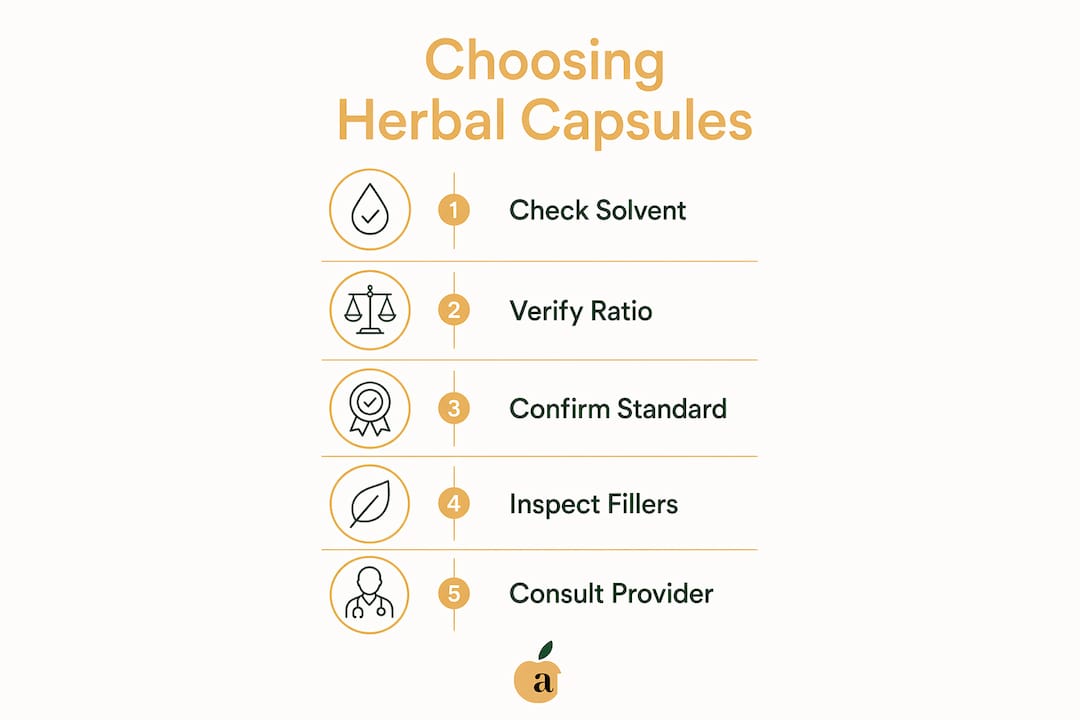
A ratio extract label such as “10:1” means ten parts of raw herb were used to produce one part of extract. A 500 mg capsule of a 10:1 extract corresponds to 5,000 mg of raw herb equivalent, but experts recommend standardising to active markers for reliable dosing. A ratio alone does not confirm which compounds are concentrated or at what level.
Standardised extracts go further. Standardised extracts provide verified active constituent levels and are preferable when specific health claims or clinical dosing is intended. A label reading “standardised to 5% withanolides” tells you exactly how much of the key active compound is present per dose. Ratio extracts preserve the full compound matrix but vary in active amounts from batch to batch.
The three extract formats compared:
| Format | Potency indicator | Best use case |
|---|---|---|
| Whole herb powder | None (bulk weight only) | General nutritional support |
| Ratio extract (e.g., 10:1) | Concentration factor | Broad spectrum plant benefit |
| Standardised extract | Active compound percentage | Targeted, clinical-level dosing |
Labels should specify the plant part used and the extraction solvent, enabling you to confirm alignment with traditional and scientific standards. Root extracts of dandelion behave differently from leaf extracts. A label that omits the plant part is incomplete.
Numbered steps for reading a label correctly:
- Identify the extract format: whole powder, ratio, or standardised
- Check the plant part: root, leaf, seed, or aerial parts
- Confirm the extraction solvent or method
- Look for excipient or carrier listings in the “other ingredients” section
- Verify the dose per capsule against established reference ranges
Pro Tip: If a label lists only “herbal extract” with no ratio, no standardisation figure, and no plant part, the product almost certainly cannot deliver consistent results.
What are the best practices to select pure and effective herbal extract capsules?
Selecting the best raw herbal capsules requires checking several criteria in sequence rather than relying on any single factor. Potency, purity, and format all matter equally.
Start with active marker standardisation. A product standardised to a named compound gives you a measurable guarantee of potency. Vitaminb17’s Dandelion Root Capsules 5000mg use a 10:1 extract ratio, giving you the equivalent of 5,000 mg of raw dandelion root per serving. That figure is verifiable and consistent across batches.
Criteria for selecting pure and effective capsules:
- Active marker standardisation: Confirms the key compound is present at a stated level
- Plant part disclosure: Root, leaf, and seed extracts have different active profiles
- Solvent transparency: Confirms which compounds were targeted during extraction
- Excipient listing: USP botanical extract guidelines specify excipients are common in powdered extracts; check the “other ingredients” list for fillers such as magnesium stearate or silicon dioxide
- Capsule format: Vegetarian cellulose capsules suit those avoiding gelatine; capsule size affects dose per unit
- Third-party testing: Look for certificates of analysis (COA) or independent lab verification on the product page
Capsule format affects more than ethics. Gelatine capsules dissolve faster in the stomach, while cellulose capsules may be slower. For herbs where rapid absorption matters, such as those targeting acute symptoms, capsule type is a practical consideration. For natural supplement absorption, taking capsules with food and adequate water consistently improves uptake.
Vitaminb17 products contain no fillers, no binders, and no synthetic additives. That commitment to purity means the stated dose reflects actual plant extract, not a blend of extract and carrier material. When comparing products, check whether the stated weight refers to extract alone or to extract plus excipients combined.
Common mistakes when choosing herbal extract capsules
The most frequent error is confusing whole herb powder with a concentrated extract. A 500 mg capsule of whole dandelion powder is not equivalent to a 500 mg capsule of 10:1 dandelion extract. Common consumer mistakes include confusing standardised extracts with raw powders, ignoring excipient listings, and overlooking solvent effects on bioactive constituents. Each mistake reduces the product’s real-world effectiveness.
Ignoring the excipient list is equally costly. Decoction and spray-dried extract powders include excipients that improve processing but mean the powders are not 100% pure plant material. A product listing maltodextrin as a primary ingredient may contain more carrier than extract by weight. You are paying for filler.
“Buying underdosed or mislabelled herbal products is the single most common reason people conclude that herbal supplements ‘don’t work.’ The product failed, not the herb. Verify the extract format, the standardisation figure, and the excipient load before you spend a penny. A clear label is not a luxury — it is the minimum standard for any supplement worth taking.”
Trusting marketing language without verification is the third major pitfall. Words like “potent,” “premium,” and “pure” carry no regulatory definition in the UK supplement market. They are marketing terms, not quality standards. The only reliable signals are standardisation figures, COA availability, and clear ingredient disclosure. If a product cannot provide these, look elsewhere. Vitaminb17’s buyer’s guide on recognising underdosed supplements explains exactly what to look for.
How do you integrate raw herbal extract capsules into your wellness routine?
Consistency matters more than timing for most herbal extracts. Taking capsules at the same time each day builds a stable intake pattern and makes it easier to track effects. Morning doses suit energising herbs such as Sea Kelp; evening doses suit calming or digestive herbs such as Celery Seed.
Steps for integrating herbal capsules effectively:
- Start with one extract at a time for two to four weeks before adding another
- Record any changes in energy, digestion, or symptom patterns in a simple daily note
- Introduce a second extract only after confirming the first is well tolerated
- Stack complementary herbs under guidance to enhance benefits without increasing interaction risk
- Review your stack every eight to twelve weeks and adjust based on observed effects
Careful monitoring and stacking with complementary herbs under guidance enhances benefits and safety when integrating herbal extract capsules into wellness routines. Combining burdock root with dandelion root, for example, supports liver and kidney function through complementary pathways. Vitaminb17’s Burdock Root Capsules and Dandelion Root Capsules are designed to work alongside each other without synthetic additives complicating the combination.
Consult a qualified healthcare provider before starting any herbal extract if you take prescription medication. Herbs such as dandelion can interact with diuretics, and standardised extracts deliver pharmacologically relevant doses. That is precisely their strength, and precisely why interactions deserve attention. For a broader view of how capsules compare to powder formats for liver support, the capsule vs powder comparison from Joyrise offers useful context.
Pro Tip: Keep a supplement log for the first 90 days. Note the product, dose, timing, and any effects. This makes it far easier to identify what is working and what to adjust.
Key takeaways
Choosing effective raw herbal extract capsules requires verifying the extraction method, confirming active marker standardisation, and checking every ingredient on the label before purchase.
| Point | Details |
|---|---|
| Extraction method matters | The solvent used determines which plant compounds are captured and at what concentration. |
| Ratio claims need context | A 10:1 ratio shows concentration but does not confirm active compound levels without standardisation. |
| Excipients reduce purity | Carriers like maltodextrin are common in powdered extracts and dilute the proportion of pure plant material. |
| Label transparency is non-negotiable | Plant part, solvent, and standardisation figure must all appear on the label for reliable selection. |
| Consistency drives results | Taking capsules at the same time daily and monitoring effects over 8–12 weeks gives the clearest picture of efficacy. |
Why label clarity changed how I choose herbal supplements
I spent years buying herbal capsules based on brand reputation and price. The turning point came when I compared two dandelion root products side by side: one listed “dandelion root extract 500 mg” with no ratio and no plant part; the other stated “dandelion root extract 5,000 mg equivalent, 10:1, root only, aqueous extraction.” The second product cost slightly more. The difference in effect was not slight at all.
Standardisation is the detail most buyers skip, and it is the one that matters most. A product standardised to a named active compound removes the guesswork entirely. You know what you are taking, at what dose, from which part of the plant. That is not a premium feature. That is the baseline for any supplement worth your money.
My honest view on the market is this: most herbal capsules are not fraudulent, but many are underdosed or vaguely labelled to the point of being ineffective. The herbs themselves are not the problem. The processing, the excipient load, and the lack of standardisation are. Vitaminb17’s approach of no fillers and no binders is the standard the whole industry should meet, not a differentiator.
If you are new to herbal extracts, start with one well-labelled, standardised product. Give it eight weeks. Track your response. Then build from there. The supplement market rewards patience and label literacy far more than it rewards spending.
— Jade
Pure herbal extract capsules worth your attention
Vitaminb17 produces a range of high-potency herbal extract capsules with no fillers, no binders, and no synthetic additives. Every product lists the extract ratio, the plant part, and the exact dose per capsule.

If you are ready to move beyond vague labels and underdosed products, the buyer’s guide to underdosed supplements from Vitaminb17 gives you a clear checklist for evaluating any herbal capsule on the market. For those interested in specific raw extracts, Vitaminb17’s Mullein Leaf Extract Capsules 5000mg and Dandelion Root range are a strong starting point. Pure. Raw. No compromise.
FAQ
What is a raw herbal extract capsule?
A raw herbal extract capsule contains a concentrated plant extract, produced by drawing active compounds from the herb using a solvent such as water or alcohol, then encapsulating the dried result. It differs from whole herb powder because the active compounds are concentrated rather than simply ground.
What is the difference between a ratio extract and a standardised extract?
A ratio extract such as 10:1 shows how much raw herb was used to make the extract, but does not confirm active compound levels. A standardised extract states the exact percentage of a named active compound, making dosing more reliable and consistent.
What is an aqueous herbal extract?
An aqueous herbal extract is produced using water as the sole solvent, making it effective for capturing polysaccharides, glycosides, and water-soluble minerals. It is the preferred method for herbs like dandelion root and burdock root, where water-soluble compounds carry the primary benefit.
How do I know if a herbal capsule contains fillers?
Check the “other ingredients” section of the label. Ingredients such as maltodextrin, dextrin, magnesium stearate, or silicon dioxide are excipients or carriers, not plant material. Products from Vitaminb17 list no such additives, as their capsules contain pure extract only.
When should I consult a healthcare provider before taking herbal extract capsules?
Consult a healthcare provider before starting any standardised herbal extract if you take prescription medication, are pregnant, or have a diagnosed health condition. Standardised extracts deliver pharmacologically relevant doses that can interact with certain drugs, including diuretics and blood thinners.


