

Before you buy any herbal extract capsule, run five quick checks: the label says “food supplement,” the mg per capsule and the standardised extract percentage are visible, a Certificate of Analysis (COA) is available, the manufacturer’s UK contact details are present, and there are no fillers or binders listed. Vitaminb17 meets all five. Its capsules, including Apricot Kernels (Amygdalin), Burdock Root, Sea Kelp, Celery Seed, and Pumpkin Seed Extract 2000mg, carry standardised extracts, no synthetic additives, and vegan-friendly shells.
- Label reads “food supplement” and names the botanical Latin name plus plant part used
- Mg per capsule and standardised extract percentage are both stated
- COA from an accredited third-party lab is available on request or online
- Batch number, expiry date, and manufacturer contact details are on the pack
- No fillers, binders, or proprietary blends hiding ingredient amounts
Pro Tip: Screenshot the product page before you buy. If the seller edits the listing after purchase, you still have the label claims on record.
Key takeaways
A compliant, high-potency herbal extract capsule must carry statutory UK label fields, a verifiable COA, and stated standardised extract percentages — anything missing is grounds to look elsewhere.
| Point | Details |
|---|---|
| Check the label first | The label must state “food supplement,” mg per capsule, standardised %, batch number, and expiry date. |
| Demand a COA | Request a Certificate of Analysis from an accredited lab matching the batch number on your pack. |
| Calculate cost per active mg | Divide price by total active mg in the bottle, not by raw herb mg or capsule count. |
| Know the red flags | No COA, proprietary blends, medical claims, and no UK address are reasons to stop. |
| Vitaminb17 meets the checks | No fillers, standardised extracts, COAs on request, and UK contact details across the full range. |
Table of Contents
- What does a high potency herb checklist cover?
- Which label faults should stop you buying immediately?
- How do you use high-potency herbal extract capsules safely?
- Why do storage conditions and batch numbers matter?
- How do you read a Certificate of Analysis?
- How do you compare potency and price fairly?
- What do UK regulations require on a herbal supplement label?
- Why you can trust this checklist
- Why this checklist exists
- Vitaminb17 high-potency capsules: ready to buy
- Sources
What does a high potency herb checklist cover?
A practical high potency herb checklist goes beyond reading the front of the pack. Consumer guidance for UK shoppers recommends verifying botanical names, the plant part used, exact dosages or standardised extract percentages, batch numbers, and third-party lab results before committing to any product.
- “Food supplement” category name — the label must use this exact phrase; it is a legal requirement under The Food Supplements (England) Regulations 2003.
- Botanical Latin name and plant part — Arctium lappa root is not the same as Arctium lappa leaf; potency and safety profiles differ.
- Mg per capsule and standardised extract percentage — both figures must be visible, not just one.
- Recommended daily portion and “do not exceed” warning — required by law; absence is a compliance failure.
- “Not a substitute for a varied diet” statement — another statutory requirement; missing it is a red flag.
- Batch/lot number — needed for recall checks and COA matching.
- expiry date or best before date — potency degrades; no date means no accountability.
- Manufacturer name and UK contact address — a PO box or overseas address with no UK presence is insufficient.
- Allergen and suitability information — vegan capsule shell, gluten-free status, and any known allergens must be declared.
- Published COA or third-party test summary — the single strongest purity signal available to a buyer.
| Label field | What to expect |
|---|---|
| Category name | Exactly “food supplement” |
| Botanical name | Latin binomial + plant part (e.g. root, leaf, seed) |
| Potency | Mg per capsule AND standardised extract % |
| Daily portion | Specific number of capsules; “do not exceed” warning present |
| Diet statement | “Not a substitute for a varied diet” |
| Batch/lot number | Alphanumeric code on base or side of pack |
| expiry date or best before date | Month and year minimum |
| Manufacturer contact | Full UK postal address and email or phone |
| Allergens/suitability | Vegan, gluten-free, or allergen declarations |
| COA reference | Lab name, accreditation number, or QR code to results |
Pro Tip: When comparing two products, open both product pages side by side and tick each row of this table. Any blank cell is a reason to pause.
Which label faults should stop you buying immediately?
Some problems on a listing or label are not minor oversights. They signal either non-compliance or deliberate concealment.
- No mg stated, or only a proprietary blend total — you cannot calculate cost per mg or verify potency
- Sensational medical claims (“cures,” “treats,” “clinically proven to eliminate”) — food supplements cannot legally make these; a product making them may lack THR registration and is likely non-compliant
- No COA and no named independent lab — no way to verify purity or contaminant levels
- No UK manufacturer address or returns policy — enforcement and redress become very difficult
- Missing batch number or expiry date — you cannot trace the product if a recall is issued
- Undisclosed excipients — fillers, binders, or flow agents not listed on the label
- Overseas seller with no UK-registered entity — UK food law applies to products sold here; a seller with no UK presence may not be subject to Trading Standards oversight
The Food Standards Agency is clear that labelling particulars must be easy to understand, legible, and conspicuous. Hidden or obscured text is not acceptable under UK law.
How do you use high-potency herbal extract capsules safely?
Start low, follow the label dose, and consult your GP if you take prescription medicines, are pregnant, or have a diagnosed medical condition.
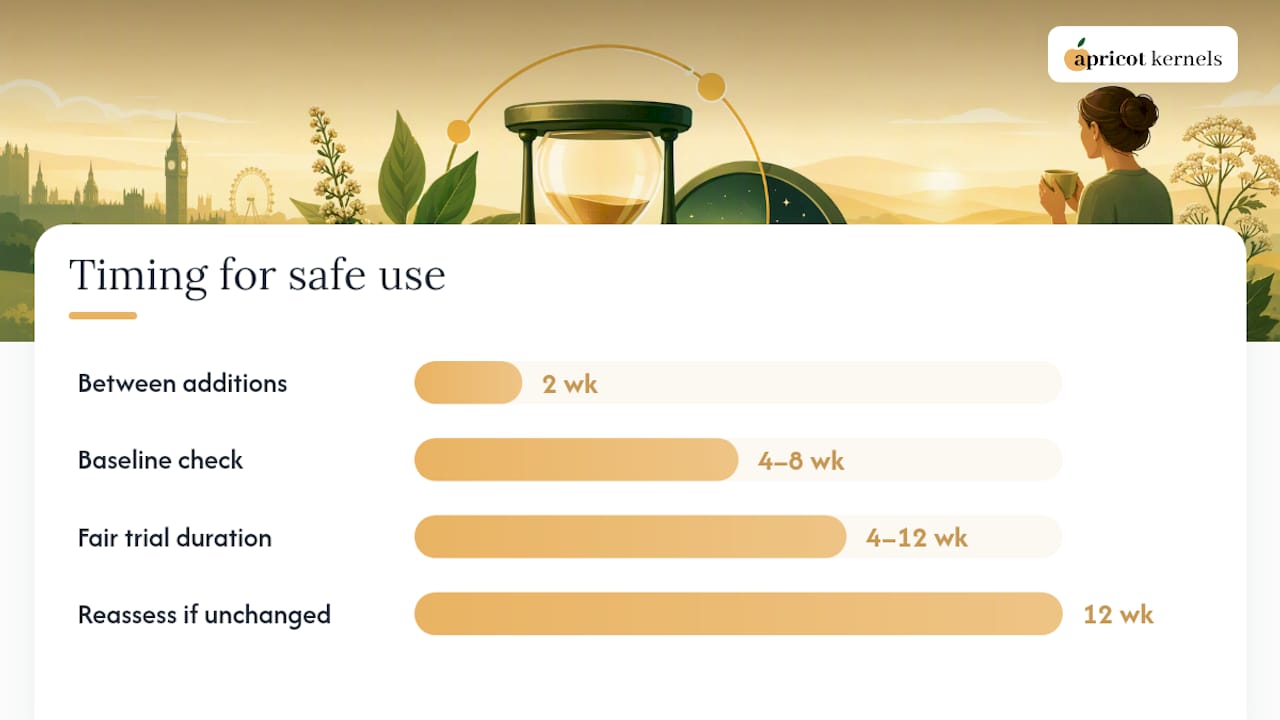
- Establish your baseline — note any current symptoms, energy levels, or health markers before starting. This gives you a reference point after four to eight weeks.
- Begin at the lowest stated dose — if the label says one to two capsules daily, start with one. Your body’s response to a concentrated extract can differ from a whole-herb product.
- Take with food — most herbal extracts are better tolerated alongside a meal and absorption can improve with dietary fats present.
- Wait before stacking — introduce one new extract at a time, with at least two weeks between additions. This makes it straightforward to identify which product causes any reaction. For structured guidance on combining products, see how to stack herbal supplements effectively.
- Give it a fair trial — most standardised extracts need four to twelve weeks of consistent use before effects are observable. Stopping after one week tells you nothing useful.
Monitoring checklist:
- Nausea, headaches, or digestive upset in the first week — reduce dose or stop
- Skin reactions or unusual fatigue — stop and contact your GP or pharmacist
- Any interaction with a prescribed medicine — seek pharmacist advice before continuing
- No change after twelve weeks at the full label dose — reassess with a clinician
Food supplements labelled as such cannot legally claim to treat or cure any disease. If you are managing a medical condition, consult a clinician before adding any high-potency extract to your routine.
Pro Tip: Keep a simple log: date started, dose, and any changes you notice. Three lines in a notes app is enough. It makes GP conversations far more productive.
Why do storage conditions and batch numbers matter?
Poor storage degrades potency faster than the expiry date suggests. Keep capsules in a cool, dry place away from direct sunlight, in the original sealed packaging. Bathrooms are the worst location: heat and humidity accelerate oxidation of active compounds.
- Store below 25°C, away from moisture and direct light
- Keep in the original container; transferring to a pill organiser exposes capsules to air repeatedly
- Check the expiry date on the base of the pack before opening a new bottle
- Note the batch/lot number when you open a new pack — this is the code you need if a recall is issued
Batch numbers connect your specific pack to a manufacturer’s production record and, critically, to the COA for that run. If a recall is announced by Trading Standards or the Food Standards Agency, your batch number tells you instantly whether your product is affected.
Pro Tip: Photograph the batch number and expiry date on your phone when you open a new pack. Register for the seller’s newsletter or recall notifications so you are alerted if that batch is ever flagged.
How do you read a Certificate of Analysis?
A COA is a document from an independent, accredited laboratory confirming what is and is not in a specific batch of product. It is the strongest purity signal a supplement brand can provide, and consumer safety guidance consistently recommends requesting one before buying.
COA checklist — fields you must see:
- Lab name and accreditation number (e.g. UKAS-accredited or ISO 17025 certified)
- Batch or lot number matching the pack you hold
- Assay result for the active marker compound (e.g. inulin % for burdock root, iodine for sea kelp)
- Heavy metals panel — lead, cadmium, arsenic, mercury; results should be below recognised limits
- Pesticide residue screen — pass/fail or quantified results
- Microbial limits — total viable count, yeast and mould, absence of pathogens
- Date of test — results older than 24 months for the specific batch are of limited value
| COA field | Acceptable result |
|---|---|
| Lab accreditation | UKAS, ISO 17025, or equivalent named standard |
| Batch number | Matches pack exactly |
| Active marker assay | Stated % or mg matches label claim (±10% tolerance is standard) |
| Lead | Below recognised limits (EU/UK food supplement guidance) |
| Total microbial count | Within pharmacopoeial limits for oral supplements |
| Pesticides | Pass (no detections above MRL) |
| Test date | Within 24 months of batch manufacture |
If a seller cannot provide a COA for the batch you are buying, treat that as a red flag. For more on what purity documentation should look like, see herbal supplement purity explained.
How do you compare potency and price fairly?
The only fair comparison between two herbal extract capsules is cost per mg of the active standardised marker, not cost per capsule or cost per gram of raw herb.
- Find the standardised extract percentage on the label (e.g. “10:1 extract” or “5% active compound”).
- Multiply the mg per capsule by the percentage to get active mg per capsule (e.g. 500 mg at 5% = 25 mg active).
- Divide the product price by the total active mg in the bottle to get cost per active mg.
Product B delivers more than twice the active compound per capsule despite a lower raw mg figure. Comparing raw herb mg across products is misleading because a 10:1 concentrated extract and a raw powder are not equivalent. For a deeper look at spotting underdosed products, see recognise underdosed herbal supplements.
What do UK regulations require on a herbal supplement label?
Under UK law, the manufacturer carries full responsibility. The UK Department of Health and Social Care does not authorise or pre-check individual product composition or labelling — that duty sits entirely with the food business operator.
Statutory label requirements under The Food Supplements (England) Regulations 2003:
- The label must include the name “food supplement”
- Recommended daily portion must be stated or clearly indicated
- A warning not to exceed the stated daily dose should be present
- A statement that supplements are not a substitute for a varied diet should be included
- Amount of active substance per recommended daily portion (quantity specified)
- A statement to keep out of reach of children
If you see a product claiming medicinal benefit without a THR mark, that is a compliance failure, not a marketing choice. Complaints can be directed to your local Trading Standards office.
Why you can trust this checklist
This checklist is authored by Jade and draws on the statutory requirements in The Food Supplements (England) Regulations 2003, FSA business guidance, and MHRA THR guidance.
Vitaminb17’s product range demonstrates the checks in practice, with pharmaceutical-grade nutraceuticals designed for whole-body optimization: supplements from EvoYouthful.
- No fillers, binders, or synthetic additives in the capsules
- Standardised extracts with amount per capsule stated on every product page
- Vegan-friendly capsule shells are used across the range
- UK-based direct-to-consumer model with contact details published
- Certificates of Analysis (COAs) are available on request for specific batches
- Products include Apricot Kernels (Amygdalin), Pumpkin Seed Extract 2000mg, Burdock Root, Sea Kelp, and Celery Seed capsules
Pro Tip: Before buying any supplement, search the brand name alongside “COA” or “Certificate of Analysis.” A brand that publishes or readily shares these documents is signalling accountability. One that deflects the question is not.
Why this checklist exists
The supplement market is large and largely self-policed. Most buyers assume that if a product is on sale in the UK, someone has checked it. That assumption is wrong. The regulator does not pre-approve individual products. You are the last line of quality control before a capsule enters your body.
This checklist exists because the gap between a compliant, pure product and a non-compliant one is often invisible to the naked eye. The label can look professional while hiding a proprietary blend, an absent COA, or an overseas address with no UK accountability. Check one product page right now using the ten-point list above. It takes under three minutes.
Vitaminb17 high-potency capsules: ready to buy
Vitaminb17 delivers what this checklist demands: pure, standardised extracts with no fillers, no binders, and no synthetic additives. Every product carries a stated mg per capsule, a botanical name, and vegan-friendly shells. COAs are available on request. UK contact details are published.

The range covers the extracts most requested by health-conscious UK buyers: Apricot Kernels (Amygdalin) capsules, Pumpkin Seed Extract 2000mg, Burdock Root capsules, Sea Kelp, and Celery Seed. Each one is a single-ingredient, standardised product, which means you can calculate cost per active mg and compare it fairly. For buyers who want to understand the full benefits of concentrated plant extracts before ordering, the high potency plant extracts guide covers the science behind standardisation and dosing consistency. Browse the range and check the label details on each product page at Vitaminb17.
Sources
- The Food Supplements (England) Regulations 2003
- Food supplements
- Apply for a traditional herbal registration (THR)
- How to choose a safe herbal supplement: a practical checklist for UK shoppers
Cross-reference any product you are considering against these sources. If a label claim conflicts with what the FSA or MHRA guidance describes as permissible, trust the regulator.
This article provides general information only and is not a substitute for professional medical or nutritional advice. Consult a qualified healthcare professional before starting any supplement, particularly if you are pregnant, breastfeeding, taking prescribed medicines, or managing a health condition.


