

Herbal supplement purity is defined as the absence of harmful contaminants combined with the confirmed presence of authentic, labelled botanical ingredients. Getting this right matters because a supplement that fails on either count can be ineffective at best and dangerous at worst. Key industry standards including USP (United States Pharmacopeia), NSF International certification, and FDA Good Manufacturing Practice guidelines set the baseline for what purity means in practice. Vitaminb17 builds its entire product range around this principle: no fillers, no binders, no synthetic additives. Understanding herbal supplement purity explained properly means knowing which tests, certifications, and manufacturing controls actually back up the claims on the label.
What scientific testing methods ensure herbal supplement purity?
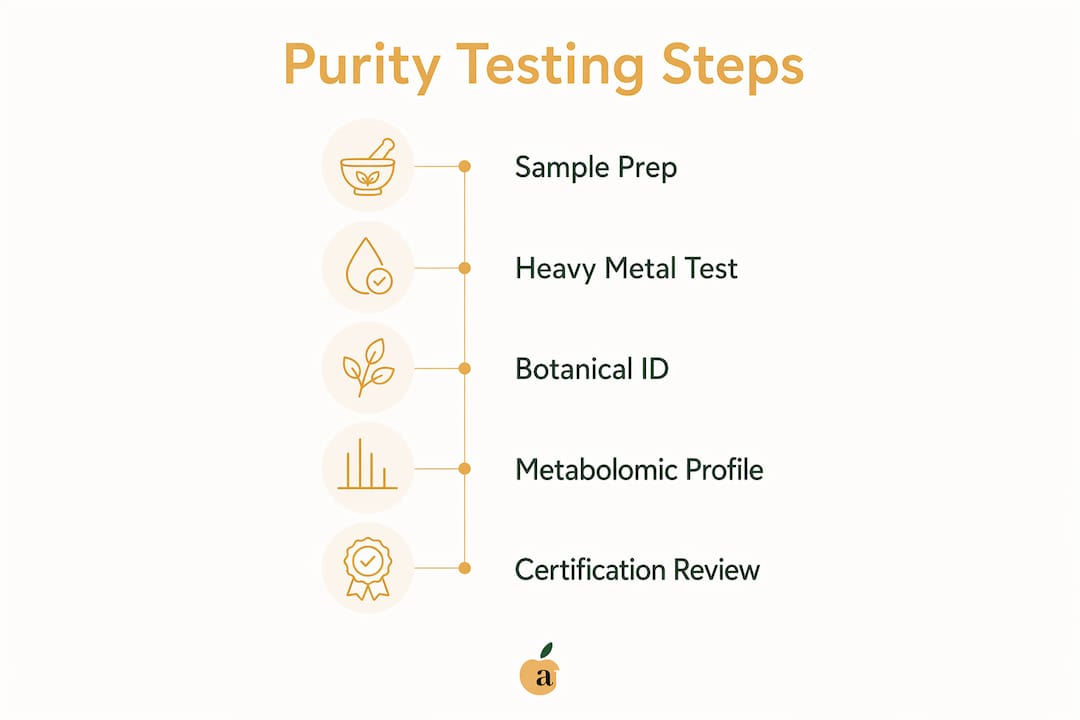
Modern purity testing goes far beyond a basic visual check or a single chemical assay. Three distinct layers of analysis now define what rigorous quality assurance looks like for botanical products.

Heavy metal testing with ICP-MS
ICP-MS is the industry standard for detecting individual heavy metals in botanical ingredients, replacing older total aggregate methods that could mask dangerous spikes in a single element. USP chapters 232 and 233 require elemental-specific limits for lead, arsenic, cadmium, and mercury. That matters because a product could pass an aggregate test while still containing a toxic concentration of a single metal. Roots in particular accumulate heavy metals from polluted soils, which is why elemental-specific testing is non-negotiable for ingredients like burdock root or dandelion root.
Botanical identity: HPTLC, HPLC, and DNA barcoding
Confirming that a capsule actually contains the plant on the label requires more than one method. HPTLC (High Performance Thin Layer Chromatography) produces a visual chemical fingerprint of the botanical. HPLC (High Performance Liquid Chromatography) quantifies specific marker compounds. DNA barcoding confirms the species at a genetic level. Synthetic marker spiking can pass single-compound assays while hiding substitution or adulteration in the underlying plant material. Combining HPTLC fingerprinting with DNA barcoding closes that gap.
Metabolomic profiling: the next standard
Untargeted metabolomic profiling captures the full chemical pattern of a botanical rather than measuring a single marker. It uses multivariate analyses such as Principal Component Analysis to compare a sample against the known chemical space of an authentic botanical. This method catches adulteration and engineered products that are specifically designed to pass simpler tests. Analytical methods are shifting from single-marker to whole-pattern approaches precisely because adulteration has become more sophisticated.
Pro Tip: When reviewing a brand’s testing claims, ask specifically whether they use ICP-MS for heavy metals and HPTLC or DNA barcoding for identity. Vague references to “lab tested” without naming the method are a red flag.
| Testing method | What it detects | Why it matters |
|---|---|---|
| ICP-MS | Individual heavy metals (lead, arsenic, cadmium, mercury) | Prevents toxic spikes masked by aggregate tests |
| HPTLC / HPLC | Chemical fingerprint and marker compound levels | Confirms botanical identity and potency |
| DNA barcoding | Species-level genetic identity | Catches plant substitution and mislabelling |
| Metabolomic profiling | Full chemical pattern of the botanical | Detects sophisticated adulteration |
How do manufacturing quality and certifications affect purity?
Supplement quality depends on two distinct factors: the quality of the raw ingredient itself, and the quality of the manufacturing process that turns it into a finished product. The second factor is invisible without independent verification. A manufacturer can self-declare GMP (Good Manufacturing Practice) compliance without any external audit. That self-declaration carries no independent weight.
Third-party certification changes this entirely. Organisations such as USP and NSF International send auditors into facilities, test finished products, and verify that what is on the label matches what is in the capsule.
- USP Verified: USP conducts rigorous audits covering identity, potency, purity, performance, and manufacturing quality. USP is the gold standard referenced by the FDA itself.
- NSF Certified for Sport: Covers contamination testing and label accuracy, widely used for sports and health supplements.
- Independently certified GMP: Means a third party has physically audited the facility, not just reviewed paperwork.
Third-party testing verifies label claims and contaminant limits, but it does not certify that an ingredient will produce a specific health outcome. That distinction matters. Certification tells you the product is what it claims to be. It does not replace clinical evidence for efficacy.
Pro Tip: Check whether a brand’s GMP claim is self-declared or independently certified. Look for the certifying body’s name and logo, not just the phrase “GMP compliant.”
You can also learn more about why clean supplements outperform their synthetic counterparts when manufacturing quality is genuinely controlled.
What are the common contamination and adulteration risks?
Contamination in herbal supplements takes several forms, and each requires a different control measure.
Heavy metal accumulation is the most consistent risk in root-based botanicals. Plants absorb metals from the soil, and roots concentrate them more than aerial parts. Soil pollution near industrial sites or heavily farmed land raises the baseline risk significantly. This is why elemental-specific testing, not aggregate screening, is the only reliable safeguard.
Microbial contamination is harder to control through testing alone. Single batch microbial tests cannot guarantee the safety of an entire production run. Adjacent production drums can differ substantially in microbial load. This means manufacturers need robust contamination prevention systems built into the process, not just end-of-line testing.
Appearance is not a reliable quality indicator. Bright colour in herbal powders can signal under-processing that leaves pathogens like Salmonella alive. Chlorophyll is heat-sensitive, so a vivid green powder may indicate insufficient heat treatment rather than superior freshness.
Adulteration risks include:
- Synthetic marker spiking: adding isolated compounds to inflate potency readings without genuine botanical content
- Plant substitution: replacing the labelled species with a cheaper or more available relative
- Dilution: bulking out genuine botanical material with inert fillers or inferior plant matter
- Misleading extract ratios: claiming a 10:1 extract without specifying the starting material or testing the final potency
Understanding these risks is the first step toward recognising underdosed supplements before you buy them.
How can you test and verify herbal supplement purity yourself?
Consumers cannot replicate laboratory-grade testing at home. What you can do is read labels and company communications with a critical eye, and know exactly what to look for.
- Demand method-specific transparency. Brands that specify testing methodologies, lot-level testing, and provide direct contact information demonstrate higher quality standards. “Lab tested” without naming the method, the lab, or the standard used is not transparency.
- Check for named certifications. Look for USP Verified, NSF Certified, or independently certified GMP on the label. Verify the certification directly on the certifying body’s website. Logos can be copied; database entries cannot.
- Understand what ISO certification means for labs. An ISO-certified lab does not automatically mean all its test methods are ISO-validated. Ask whether the specific method used for your supplement is itself ISO-certified, not just the facility.
- Request a Certificate of Analysis (CoA). A genuine CoA shows the specific batch number, the tests performed, the methods used, and the results. Refuse to accept a generic CoA that lacks batch-specific data.
- Spot red flags quickly. Avoid products with vague claims such as “all-natural,” “pure,” or “premium” without supporting documentation. No filler claims mean nothing without a full ingredient declaration and third-party verification.
Pro Tip: Contact the manufacturer directly and ask which third-party lab tested the specific batch you are buying. A quality brand will answer this question without hesitation. Silence or deflection is your answer.
For a practical framework on evaluating supplement quality before purchasing, independent guides can help you build a consistent checklist. You can also cross-reference against advice on avoiding fake supplements to sharpen your eye for deceptive labelling.
Key takeaways
Herbal supplement purity requires elemental-specific testing, independently certified manufacturing, and transparent lot-level documentation to be meaningful.
| Point | Details |
|---|---|
| ICP-MS is the gold standard | USP 232/233 require elemental-specific heavy metal limits, not aggregate totals. |
| Self-declared GMP is not enough | Only independently audited GMP certification confirms manufacturing controls are real. |
| Appearance deceives | Bright colour in herbal powders can signal under-processing, not superior quality. |
| Batch testing has limits | Single batch microbial results do not guarantee safety across an entire production run. |
| Transparency is the clearest signal | Brands that name their methods, labs, and batch numbers are the ones worth trusting. |
Why purity claims need more scrutiny than most buyers give them
I have spent years reviewing supplement labels, and the single most consistent problem is not outright fraud. It is the gap between what a brand implies and what its testing actually proves. A product can carry the phrase “third-party tested” and still have been tested only for one contaminant, by a lab whose specific methods are not ISO-validated, on a single batch that does not represent ongoing production.
The advance of metabolomic profiling is genuinely exciting because it makes sophisticated adulteration much harder to hide. But it also means the bar for what counts as “rigorous testing” has moved. Buyers who learned to look for HPLC results five years ago now need to understand why a metabolomic fingerprint provides stronger assurance.
My honest view is that most people focus too much on the ingredient name and too little on the manufacturing story behind it. A high-potency burdock root extract means nothing if the facility producing it has never been independently audited. The plant-based supplement benefits you are paying for only materialise when the ingredient is genuinely what the label says it is, at the potency stated, free from contaminants.
Prioritise brands that publish their CoAs, name their certifying bodies, and answer direct questions about batch-specific testing. That is not a high bar. It is the minimum standard for any product you are putting into your body.
— Jade
Vitaminb17 and the standard for pure herbal supplements
Vitaminb17 produces high-potency herbal extracts with no fillers, no binders, and no synthetic additives. Every product in the range is built around raw, clean ingredients: apricot kernels, burdock root, dandelion root, mullein leaf, and more.

If you want to know whether the supplement you are buying is genuinely pure or just marketed that way, start with Vitaminb17’s detailed buyer’s guide to underdosed supplements. It covers exactly what to look for on labels and in CoAs. For those building a broader natural health routine, the natural supplement absorption guide explains how purity directly affects how much of an ingredient your body actually uses.
FAQ
What does herbal supplement purity mean?
Herbal supplement purity means the product is free from harmful contaminants such as heavy metals and microbes, and contains the authentic botanical ingredients stated on the label at the declared potency.
What is the best test for heavy metals in herbal supplements?
ICP-MS (Inductively Coupled Plasma Mass Spectrometry) is the current industry standard. USP chapters 232 and 233 require elemental-specific limits for lead, arsenic, cadmium, and mercury rather than aggregate totals.
Does third-party certification guarantee a supplement works?
No. Third-party certification from bodies such as USP or NSF verifies identity, potency, purity, and manufacturing quality. It does not certify that an ingredient will produce a specific health outcome.
How can I verify a supplement’s purity before buying?
Request a batch-specific Certificate of Analysis, check for named third-party certifications on the certifying body’s database, and confirm the testing methods used are named explicitly rather than described vaguely as “lab tested.”
Is a bright colour a sign of a high-quality herbal powder?
No. Bright colour in herbal powders can indicate under-processing that leaves pathogens alive. Chlorophyll is heat-sensitive, so vivid colour may signal insufficient heat treatment rather than superior freshness or potency.


