

A food-grade herbal supplement is a plant-derived product regulated as food rather than medicine, meaning it must meet food safety standards but is not required to prove medicinal effects or consistent potency. The term “food-grade” is an informal descriptor; the recognised industry classification is “food supplement,” governed in the UK by the Food Supplements (England) Regulations 2003 and overseen by the Food Standards Agency. Regulatory bodies including the European Food Safety Authority (EFSA), the US Food and Drug Administration (FDA), and the UK Traditional Herbal Registration (THR) scheme each apply different rules, but all treat these products primarily as food. Understanding this distinction is the first step to using herbal supplements wisely. Vitaminb17 builds its entire range on this principle: pure, raw extracts with no fillers or binders, designed for people who want clean supplementation without compromise.
What is a food-grade herbal supplement and how is it regulated?
Food-grade herbal supplements are regulated under general food laws and do not require clinical efficacy trials before reaching the market. That single fact separates them from pharmaceutical products, which must pass rigorous clinical testing before a regulator approves them for sale.
The FDA classifies herbal supplements as food, not medicine. This means no efficacy proof is required before a product goes on sale. A manufacturer can market a supplement without demonstrating it works, provided it does not make explicit disease-treatment claims.
EFSA takes a similar position in Europe. The authority places the burden of safety on the food business operator, not the regulator. Manufacturers must show their product is safe to consume, but they are not required to prove it delivers specific physiological effects or prevents disease.
In the UK, the THR scheme offers a middle ground for traditional herbal medicines. Products registered under THR carry a yellow logo and are assessed for safety and quality, though still not for clinical efficacy. Most everyday herbal capsules, teas, and tinctures sold in health shops sit outside THR and are simply food supplements.
Pro Tip: When you buy a herbal supplement in the UK, check whether it carries a THR registration number. If it does, it has passed a safety and quality review. If it does not, it is sold purely as a food product.
How do food-grade supplements differ from pharmaceutical-grade ones?
The core difference is purity. Food-grade supplements contain 80%–95% active ingredient, with the remainder made up of natural impurities, fillers, or processing residues. Pharmaceutical-grade products must exceed 99% purity. That gap directly affects how consistent each dose is.
Manufacturing standards also diverge sharply. Food supplements are produced under food safety rules, which focus on hygiene and contamination prevention. Pharmaceutical manufacturing follows Good Manufacturing Practice (GMP) guidelines, which include batch testing, validated equipment, and documented quality controls at every stage.
The table below summarises the key differences.
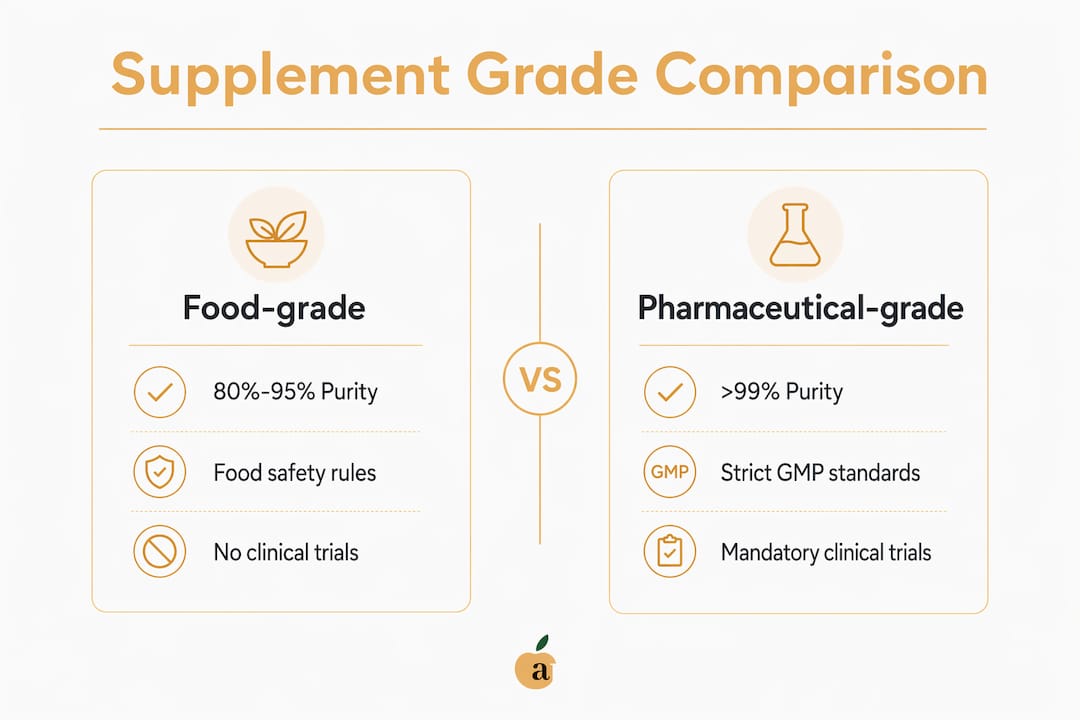
| Feature | Food-grade supplement | Pharmaceutical-grade supplement |
|---|---|---|
| Purity of active ingredient | 80%–95% | 99%+ |
| Regulatory framework | Food safety law | Medicines regulation |
| Clinical efficacy trials required | No | Yes |
| Manufacturing standard | Food GMP | Pharmaceutical GMP |
| Prescription required | No | Often yes |
| Pre-market safety review | Manufacturer’s responsibility | Regulator-approved |
The absence of clinical trial requirements for food-grade products has a practical consequence. Potency can vary between batches, and absorption rates are not standardised. This is why label claims on food supplements often read “contributes to normal function” rather than “treats” or “cures.”
Pro Tip: Look for supplements that use standardised extracts. A standardised extract guarantees a fixed percentage of the key active compound in every capsule, which is the closest a food-grade product can get to pharmaceutical consistency.
What are the safety risks and common misconceptions?
Natural origin does not guarantee safety. This is the single most persistent misconception in the herbal supplement market, and it causes real harm when people self-medicate without professional guidance.
Herbal ingredients can alter drug metabolism, particularly for SSRIs and blood thinners. St. John’s wort, for example, is widely sold as a food supplement for mood support, yet it is a known inducer of cytochrome P450 enzymes. That means it can reduce the effectiveness of contraceptive pills, anticoagulants, and certain HIV medications.
Common safety risks with food-grade herbal supplements include:
- Drug interactions: Herbs such as St. John’s wort, garlic, and ginkgo biloba can interfere with prescription medicines.
- Underdosing or overdosing: Variable purity between 80% and 95% means the actual dose you receive can differ from the label claim.
- Contamination: Food-grade manufacturing does not require the same contamination controls as pharmaceutical production.
- Allergic reactions: Plant-based products can trigger reactions, particularly in people with pollen or food allergies.
- Cumulative effects: Taking multiple supplements simultaneously can create unintended interactions, even between herbal products.
Experts stress that natural products do not replace prescription medicines and that the best foundation for health remains a balanced lifestyle. Supplements support that foundation; they do not substitute for it.
“The responsibility for the safety of food supplements lies with the food business operator. The ‘food-grade’ classification confirms a product is safe for consumption, but it does not guarantee specific physiological effects or disease prevention.”
— European Food Safety Authority (EFSA)
For a clear breakdown of why clean formulations matter, the Vitaminb17 guide on clean versus synthetic supplements explains the evidence in plain terms.
What benefits can food-grade herbal supplements realistically offer?
Herbal supplements can deliver genuine support for general wellness, provided you hold realistic expectations. The key word is “support.” These products are not treatments. They are concentrated sources of bioactive plant compounds that interact with normal physiological processes.
Herbs are antioxidant sources that neutralise free radicals, which contribute to cellular oxidative stress. Reducing oxidative stress is associated with supporting cardiovascular health and moderating inflammatory responses. This is a plausible mechanism, not a guaranteed clinical outcome.
The most realistic benefits you can expect from quality food-grade herbal supplements are:
- Antioxidant support: Compounds in herbs such as turmeric, ginger, and rosemary scavenge free radicals and may reduce markers of oxidative stress.
- Digestive comfort: Herbs including peppermint, fennel, and dandelion root have a long history of use for digestive support, with some clinical evidence behind them.
- Immune function: Certain botanicals, including elderberry and echinacea, show modest evidence for supporting normal immune responses during seasonal changes.
- Mood and cognitive support: Hypericin in St. John’s wort has shown results comparable to some SSRIs for moderate depression in controlled trials, though this also explains its drug interaction risk.
- Mineral and micronutrient delivery: Sea kelp, for instance, is a natural source of iodine, which supports normal thyroid function.
The quality of the supplement determines how much of this potential you actually access. A product with 80% active ingredient purity and poor absorption will deliver less benefit than a standardised extract with no fillers. Vitaminb17’s plant-based supplement range uses high-potency extracts specifically to close that gap.
How to choose and use food-grade herbal supplements wisely
Reading the label is your first quality check. A trustworthy supplement lists the exact botanical name, the plant part used (root, leaf, seed), the extract ratio or standardisation percentage, and the amount per serving in milligrams. If any of these are absent, treat the product with caution.
Recognising an underdosed product is a skill worth developing. Many budget supplements list impressive-sounding doses but use low-concentration raw powder rather than a concentrated extract. A buyer’s guide to underdosed supplements walks through exactly what to look for on the label.
Practical steps for safe and effective use:
- Consult a healthcare provider before starting any herbal supplement, especially if you take prescription medicines or have a chronic health condition.
- Start with one supplement at a time so you can identify any reaction clearly before adding another.
- Take fat-soluble herbal compounds with a meal containing healthy fats to improve absorption. Curcumin from turmeric is a clear example.
- Cycle your supplements where appropriate. Continuous use of some herbs, such as valerian or echinacea, may reduce their effectiveness over time.
- Source from reputable suppliers who provide third-party testing certificates or clear standardisation data on their labels.
Pro Tip: If you plan to take more than two herbal supplements together, check the Vitaminb17 guide on stacking herbal supplements before you start. Certain combinations amplify effects; others cancel them out.
For a broader view of herbal supplement examples and how they fit into a wellness routine, independent consumer resources can help you compare options without bias.
Are food-grade herbal supplements suitable for everyone?
Food-grade herbal supplements are not universally appropriate. Certain groups carry a higher risk of adverse effects and should seek professional advice before use.
Pregnant and breastfeeding women face the greatest uncertainty. Most herbal supplements have not been tested in pregnancy, and some, including blue cohosh and pennyroyal, carry known risks. Children’s metabolic rates differ from adults, so adult doses are inappropriate and some herbs are contraindicated entirely.
People managing chronic conditions such as diabetes, hypertension, or autoimmune disorders need particular caution. Herbal ingredients can interact with blood thinners, SSRIs, and immunosuppressants in ways that are clinically significant. A supplement that is safe for a healthy adult may be dangerous for someone on warfarin.
That said, food-grade supplements can be preferable to pharmaceutical alternatives in specific contexts. For general wellness support, antioxidant intake, or mild digestive comfort, a clean herbal supplement carries fewer side effects than a synthetic drug and is accessible without a prescription. The Dietary Supplement Health and Education Act of 1994 in the US, and equivalent UK food supplement regulations, allow over-the-counter access precisely because these products are considered safe for general consumption at labelled doses.
The key is matching the supplement to the person, not assuming one product suits all.
Key takeaways
Food-grade herbal supplements are classified as food, not medicine, which means they are safe for general consumption but are not required to prove clinical efficacy or deliver pharmaceutical-grade purity.
| Point | Details |
|---|---|
| Regulatory classification | Food supplements are governed by food safety law, not medicines regulation, in the UK and EU. |
| Purity gap | Food-grade products contain 80%–95% active ingredient versus 99%+ for pharmaceutical-grade. |
| Safety is not guaranteed by nature | Herbal ingredients can interact with prescription drugs, including SSRIs and blood thinners. |
| Benefits are real but limited | Antioxidant support, digestive comfort, and immune function are realistic outcomes; disease treatment is not. |
| Label literacy matters | Check for botanical name, plant part, extract ratio, and standardisation percentage before buying. |
Why I think most people misread the food-grade label
After years of watching the supplement market, the pattern I see most often is this: people read “food-grade” and assume it means “safe for anything.” It does not. It means safe for general consumption at labelled doses, full stop.
The regulatory gap between food and pharmaceutical classification is wider than most shoppers realise. A product can sit on a health shop shelf with no clinical evidence behind it whatsoever, and that is entirely legal. EFSA’s position is clear: safety is the manufacturer’s responsibility, not a regulator’s endorsement of efficacy. That shifts the burden onto you as the buyer.
What I have found actually works is treating herbal supplements the way you would treat any concentrated plant extract: with respect for dose, timing, and interactions. The people who get the most from them are those who choose standardised extracts, avoid stacking too many at once, and check with a GP when they are on other medications.
The herbal supplement market has genuine value. Antioxidant-rich botanicals, well-dosed mineral sources like sea kelp, and traditional extracts with centuries of use behind them are worth taking seriously. But that value only materialises when you choose quality products and use them with clear eyes. Informed use is the only kind that works.
— Jade
Vitaminb17 and your herbal supplement choices
Choosing the right herbal supplement starts with knowing what is actually in the capsule.

Vitaminb17 produces high-potency herbal extracts with no fillers, no binders, and no synthetic additives. Every product uses standardised extracts to deliver consistent active ingredient levels, which closes the purity gap that affects most food-grade products. Whether you are looking at Burdock Root Capsules for traditional herbal support or want to understand how to avoid fake supplements before you buy, quality information and clean products go together. Visit Vitaminb17 to read the underdosed supplement buyer’s guide and find products that match what the label actually says.
FAQ
What does food-grade mean for herbal supplements?
Food-grade means a supplement is regulated under food safety law rather than medicines regulation. It confirms the product is safe for general consumption but does not verify its health benefits or clinical efficacy.
How does food-grade purity compare to pharmaceutical-grade?
Food-grade supplements contain 80%–95% active ingredient, while pharmaceutical-grade products must exceed 99% purity. The difference affects dose consistency and absorption.
Are herbal supplements safe to take with prescription medicines?
Not always. Herbal ingredients such as St. John’s wort and ginkgo biloba can interact with SSRIs, blood thinners, and contraceptives. Always consult a healthcare provider before combining herbal supplements with prescription drugs.
Do food-grade herbal supplements need to prove they work?
No. The FDA and EFSA do not require food supplements to prove efficacy before sale. Manufacturers must show safety, not effectiveness.
Who should avoid food-grade herbal supplements?
Pregnant women, breastfeeding mothers, children, and people with chronic conditions or on prescription medicines should seek professional advice before taking herbal supplements. Individual health status determines suitability.


