

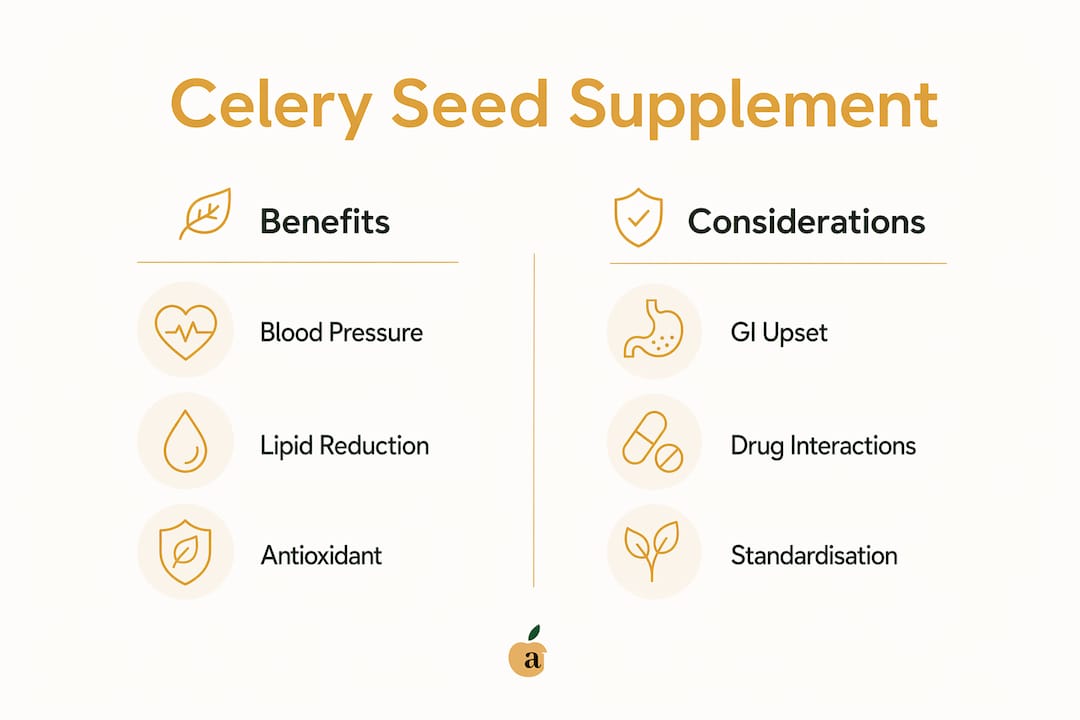
Celery seed supplements can modestly lower blood pressure and support certain metabolic markers, but the human evidence is still early-stage. A 12-week randomised trial found that 150 mg/day of an NBP-standardised extract reduced systolic blood pressure from 121.0 to 115.7 mmHg and diastolic from 82.2 to 78.5 mmHg, alongside falls in triglycerides and uric acid. A 2025 pharmacological review covering 62 studies identifies 3-n-butylphthalide (3nB), luteolin and apigenin as the key active compounds driving those effects. Worth taking? Yes, cautiously, if you choose a standardised extract, keep doses within studied ranges, and get the green light from a GP or pharmacist first.
- Celery seed benefits are most clearly seen in blood pressure, triglycerides and uric acid in short-term trials.
- The active compound to look for on a label is 3-n-butylphthalide (3nB or NBP), ideally with a declared percentage.
- If you take levothyroxine or any antihypertensive, speak to a pharmacist before starting.
- Vitaminb17 offers standardised celery seed capsules as a clean, filler-free option for UK shoppers.
Pro Tip: Look for “standardised extract” plus a declared NBP percentage on the label. A product that lists only “celery seed powder” gives you no guarantee of active-compound content.
Table of Contents
- What is celery seed and what are the active compounds?
- What does the research actually show?
- Safety, side effects and drug interactions you must know
- Forms, typical study doses and how cooking differs from supplementing
- How to choose a quality celery seed supplement in the UK
- When should you speak to a GP or pharmacist?
- Key takeaways
- A considered view on herbal supplement quality
- Why standardisation is the only thing that matters when buying celery seed
- Vitaminb17 celery seed capsules: clean, standardised, clearly dosed
- Further reading and sources
What is celery seed and what are the active compounds?
Celery seed comes from Apium graveolens, the same plant that produces the familiar salad vegetable, but the seed and the stalk are nutritionally quite different. The seeds are tiny, brown, and intensely aromatic. Culinary use means a pinch in a dressing or a pickle brine. A supplement extract is a concentrated form, often many times stronger than anything you would eat.
Common supplement forms:
- Whole seed / ground powder — lowest concentration; useful in cooking but not equivalent to a clinical dose.
- Essential oil — highly concentrated volatile compounds; not for internal use without professional guidance.
- Standardised extract capsule — the form used in clinical trials; declares a specific NBP or phthalide percentage per serving.
- Non-standardised extract — potency varies batch to batch; harder to dose reliably.
The pharmacological review identifies three major bioactives: 3-n-butylphthalide (3nB/NBP), the phthalide class broadly, and the flavonoids luteolin and apigenin. NBP is the compound most consistently linked to blood-pressure and lipid effects. When a label declares “standardised to 85% NBP,” it means the manufacturer has verified that concentration in every batch, which is why standardisation matters for repeatable results. Without it, two capsules from different brands could deliver wildly different amounts of active compound.
What does the research actually show?
The evidence base is promising but limited. Here is an honest summary.
| Claimed benefit | Evidence type | Key finding | Limitation |
|---|---|---|---|
| Blood pressure reduction | Human RCT (12 weeks) | The study reported statistically significant reductions in systolic and diastolic blood pressure at 150 mg/day NBP extract | Small sample; single trial |
| Triglyceride and VLDL reduction | Same RCT | Statistically significant reductions in triglycerides and VLDL were observed alongside blood pressure improvements | Short duration; one population |
| Uric acid reduction (gout support) | Same RCT | The study found a reduction in serum uric acid levels | Needs replication in gout-specific trials |
| Anti-inflammatory / antioxidant | Preclinical and in vitro | Consistent mechanistic evidence | Limited large human trials |
| Hepatoprotective effects | Animal and in vitro | Positive signals | No robust human RCT yet |
The pharmacological review calls for larger, standardised RCTs across all these areas. The antioxidant and anti-inflammatory mechanisms are well characterised in the lab, but translating that into confirmed human outcomes takes time. For blood pressure and lipids, the human data is the strongest available, though still based on small studies. For gout, the uric acid finding is encouraging; it is not yet proof of clinical gout prevention.
The honest takeaway: celery seed extract is not a replacement for prescribed medication, but it shows genuine pharmacological activity at studied doses.
Safety, side effects and drug interactions you must know
This is the section to read carefully before you buy anything.
Key cautions:
- Pregnancy and breastfeeding — avoid medicinal doses; culinary amounts in food are generally considered safe, but concentrated extracts are not.
- Apiaceae family allergy — celery belongs to the same plant family as carrots, parsley and fennel. Cross-reactivity is real; anyone with a known allergy to these plants should not take celery seed supplements.
- Photosensitivity — psoralen compounds in celery can increase skin sensitivity to sunlight.
- Renal inflammation — high-potency extracts carry label warnings about kidney inflammation; avoid if you have existing kidney disease.
Drug interactions to flag with your pharmacist:
- Levothyroxine — celery seed may affect thyroid hormone absorption or metabolism.
- Antihypertensives — the hypotensive effect of celery seed combined with prescribed blood-pressure medicines can push blood pressure dangerously low; monitoring is not optional.
- Lithium — celery seed has diuretic properties that may raise lithium levels in the blood.
- Anticoagulants — potential interaction with blood-thinning medicines; report any unexpected bruising.
- CYP pathway drugs — some evidence suggests phthalides may influence liver enzyme pathways; relevant if you take complex polypharmacy.
Common adverse effects include mild gastrointestinal upset and increased urination, both of which tend to settle when the supplement is taken with food.
Pro Tip: If you are on any prescribed medicine, take the product label to your pharmacist before starting. A five-minute conversation can prevent a serious interaction.
Forms, typical study doses and how cooking differs from supplementing
The gap between a culinary pinch and a clinical dose is large. Healthline notes that the benefits seen in studies are typically based on concentrated extracts, not the amounts you would sprinkle into a salad dressing.
Clinical doses cited in trials: 150 mg/day of an NBP-standardised extract (as used in the MDPI RCT). Other cited doses may vary, but the most robust human evidence is based on this amount.
Practical guidance:
- Always follow the dose on your specific product label; extract concentration varies significantly between brands.
- Take capsules with food to reduce gastrointestinal discomfort, as manufacturer guidance consistently advises.
- Never take celery essential oil by mouth; it is not a substitute for an encapsulated extract.
- Capsule formats offer more consistent dosing than loose powder.
For cooking, whole seeds are best ground before use to avoid a gritty texture. One important note: celery seed and celery salt are not interchangeable in recipes without altering the dish’s sodium content, since celery salt contains added salt.
How to choose a quality celery seed supplement in the UK
Most products on the UK market are not created equal. Here is what separates a reliable supplement from a poorly labelled one.
Buyer checklist:
- Standardised extract with declared NBP % — the label should state the percentage of 3-n-butylphthalide or NBP mg per capsule, not just “celery seed extract.”
- Clear dose per serving — mg per capsule and servings per day must be stated.
- Third-party testing / Certificate of Analysis (COA) — an independent lab verifies potency and purity; ask the retailer or check the brand’s website.
- GMP manufacturing — Good Manufacturing Practice certification means the facility meets quality standards.
- No fillers, binders or synthetic additives — a clean ingredient list is a basic quality signal.
- Single-ingredient formula — single-ingredient supplements make it easier to attribute effects and adjust dose without interference from other compounds.
In the UK, reputable online health retailers and specialist supplement brands are the most reliable sources. Avoid products that list only “celery seed” with no extract ratio or standardisation claim; these are almost certainly underdosed. Understanding how to spot underdosed products is one of the most practical skills a supplement buyer can develop.
Pro Tip: Request a COA before purchasing from any brand you have not used before. A brand that cannot supply one is a brand to avoid.
When should you speak to a GP or pharmacist?
Some situations make professional advice non-negotiable, not just advisable.
Consult immediately if you:
- Are pregnant or breastfeeding.
- Have a planned surgical procedure (celery seed may affect bleeding and blood pressure under anaesthesia).
- Have a bleeding disorder or are taking anticoagulants.
- Have existing low blood pressure (hypotension) or kidney disease.
- Have a known allergy to any Apiaceae family plant.
Consult before starting if you take:
- Levothyroxine or any thyroid medication.
- Any prescribed antihypertensive.
- Lithium.
- Multiple medicines (polypharmacy increases interaction risk).
Monitoring guidance: If your GP approves use alongside antihypertensives, check your blood pressure regularly. Report dizziness, unexpected rash or bruising promptly. These are the three symptoms most likely to signal an interaction worth investigating.
Key takeaways
Celery seed extract shows genuine, evidence-backed potential for modest blood pressure and lipid reduction, but the human trial base remains small and standardised extracts are the only form worth buying.
| Point | Details |
|---|---|
| Blood pressure and lipid effects | A 12-week RCT found SBP fell from 121.0 to 115.7 mmHg and DBP from 82.2 to 78.5 mmHg at 150 mg/day NBP extract. |
| Evidence is promising but limited | The 2025 pharmacological review of 62 studies calls for larger, standardised RCTs before firm conclusions can be drawn. |
| Safety and interactions | Avoid during pregnancy; flag levothyroxine, antihypertensives, lithium and anticoagulants with a pharmacist before use. |
| Buying standard | Choose standardised extracts with a declared NBP percentage, a COA, GMP manufacturing and no fillers. |
| Vitaminb17 option | Vitaminb17’s celery seed capsules are standardised, filler-free and clearly dosed, matching the checklist above. |
A considered view on herbal supplement quality
Why standardisation is the only thing that matters when buying celery seed
The supplement market is full of products that gesture at clinical evidence without actually delivering the doses those trials used. A bottle labelled “celery seed” with no extract ratio, no NBP percentage and no COA is not the product studied in the MDPI trial. It is something else entirely, and you have no way of knowing what.
The clinical data for celery seed is genuinely interesting. A statistically significant blood-pressure reduction in a double-blind RCT is not nothing. But that result was achieved with a specific extract standardised to 85% NBP at 150 mg/day. Buying a non-standardised powder and expecting the same outcome is wishful thinking.
At Vitaminb17, the selection criteria start with standardisation and third-party testing. A product either declares its active-compound content or it does not get listed. That is not a marketing position; it is the only way to connect a product to the evidence that justifies recommending it.
Vitaminb17 celery seed capsules: clean, standardised, clearly dosed
If you have read this far, you know what a quality celery seed supplement looks like: standardised extract, declared NBP potency, no fillers, no binders, GMP manufacturing, and a COA available on request.

Vitaminb17’s celery seed extract capsules are built to exactly those criteria. Pure. Raw. No synthetic additives. The capsule format delivers consistent dosing without the guesswork of loose powder, and the 8,000 mg equivalent potency is clearly stated on the label. Take one capsule with food, as the evidence and manufacturer guidance both recommend, and keep your GP informed if you are on any prescribed medicine.
Not sure whether a single-ingredient supplement is right for you? The underdosed supplement buyer’s guide walks you through exactly what to check before you spend a penny.
This article is general information, not medical advice. Confirm current guidance with a qualified healthcare professional or pharmacist for your own situation.
Further reading and sources
- Effect of Celery Seed Administration on Components of Metabolic Syndrome — the primary 12-week RCT; cite for blood pressure, lipid and uric acid data.
- A Narrative Pharmacological Review of Celery Seed — 2025 review of 62 studies; cite for mechanism and bioactive compound identification.
- WebMD: Celery overview, interactions and safety — primary safety and drug interaction reference.
- Healthline: 6 surprising benefits of celery seeds — useful for culinary versus supplement dose contrast.
- Verywell Health: What happens when you take celery seed — dosing examples and safety caveats.
- Serious Eats: How to use celery seeds — culinary guidance and the celery seed versus celery salt distinction.


