

Celery seed is safe in food amounts for almost everyone. In supplement or medicinal doses, though, it carries specific risks you need to know before you swallow a capsule: allergic reactions, sun sensitivity, blood pressure changes, and pregnancy warnings top the list.
Clinical trials on standardised extracts have reported good short-term tolerability, but the evidence base is still young and long-term safety data remain limited. Here is what matters most, right now:
- Allergic reactions — from mild oral itching to, rarely, anaphylaxis, especially if you react to birch pollen, mugwort, or certain spices.
- Photosensitivity — celery seed extracts and oils can make skin more reactive to sunlight, raising burn and rash risk.
- Blood pressure and fluid balance effects — the same mechanism that helps hypertension in trials can cause dizziness or interact with blood pressure medication.
- Pregnancy and uterine stimulation — medicinal amounts are widely considered unsafe in pregnancy due to a possible miscarriage risk.
Trials using 1.34 g/day celery seed extract for 4 weeks found no significant increase in side effects versus placebo. That is reassuring, but small sample sizes mean rare reactions could easily be missed.
Key Takeaways
Celery seed is generally safe in food amounts, but concentrated supplements demand real caution around allergy risk, blood pressure medication, and pregnancy.
| Point | Details |
|---|---|
| Allergy risk is real | Cross-reactivity with birch pollen, mugwort, and certain spices can trigger anything from oral itching to anaphylaxis. |
| Pregnancy is a hard no | Medicinal doses of celery seed are considered unsafe in pregnancy due to uterine stimulation risk. |
| Trial doses run high | Clinical trials used 1.34 g/day extract; doses above 1,000 mg/day showed the strongest, and riskiest, effects. |
| Interactions are wide-ranging | Anticoagulants, antihypertensives, lithium, and thyroid medication all carry documented interaction concerns. |
| Standardisation reduces uncertainty | Vitaminb17’s celery seed capsules are standardised and filler-free, matching the dosing consistency used in trial research. |
Table of Contents
- What is celery seed and why do people take it?
- What are the common celery seed side effects?
- Which medications interact with celery seed?
- Is celery seed safe during pregnancy or breastfeeding?
- Who should avoid celery seed and what are the warning signs?
- How much celery seed do people actually take?
- How can you reduce your risk when taking celery seed?
- What does the research actually say about celery seed?
- What should you do if you experience side effects?
- Where Vitaminb17 stands on celery seed safety
- Choosing a celery seed supplement without the guesswork
- Frequently asked questions about celery seed side effects
- Sources
What is celery seed and why do people take it?
Celery seed comes from Apium graveolens, the same plant family as the celery stalk you’d chop into a soup. The seed itself is far more concentrated than the vegetable, and it turns up in three main supplement formats: dried seed powder, standardised extract capsules, and celery seed oil.
People take it for traditional reasons, mostly linked to joint comfort and mild fluid retention, and increasingly for its studied effect on blood pressure. A randomised, triple-blind, placebo-controlled trial found meaningful blood pressure reductions using a standardised extract, and a companion safety-focused study reported good tolerability at the same dose. Those trials are a teaser for the fuller evidence picture later in this article, not the whole story.
Here is the distinction that actually matters for safety: a stick of celery and a celery seed capsule are not the same exposure.
- Culinary use: seeds sprinkled in cooking, salt blends, or pickling. Minimal concentration, minimal risk.
- Supplement use: capsules or tinctures delivering a standardised, measured dose of active plant compounds.
- Medicinal/trial doses: concentrated extracts, often exceeding 1,000 mg per day, used specifically to test therapeutic effects.
Pro Tip: Concentration is everything with herbal extracts. A pinch of celery seed in a stew and a standardised 1,000mg extract capsule are worlds apart in strength, and worlds apart in the caution they demand.
What are the common celery seed side effects?
Most people who try celery seed supplements at sensible doses tolerate them well. Trial data backs that up. But “well tolerated” doesn’t mean “risk-free,” and the side effect profile ranges from mildly annoying to genuinely urgent.
Mild and common effects
These show up most often in early use, particularly before your body adjusts to a new extract:
- Stomach upset — bloating, mild cramping, or a heavy feeling after taking the capsule.
- Nausea — usually transient, often linked to taking supplements on an empty stomach.
- Diarrhoea or loose stools — more common with higher-strength extracts.
- Dizziness — can be linked to celery seed’s mild effect on blood pressure, discussed further below.
Allergic reactions: the risk people underestimate
This is the side effect category that catches people off guard because celery sits in a cluster of cross-reactive allergens. If you react to birch pollen, mugwort, or certain spices like caraway or fennel, you may be at risk of what allergists call the celery-carrot-mugwort-spice syndrome. This can trigger oral itching, hives, a rash, or in rare but serious cases, wheezing and anaphylaxis.

If you’ve never eaten celery and reacted, that doesn’t guarantee a supplement is safe. Concentrated extracts deliver a dose of allergenic proteins far beyond what you’d get from a stalk in a soup.
Photosensitivity: a lesser-known risk
Celery seed and celery oil contain compounds called furanocoumarins, which are known to increase skin’s sensitivity to ultraviolet light. That means sunburn can happen faster and more severely than usual, and some people develop a rash or inflammation on sun-exposed skin. Oils and concentrated extracts carry more of these compounds than food-grade seed, so the risk scales with potency. Preventing it is straightforward: cover up or apply sunscreen while using celery seed extract, particularly in summer months or if you already burn easily.
Blood pressure and bleeding risk
Celery seed’s studied ability to lower blood pressure is a benefit for some and a caution for others. If you already run low blood pressure, or you’re on medication for hypertension, adding celery seed extract could push things too far, causing dizziness, fainting, or fatigue. There’s also a possible bleeding risk flagged in clinical references, worth taking seriously if you’re on anticoagulants or antiplatelet medication, a point covered in more depth in the interactions section below.
What the trials actually show: across the 4-week randomised trial using 1.34 g/day extract, researchers found no significant difference in side effects between celery seed and placebo groups. Reassuring for short-term use, but long-term safety data remain scarce, and trial populations were small.
Pro Tip: Stop taking celery seed supplements immediately and seek medical review if you notice a new rash, difficulty breathing, fainting, or unusually heavy or unexplained bleeding. These are not “wait and see” symptoms.
Which medications interact with celery seed?
Celery seed doesn’t act in isolation once it’s in your system. It can interact with several common medication categories, sometimes amplifying an effect you want less of, sometimes blunting a drug’s clearance from your body. RxList’s clinical summary names several categories worth knowing before you combine celery seed with a prescription.
- Anticoagulants and antiplatelets (warfarin, aspirin, clopidogrel): possible increased bleeding risk.
- Antihypertensives and diuretics: additive blood pressure lowering, plus a dehydration risk when combined with celery seed’s mild diuretic action.
- Lithium: celery seed’s diuretic effect may reduce how efficiently your kidneys clear lithium, risking toxic build-up.
- Thyroid medications (levothyroxine): potential interference with absorption or metabolism.
- Sedatives: additive drowsiness when combined with celery seed, particularly at higher doses.
- Photosensitising drugs (certain antibiotics, retinoids): combined with celery seed’s own photosensitivity risk, sunburn potential compounds.
Compounds processed through the CYP1A2 liver enzyme pathway are also worth flagging with a pharmacist, since celery seed may compete for the same metabolic route and alter how quickly certain drugs clear your system.
| Drug category | Likely effect | Clinical action to take |
|---|---|---|
| Anticoagulants/antiplatelets | Increased bleeding risk | Avoid combining without clinician sign-off; stop before surgery |
| Antihypertensives/diuretics | Additive BP lowering, dehydration | Monitor BP regularly; watch for dizziness |
| Lithium | Reduced drug clearance | Avoid unless a clinician is monitoring lithium levels |
| Thyroid medication | Possible absorption interference | Separate dosing times; discuss with prescriber |
| CYP1A2-metabolised drugs | Altered drug clearance | Flag to pharmacist before starting celery seed |
| Sedatives | Additive drowsiness | Avoid combining at higher doses |
Pro Tip: When you speak to a pharmacist or GP about celery seed, bring the actual product label and describe your dose in milligrams per day rather than “a capsule” or “a few drops.” That precision is what lets them assess real risk instead of guessing.
For anyone already taking herbal or prescription support for blood pressure or circulation, it’s worth reading how different herbal extracts for blood health interact before stacking supplements together.
Is celery seed safe during pregnancy or breastfeeding?
No. Medicinal amounts of celery seed are not considered safe during pregnancy. This is one of the clearest, least ambiguous warnings in the entire celery seed safety picture, and it deserves to be treated as such.
The concern centres on uterine stimulation. Concentrated celery seed has traditionally been used to bring on menstruation, and that same mechanism raises the risk of miscarriage if taken in medicinal doses during pregnancy, a warning WebMD’s clinical overview states plainly. This isn’t a “check with your doctor first, just in case” caution. It’s a “don’t take it” caution.
High-priority risk: celery seed extract and celery oil in medicinal doses are classed as likely unsafe in pregnancy due to uterine-stimulating potential. Food amounts of celery, the stalk and small culinary seed use, are a different matter entirely and not the concern here.
Breastfeeding guidance is less dramatic but still firm: there simply isn’t enough safety data to recommend medicinal-dose celery seed while nursing. Absence of evidence isn’t evidence of safety, and until better data exists, the sensible position is to avoid concentrated extracts.
If you’re trying to conceive, the picture is murkier. Evidence on celery seed’s effect on fertility is limited, not because it’s been proven safe, but because it hasn’t been well studied either way. That gap is exactly why this is a conversation to have with a clinician before starting a course of celery seed extract, rather than a decision to make from a supplement label alone.
Who should avoid celery seed and what are the warning signs?
Some readers should skip celery seed supplements altogether, or only use them under direct clinical supervision. Working through this checklist honestly before you buy anything is worth five minutes of your time.
Avoid celery seed supplements if you are:
- Pregnant, or actively trying to conceive
- Breastfeeding, unless a clinician has specifically advised otherwise
- Allergic to celery, birch pollen, mugwort, or related spices
- Taking blood-thinning medication (anticoagulants or antiplatelets)
- Managing unstable or poorly controlled blood pressure
- Living with kidney disease, or taking lithium
- A parent considering celery seed for a child, without paediatric clinical advice
Each of these groups faces a distinct risk pathway. Kidney disease and lithium use both intersect with celery seed’s mild diuretic action, which can worsen fluid or electrolyte imbalances that are already fragile in those conditions.
Seek urgent medical care if you experience:
- Signs of anaphylaxis: swelling of the face, throat tightness, difficulty breathing
- Severe or unexplained bleeding, including blood in stool or urine
- Chest pain, alongside supplement use
- Severe dizziness, fainting, or signs of dehydration
These aren’t symptoms to monitor at home. They warrant emergency attention, not a wait-and-see approach.
How much celery seed do people actually take?
Supplement labels vary widely, which makes comparing products confusing unless you know what the underlying research actually used.
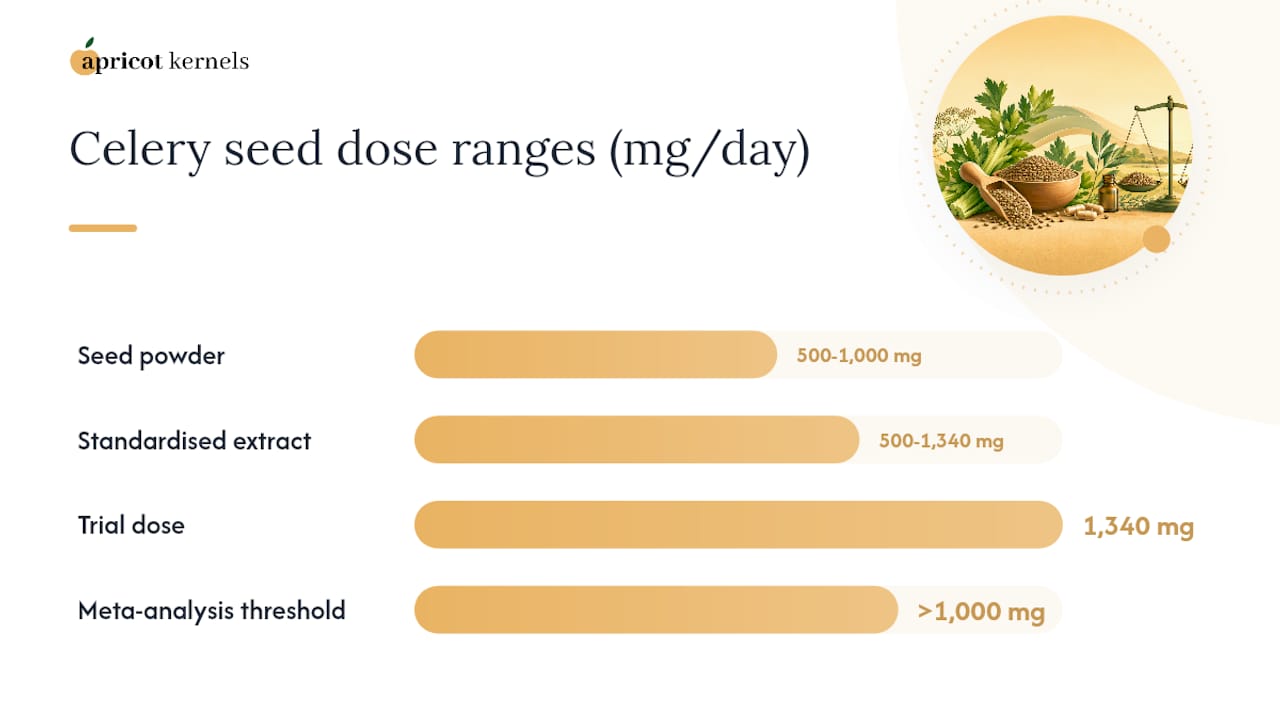
Clinical trials investigating blood pressure effects used 1.34 g (1,340 mg) per day of standardised celery seed extract, split across doses, for a four-week period. That’s the figure behind both the blood pressure trial and its companion safety study. A broader 2025 meta-analysis covering ten trials found that preparations exceeding 1,000 mg/day tended to show stronger effects, which tells you something important: the doses that work best in trials are also the doses that demand the most caution.
Standardisation matters as much as the milligram figure on the label. A standardised extract guarantees a consistent percentage of active plant constituents batch to batch, whereas an unstandardised seed powder can vary considerably depending on growing conditions and processing. That variability is exactly why quality and labelling accuracy shape both how well a product works and how predictable its side effect profile will be.
| Format | Typical supplement dose | Trial dose example | Safety notes |
|---|---|---|---|
| Seed powder (whole/ground) | 500mg to 1,000mg/day | Not typically used in major trials | Variable potency; food-first approach preferred |
| Standardised extract | 500mg to 1,340mg/day | 1.34 g/day over 4 weeks | Most trial data exists at this dose range |
| Celery seed oil | Small drop-based dosing | Rarely used in blood pressure trials | Higher photosensitising compound concentration |
Pro Tip: Read the label for the word “standardised” and a stated percentage of active constituents. A product listing only “celery seed powder 500mg” with no standardisation detail gives you far less certainty about what dose you’re actually consuming, which makes it harder to judge risk.
How can you reduce your risk when taking celery seed?
A few sensible habits sit between “trying celery seed” and “having a bad reaction to it.”
Before you start, run through the basics: speak to your GP or pharmacist, especially if you take any regular medication, and check this patient guide on supplements to avoid during immunotherapy. Check your own allergy history against birch pollen, mugwort, and related spices. If you’re pregnant, breastfeeding, or trying to conceive, don’t start without direct clinical advice.
Once you’re using it, keep the dose low to begin with, choose a standardised extract over an unlabelled powder, and avoid stacking celery seed with other blood-pressure-lowering or diuretic supplements at the same time. Monitor your blood pressure at home if you have a monitor, and pay attention to anything unusual in the first few weeks.
- Apply sunscreen or cover exposed skin while taking celery seed extract, particularly in strong sunlight.
- Stop immediately if you notice a rash, breathing difficulty, or unusual bruising or bleeding.
- Avoid celery seed for at least two weeks before any planned surgery, since it may affect bleeding and interact with anaesthesia.
Pro Tip: Keep a simple symptom log alongside a list of everything you’re taking, doses included. If you ever need a GP or pharmacist to assess a reaction, that log turns a vague conversation into a useful one.
What does the research actually say about celery seed?
The evidence base for celery seed is more substantial than many herbal supplements, but it’s still early days.
The randomised, triple-blind, placebo-controlled trial using 1.34 g/day extract for four weeks found systolic blood pressure dropped from an average of 141.2 to 130.0 mmHg, and diastolic pressure fell from 92.2 to 84.2 mmHg. Both changes were statistically significant, and the trial reported no meaningful difference in side effects compared with placebo.
Its companion safety study looked specifically at tolerability in around 51 hypertensive participants at the same dose, finding improvements in fasting blood sugar (dropping from 108.53 to 97.96 mg/dL) alongside blood pressure and lipid benefits, with no significant changes to blood counts or electrolytes.
The most comprehensive evidence comes from a 2025 systematic review and meta-analysis pooling ten randomised controlled trials and 511 participants. It found significant improvements in blood pressure, fasting glucose, and triglycerides, and, importantly for this article, reported no overall increase in adverse events compared with placebo across the pooled data. Subgroup analysis suggested doses above 1,000 mg/day drove the strongest effects.
That’s a genuinely encouraging safety signal. But it comes with caveats worth taking seriously:
- Most trials involved small sample sizes, rarely more than a few dozen participants each.
- Follow-up periods were short, typically four to twelve weeks, so nothing tells us about years of continuous use.
- Heterogeneity between trials, different extract formulations, doses, and populations, makes direct comparison difficult.
Short-term data is reassuring. Long-term safety data, frankly, doesn’t exist yet in any robust form.
What should you do if you experience side effects?
If a reaction is mild or moderate, stop taking the supplement, note the exact brand and dose you were using, and contact your pharmacist or GP for guidance. Keep monitoring your symptoms over the following days rather than assuming they’ll resolve on their own.
- Stop the supplement immediately once you notice anything unusual.
- Record the details: brand, dose in mg, and how long you’d been taking it.
- Contact your pharmacist or GP to discuss the reaction and next steps.
- Monitor symptoms over the following 24 to 48 hours.
If the reaction is severe, treat it as an emergency. Call emergency services for signs of anaphylaxis (swelling, breathing difficulty), and go to A&E for severe bleeding or chest pain. Preserve the product packaging and batch number. This information matters if you or your clinician later want to report the adverse reaction for pharmacovigilance purposes, and it helps investigate whether a specific batch was at fault.
Where Vitaminb17 stands on celery seed safety
We sell celery seed capsules, so it would be dishonest to pretend this section is neutral. What we can offer is transparency about how we approach it.
Every batch we produce is standardised for consistent potency and manufactured without fillers, binders, or synthetic additives, because dose consistency is exactly what the clinical trials behind celery seed’s blood pressure benefits depend on. Unstandardised, poorly labelled powder is where uncertainty creeps in, both for effectiveness and for predicting side effects.
We test for purity and potency before anything reaches a capsule, precisely because concentrated extracts carry more risk than culinary use, and that risk needs managing at the manufacturing stage, not guessed at by the customer. If you want more detail on how celery seed behaves in the body, our evidence-based celery seed guide goes deeper into the clinical picture behind the product.
Choosing a celery seed supplement without the guesswork
Vitaminb17’s celery seed capsules are made from pure, raw extract, standardised for consistent dosing and produced with no fillers or synthetic additives. That matters because, as the dosing evidence above shows, the strength and consistency of what’s in the capsule directly affects both how well it works and how predictable the side effects are.

This isn’t a “take it and hope” product. Every capsule is dosed to a known standard, which is the opposite of the unlabelled, vaguely-dosed powders that make safety genuinely hard to judge. If you’re unsure whether a product you’re considering elsewhere is properly dosed, our guide on recognising underdosed herbal supplements walks through exactly what to check on a label before you buy.
None of this replaces medical advice. If you’re pregnant, on medication, or managing a health condition, speak to your GP or pharmacist before starting celery seed, regardless of which brand you choose. If you’ve done that and want a purity-first, standardised option, you can view the celery seed capsule range and check the label details for yourself.
Frequently asked questions about celery seed side effects
Is celery seed safe for daily use?
Short-term use at standardised doses around 1.34 g/day has shown good tolerability in trials lasting up to four weeks. Long-term daily use hasn’t been well studied, so check with a clinician before continuing beyond a few weeks, especially at higher doses.
Can celery seed cause an allergic reaction even if I’ve eaten celery before?
Yes. Concentrated extracts deliver a much higher dose of allergenic compounds than a stalk of celery in a meal, so a mild past tolerance doesn’t guarantee safety with a supplement, particularly if you have birch pollen or mugwort allergies.
Does celery seed lower blood pressure too much?
It can, particularly if you’re already on blood pressure medication. Trials have shown meaningful reductions in both systolic and diastolic pressure, which is a benefit for some but a dizziness or fainting risk for others.
Is celery seed safe while breastfeeding?
Medicinal doses aren’t recommended due to insufficient safety data, not because harm has been proven. Discuss any use with your GP before taking concentrated celery seed extract while nursing.
What’s the difference between celery seed and celery extract side effects?
They largely overlap, since celery extract is simply a more concentrated form. Extracts carry a higher photosensitivity and allergy risk purely because of their potency, even though the underlying compounds are the same.
This article is general information, not a substitute for advice from a qualified doctor. Consult a qualified healthcare professional about your own circumstances before acting on anything here.
Sources
- Celery: Overview, Uses, Side Effects, Precautions, Interactions, Dosing and Reviews
- Effect of celery (Apium graveolens) seed extract on hypertension: A randomized, triple-blind, placebo-controlled, cross-over, clinical trial
- Clinical trial evaluating safety of celery seed extract in hypertensive patients
- Effects of celery (Apium graveolens) on blood pressure, glycemic and lipid profile in adults: systematic review and meta-analysis
- Celery: Health Benefits, Side Effects, Uses, Dose & Precautions


