

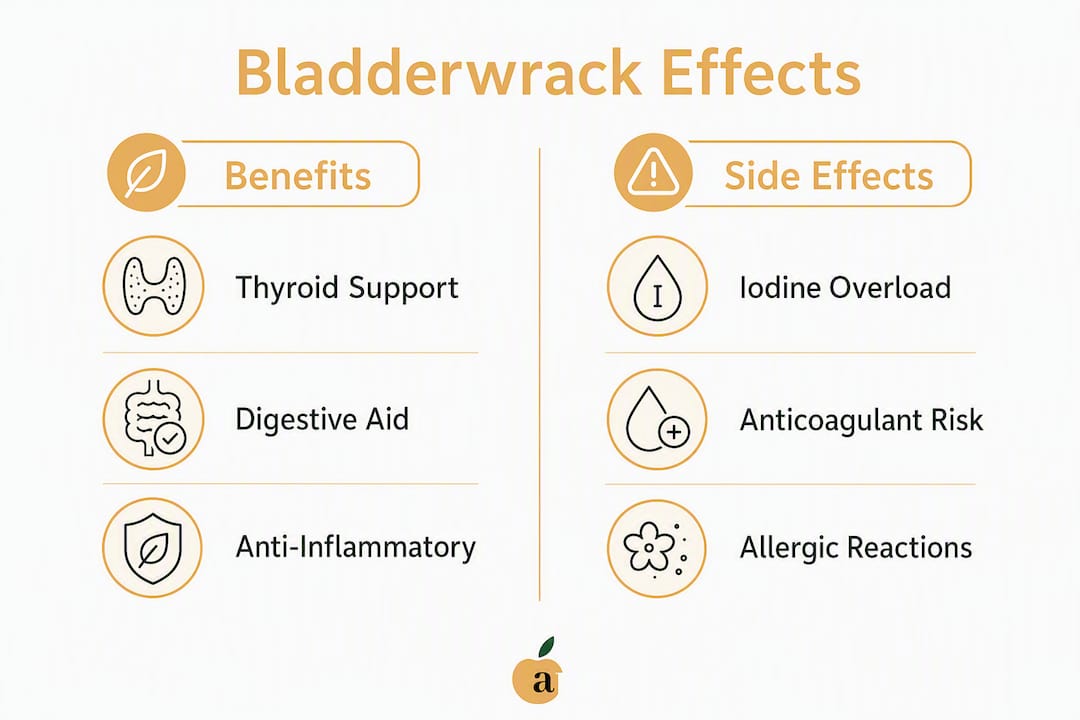
Bladderwrack (Fucus vesiculosus) is a brown intertidal seaweed and one of the richest natural sources of iodine available in UK coastal waters. If you have a thyroid condition or take anticoagulant medicines such as warfarin, speak to your GP before using any bladderwrack supplement. For most other adults, it is a well-tolerated traditional botanical with genuinely useful compounds, though the clinical evidence for many popular claims is still limited.
The essentials at a glance:
- Grows on rocky mid-shore coastlines throughout Britain, Ireland and the North Sea coast
- Sold as dried seaweed, powder, tea, topical preparations and bladderwrack capsules
- Active compounds include iodine, fucoidans, alginic acid and phlorotannins; iodine content is the primary clinical concern
- Evidence for thyroid support and digestive benefits is plausible but mostly preclinical; large human trials are lacking
- Avoid during pregnancy, breastfeeding, or if you have hyperthyroidism or take blood thinners
Most readers can consider trying a low-dose, standardised product, but anyone with a thyroid disorder or on regular medication should consult a clinician first.
Table of Contents
- How do you identify bladderwrack on UK shores?
- What does bladderwrack actually contain?
- What are the claimed benefits and what does the evidence say?
- How do people use bladderwrack, and what dosage is sensible?
- Who should avoid bladderwrack, and what are the key interactions?
- How do you source bladderwrack responsibly?
- Where does the science actually stand?
- Key takeaways
- A note on quality and caution
- Vitaminb17’s bladderwrack sea kelp capsules: pure, tested and traceable
- Useful sources and further reading
How do you identify bladderwrack on UK shores?
Fucus vesiculosus is one of the most recognisable seaweeds on British beaches once you know what to look for. The plant is olive-green to dark brown, typically 20–100 cm long, and has a prominent central midrib running the full length of each frond. Its most distinctive feature is the paired, pea-sized air bladders (vesicles) arranged symmetrically on either side of the midrib. These bladders keep the fronds buoyant at high tide, allowing the plant to photosynthesise in the water column.

The branching pattern is dichotomous — each frond forks into two roughly equal branches repeatedly — and the frond margins are smooth, not serrated. Reproductive tips (receptacles) swell into swollen, warty structures during the breeding season and release eggs and sperm directly into the water.
One important caveat for foragers: morphology varies with wave exposure. On highly exposed Atlantic-facing shores, plants often lack vesicles entirely, producing a compact dwarf form sometimes called forma evesiculosus. These bladderless plants can be confused with Fucus spiralis (spiral wrack), which has a twisted frond and no midrib groove, or with Fucus serratus (serrated wrack), which has a toothed margin. If you are foraging for consumption, confirm the midrib, smooth margin and paired vesicles on sheltered-shore specimens before harvesting.
Bladderwrack occupies the mid-shore intertidal band on sheltered to moderately exposed rocky coasts. It is common throughout Britain and Ireland, including the North Sea coast, the English Channel, and Atlantic-facing shores of Scotland, Wales and the west of England. It forms dense canopies that shelter small crustaceans, gastropods and grazing snails such as Littorina and Idotea species. That ecological role matters: stripping large areas of bladderwrack removes habitat for dozens of invertebrate species, which is why responsible harvesting is not just an ethical preference but a conservation necessity.
What does bladderwrack actually contain?
The seaweed’s nutritional and bioactive profile is genuinely varied. Iodine dominates the clinical picture, but several other compounds have attracted serious research interest.
| Compound | Primary function / claim | Practical notes |
|---|---|---|
| Iodine | Thyroid hormone synthesis; historically used to treat goitre | Concentrations vary widely by location and processing; excess causes thyroid dysfunction |
| Fucoidans | Antioxidant, anti-inflammatory, potential anticoagulant activity | Sulphated polysaccharides; most evidence is preclinical |
| Alginic acid (alginate) | Dietary fibre; forms a gel barrier in the stomach | Used in licensed reflux medicines (e.g., Gaviscon formulations) |
| Phlorotannins | Antioxidant and antimicrobial activity in lab studies | Polyphenols unique to brown algae; human bioavailability data limited |
| Fucoxanthin | Carotenoid with proposed metabolic and anti-inflammatory effects | Promising in animal studies; human evidence sparse |
| Minerals (calcium, magnesium, potassium, iron) | General micronutrient contribution | Levels vary significantly by harvest site |
| Vitamins (B-group, vitamin C, vitamin K) | General micronutrient contribution | Vitamin K content relevant for anticoagulant interactions |
Research published in PMC confirms that the phycochemical profile of Fucus species includes fucoidans, phlorotannins, fucoxanthin and alginates, all with proposed biological activities in laboratory settings. The key word is “proposed”: concentration varies considerably between specimens depending on water temperature, salinity, season and how the plant is dried and processed.
Contamination is a real concern. Seaweeds are bioaccumulators, meaning they absorb heavy metals and other pollutants from surrounding water. Arsenic, lead and cadmium have all been detected in commercial seaweed products at varying levels. The harvest site and processing method directly affect how much of these contaminants reach the final product, which is why traceability matters.
What are the claimed benefits and what does the evidence say?
Bladderwrack has a long history of traditional use across coastal cultures, and several of its compounds offer plausible biological mechanisms. The gap between “plausible” and “proven in humans” is wide for most claims.
Thyroid support (evidence: moderate for iodine-deficient populations)
Seaweed is one of the highest dietary sources of iodine, and bladderwrack has historically been used to treat iodine-deficiency goitre. For people with genuine iodine deficiency, supplementing with a low-dose, standardised product may support normal thyroid function. The risk cuts both ways: excess iodine can trigger hyperthyroidism or worsen autoimmune thyroid conditions such as Hashimoto’s disease. There are documented case reports of thyroid dysfunction occurring after taking bladderwrack supplements, particularly when combined with interacting medications.
Digestive and reflux relief (evidence: limited but mechanistically plausible)
Alginic acid forms a viscous gel when it contacts stomach acid, creating a physical barrier that reduces acid reflux. This mechanism is well-established in licensed medicines. Alginic acid is an active component in alginate-based antacid formulations used for reflux. Whether consuming whole bladderwrack delivers a clinically meaningful dose of alginate is unproven, but the mechanism is real.
Anti-inflammatory effects (evidence: preclinical only)
Fucoidans and phlorotannins show antioxidant and anti-inflammatory activity in cell and animal studies. For readers interested in herbal supplements for chronic inflammation, this is worth noting, but no large human trial has confirmed these effects in bladderwrack specifically.
Weight management (evidence: insufficient)
Fucoxanthin has generated interest for its potential effect on fat metabolism in animal models. Human evidence remains sparse and inconclusive.
Skin and wound healing (evidence: early-stage)
Fucoidan has shown wound-healing properties in laboratory settings. Topical bladderwrack preparations are sold for skin hydration and anti-ageing, but clinical trial data is limited.
Most clinical evidence for bladderwrack is limited; many promising results come from in vitro or animal studies rather than large human trials. Stronger evidence is lacking for weight-loss, arthritis, fertility and UTI claims.
The honest summary: thyroid iodine support and alginate-based digestive relief have the strongest mechanistic grounding. Everything else is promising but unproven in humans at the doses available in supplements.
How do people use bladderwrack, and what dosage is sensible?
Common forms
Fresh and dried fronds are used in coastal cooking, particularly in Scotland and Ireland, added to soups, stocks and salads. Dried powder can be stirred into smoothies or used as a seasoning. Tea is made by steeping dried fronds in hot water. Topical gels and creams use bladderwrack extract for skin applications. Capsules and tablets are the most popular supplement format in the UK.
Practical dosing notes
No standardised clinical dose exists for bladderwrack. The UK’s recommended daily iodine intake is 150 micrograms for adults, rising to 200 micrograms during pregnancy (though bladderwrack is not recommended during pregnancy at all). Many commercial capsules provide far more than this from iodine alone. Read the label carefully and add up all iodine sources in your diet, including dairy, fish and fortified foods, before adding a supplement.
Pro Tip: Check the iodine content per serving on the supplement label, then use the NHS’s daily reference value of 150 mcg as your ceiling. If the product does not state iodine content in micrograms, contact the manufacturer before purchasing.
What to check on a supplement label
- Species name: must state Fucus vesiculosus, not just “sea kelp” or “brown seaweed”
- Extract standardisation: look for a stated iodine content per serving
- Harvest location: UK, Norwegian or Icelandic Atlantic coasts are generally lower-risk for heavy metals than some Asian sources
- Third-party heavy-metal testing: certificate of analysis available on request
- No fillers, binders or synthetic additives
The term “kelp” is used loosely in commerce. Confirm the species label if you specifically want bladderwrack rather than a generic brown seaweed blend. A guide on how to choose raw herbal extract capsules covers these label checks in detail.
Who should avoid bladderwrack, and what are the key interactions?
Safety is the most important section of this article for most readers. The risks are real and specific.
Red flags: avoid bladderwrack if you:
- Have hyperthyroidism, Hashimoto’s disease or any diagnosed thyroid disorder
- Are pregnant or breastfeeding (insufficient safety data; iodine excess harms foetal thyroid development)
- Take warfarin, heparin or any anticoagulant medicine (bladderwrack may increase bleeding risk)
- Have a known iodine allergy or sensitivity
- Take lithium (case reports link bladderwrack plus lithium to thyroid alterations)
- Take thyroid hormone replacement (levothyroxine) without medical supervision
Drug interactions to discuss with your GP or pharmacist:
Fucoidans have anticoagulant properties in laboratory studies, and vitamin K in bladderwrack can affect INR in people on warfarin. If you take a blood thinner, request an INR check before and after starting any seaweed supplement. Lithium and thyroid medications both interact with iodine load; any change in iodine intake should be discussed with the prescribing clinician.
UK regulatory context
Bladderwrack supplements are sold as food supplements in the UK, not as licensed medicines. The Medicines and Healthcare products Regulatory Agency (MHRA) regulates products that make medicinal claims; the Food Standards Agency (FSA) oversees food supplements. Neither body has approved bladderwrack for any specific health condition. This means manufacturers cannot legally claim it treats or prevents disease, but they can make general nutrition and structure-function statements. Check the MHRA’s Yellow Card scheme if you experience an adverse reaction to a supplement.
This article provides general information, not medical advice. Confirm current guidance with the FSA, MHRA or a qualified healthcare professional before starting any supplement.
How do you source bladderwrack responsibly?
Fucus vesiculosus functions as a foundation species on many UK rocky shores. Its dense canopy provides substratum and shelter for Spirorbis, Idotea and Littorina species, and removing large quantities disrupts the entire mid-shore community. Overharvesting is not a theoretical risk: commercial demand for seaweed supplements has increased pressure on wild populations in several European coastal regions.
Sustainability checklist when buying bladderwrack products:
- Hand-harvested or low-impact mechanical methods (not dredged)
- Stated harvest location with traceable supply chain
- Evidence of quota compliance or harvest rotation (leaving at least two-thirds of the plant to regenerate)
- Third-party audit or NGO endorsement for sustainable practice
- No harvesting from polluted or designated protected marine areas
Pro Tip: Ask the supplier for a harvest report or certificate of analysis. Reputable suppliers will provide one. If a company cannot tell you where or how its seaweed was harvested, that is a clear signal to look elsewhere.
Ethical sourcing in botanical supply chains is not just about environmental credentials; it directly affects product safety. Seaweed harvested near industrial outflows or busy shipping lanes carries a higher contamination risk. Sustainable, traceable supply chains reduce both ecological harm and the heavy-metal risk that reaches your capsule. For a broader view of ethical sourcing standards in supplements, the guidance at Apiceuticals on ethics and sustainability is worth reading.
Where does the science actually stand?
| Study type | Sample / scale | Main finding | Key limitation |
|---|---|---|---|
| In vitro (cell studies) | N/A | Fucoidans show antioxidant, anti-inflammatory and anticoagulant activity | No human relevance confirmed; dose not translatable |
| Animal studies | Rodent models | Fucoxanthin associated with reduced fat accumulation; fucoidan supports wound healing | Species differences; doses far exceed typical human intake |
| Small human trials | Typically small participant numbers | Alginate-based products reduce acid reflux symptoms; iodine from seaweed raises urinary iodine | Short duration; no placebo control in many studies |
| Population / observational | Coastal populations | Higher seaweed intake associated with lower rates of certain conditions | Confounded by diet, lifestyle; causation not established |
Human data are scarce and often from small studies; stronger evidence is lacking for weight-loss, arthritis, fertility and UTI claims. The most pressing research gaps are: large randomised controlled trials in humans, standardised product composition across studies, long-term safety data (particularly for pregnancy and drug interactions), and dose-response data for iodine from whole-plant versus extract products.
What the current evidence is sufficient to suggest: bladderwrack can contribute iodine to the diet, and alginate from brown seaweeds has a plausible and clinically used mechanism for reflux relief. What remains speculative: most other claimed benefits, including weight management, anti-ageing, joint health and fertility support.
Key takeaways
Bladderwrack (Fucus vesiculosus) is a high-iodine brown seaweed with plausible but mostly preclinical evidence for its claimed benefits; anyone with a thyroid condition or on anticoagulant medication must consult a clinician before use.
| Point | Details |
|---|---|
| Identification | Look for paired air bladders, a central midrib and smooth margins on mid-shore rocky UK coasts. |
| Iodine is the chief concern | Excess iodine can trigger or worsen thyroid dysfunction; always check the stated iodine content per serving against the 150 mcg daily reference value. |
| Evidence snapshot | Thyroid iodine support and alginate-based reflux relief have the strongest mechanistic grounding; weight loss, joint and skin claims remain preclinical. |
| Safe use | Avoid during pregnancy, breastfeeding, anticoagulant use or diagnosed thyroid disease; check for Fucus vesiculosus on the label and request a certificate of analysis. |
| Vitaminb17 sea kelp capsules | Vitaminb17’s Sea Kelp Extract Capsules 5000mg specify Fucus vesiculosus, contain no fillers or binders, and are standardised for consistent dosing. |
A note on quality and caution
The supplement market for seaweed products is crowded, and label accuracy varies considerably. Many products sold as “sea kelp” or “bladderwrack” do not specify the species, the harvest location or the iodine content per serving. That lack of transparency is not a minor inconvenience; it makes it impossible for you to manage your iodine intake safely.
At Vitaminb17, the commitment is to pure, single-ingredient extracts with no fillers, no binders and no synthetic additives. Every product specifies the botanical name and extract strength so you know exactly what you are taking. That matters most for a compound like bladderwrack, where iodine variability between products can be significant.
If you have a thyroid condition, take prescription medication, or are pregnant, please speak to a healthcare professional before starting any seaweed supplement. General information, however well-researched, is not a substitute for clinical advice tailored to your situation.
Vitaminb17’s bladderwrack sea kelp capsules: pure, tested and traceable
If you have read this far, you already know that product quality separates a useful bladderwrack supplement from a risky one. Vitaminb17’s Sea Kelp Extract Capsules 5000mg Bladderwrack are formulated from pure Fucus vesiculosus extract with no fillers, no binders and no synthetic additives. The extract is standardised, so each capsule delivers a consistent dose rather than the variable iodine load you get from unprocessed dried seaweed.

Before you buy any seaweed supplement, check whether it specifies the species, states iodine content per serving and provides third-party testing. Vitaminb17 products meet all three criteria. If you want to understand what separates a properly dosed product from an underdosed one, the buyer’s guide to recognising underdosed herbal supplements is a practical next step.
Consult your GP or pharmacist first if you have a thyroid condition or take anticoagulant medication. Then visit the product page to check the current specification and place your order.
Useful sources and further reading
- Phycochemical constituents and biological activities of Fucus spp. (PMC) — peer-reviewed review of bioactive compounds in Fucus species; the primary reference for composition and mechanisms.
- Bladder wrack (Fucus vesiculosus) — MarLIN — Marine Life Information Network species account; authoritative UK source for identification, habitat and ecological role.
- Fucus vesiculosus description — AlgaeBase — detailed morphological description including the bladderless exposed-shore form; essential for foragers.
- Bladderwrack: benefits, uses and side effects — Healthline — evidence-reviewed consumer summary covering safety, interactions and evidence gaps.
- Health benefits, uses and safety information — WebMD — practical overview including alginate mechanism and species-labelling caution.
- Fucus vesiculosus — Wikipedia — accessible taxonomy, history and iodine/goitre background.
- Food Standards Agency (FSA) — UK regulatory body for food supplements; check for current advisories on seaweed and iodine.
- MHRA Yellow Card scheme — report adverse reactions to supplements and check safety alerts for herbal products in the UK.


