

Apricot kernel supplements, marketed under the “vitamin B17” label, deliver meaningful antioxidant and anti-inflammatory support for general wellbeing — but the evidence base is mostly preclinical, and every product carries a non-negotiable safety caveat: amygdalin, the active compound, releases hydrogen cyanide during digestion. That risk is real and manageable with the right product and the right dose, but it means B17 is not suitable for pregnant or breastfeeding women, children, or anyone on thyroid or liver-affecting medications without GP clearance first. Read on for the full compound breakdown, evidence summary, safety guide, and UK buying checklist.
Table of Contents
- What the research actually shows — and where it falls short
- Where apricot kernel supplements may help you
- Amygdalin, cyanide risk, and who should avoid B17
- When should you seek medical advice?
- Key takeaways
- An honest perspective on B17 supplements
- Vitaminb17 apricot kernel capsules: pure, tested, and UK-ready
- Useful sources and further reading
What the research actually shows — and where it falls short
Preclinical evidence is strong. Human clinical evidence is limited.
In vitro antioxidant assays consistently show that apricot kernel polyphenols scavenge free radicals and reduce markers of oxidative stress. The most compelling animal study to date used a TNBS-induced colitis model in rats: apricot extracts reduced ulcer index scores and histological colitis markers, performing comparably to prednisolone on some metrics. That is a meaningful preclinical signal for anti-inflammatory activity.
Evidence grade: strong preclinical, limited clinical. In vitro and animal models consistently support antioxidant and anti-inflammatory activity. Controlled human trials are sparse, and no high-quality randomised controlled trial has confirmed these effects in healthy adults taking standardised apricot kernel capsules.
Compositional analyses also confirm wide geographic variability. One study comparing seeds from multiple origins found amygdalin content ranging from 89.1 mg/100 g to 879.6 mg/100 g across samples — a tenfold difference that underlines why origin and batch testing matter far more than a label claim alone.
The honest position: apricot kernel supplements are nutritional support with plausible mechanisms, not medicines with proven clinical outcomes.
Where apricot kernel supplements may help you
Blood health and cholesterol: Dietary fibre and polyphenols in apricot kernels may support cholesterol absorption in the gut and modulate the microbiota in ways that benefit lipid profiles. See the herbal extracts for blood health guide for broader context. Evidence level: preclinical and food-science models only.
Gout and joint inflammation: Anti-inflammatory polyphenols could theoretically reduce inflammatory signalling relevant to gout flares, but direct evidence for urate control from apricot kernel is speculative. Diet and hydration remain the primary levers. Evidence level: hypothetical; no direct human data.
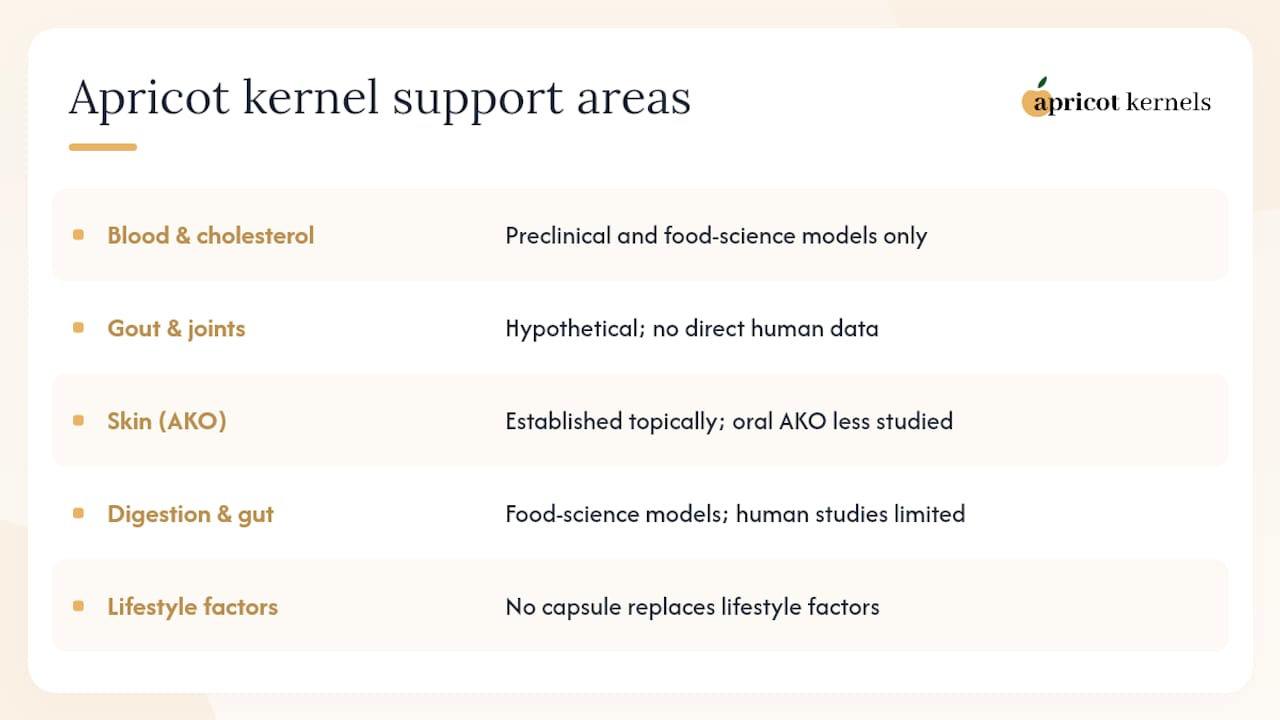
Skin support via apricot kernel oil (AKO): Cold-pressed AKO is rich in oleic and linoleic acids and vitamin E, making it a well-established topical emollient. Processed to remove amygdalin, it is safe for skin use. Evidence level: established for topical application; oral AKO for skin is less studied.
Digestion and gut lining: Fibre fractions in apricot kernels ferment to short-chain fatty acids in the colon, which support gut lining integrity. Pectin and polysaccharide content add a prebiotic dimension. Evidence level: food-science models; human gut studies are limited.
For each of these areas, a single supplement is rarely sufficient on its own. Diet quality, sleep, and other lifestyle factors are co-factors that no capsule replaces.
Amygdalin, cyanide risk, and who should avoid B17
Amygdalin is hydrolysed in the gut to release hydrogen cyanide. At low doses from a standardised, debittered extract, the body’s detoxification pathways handle this without issue for most healthy adults. At higher doses — or from raw, unprocessed bitter kernels — cyanide accumulation becomes a genuine clinical risk.
Safety warning: Symptoms of cyanide toxicity include headache, nausea, dizziness, rapid heart rate, and in severe cases, loss of consciousness or convulsions. If you experience any of these after taking an apricot kernel product, stop immediately and seek medical attention.
Groups who must avoid B17 supplements:
- Pregnant and breastfeeding women
- Children and adolescents
- People with thyroid disease (amygdalin may affect thyroid function)
- Anyone taking medications metabolised by the liver’s cytochrome P450 pathways
- People with known nut or stone-fruit allergies
WebMD’s apricot kernel safety summary confirms that both raw kernels and laetrile-type products carry documented cyanide risk, and that processed forms such as cold-pressed oil — where amygdalin has been removed — are generally safe for topical use.
For a deeper look at amygdalin specifically, the amygdalin benefits, risks, and the truth page covers the compound in full detail.
When should you seek medical advice?
For mild adverse effects (digestive upset, mild headache): stop the supplement and phone your pharmacist or GP within 24 hours.
Seek emergency care immediately if you experience breathlessness, confusion, fainting, or convulsions after taking any apricot kernel product. Tell the clinician the product name, the dose you took, and the time you took it. These symptoms can indicate cyanide toxicity and require urgent assessment.
Ask for monitoring if you notice persistent digestive disturbance lasting more than a few days, unexplained fatigue, or any change in thyroid function markers. A blood test can rule out metabolic causes before you continue supplementation.
Key takeaways
Apricot kernel supplements offer plausible antioxidant and anti-inflammatory support, but safe use depends entirely on choosing a standardised, batch-tested product and following label dosing without exception.
| Point | Details |
|---|---|
| Evidence is preclinical | Animal and in vitro studies support antioxidant effects; controlled human trials are limited. |
| Amygdalin carries real risk | HCN release is dose-dependent; always choose a debittered, batch-tested extract with a COA. |
| Origin and processing matter | Amygdalin content varies up to tenfold by origin; standardised extracts reduce this variability. |
| Vulnerable groups must avoid B17 | Pregnant women, children, and those on certain medications should not take B17 without GP clearance. |
| Vitaminb17 offers a tested option | Vitaminb17’s apricot kernel capsules are standardised, filler-free, and backed by batch lab testing. |
This article is general information, not medical advice. Confirm current guidance with your GP, pharmacist, or a qualified health professional before starting any new supplement.
An honest perspective on B17 supplements
The conversation around apricot kernel supplements tends to split into two camps: uncritical enthusiasm and blanket dismissal. Neither serves you well.
What the evidence actually supports is narrower and more useful than either extreme. Polyphenols from apricot kernels are genuine antioxidants. The anti-inflammatory signal from preclinical models is real and worth taking seriously as a plausible mechanism. But “plausible mechanism” is not the same as “proven clinical benefit,” and anyone selling you certainty on human outcomes from these supplements is overstating the science.
The safety question is where most articles go wrong by underplaying it. Amygdalin is not a theoretical risk. The tenfold variation in HCN content across origins means that two products with identical label claims can carry very different actual exposures. That is precisely why batch testing and COA transparency are not optional extras — they are the minimum standard for a responsible product.
The brands worth trusting are the ones that publish their COA data, declare their kernel origin, and state clearly that their product is nutritional support rather than a treatment. That combination of transparency and realistic positioning is what separates a supplement worth taking from one worth avoiding.
Vitaminb17 apricot kernel capsules: pure, tested, and UK-ready

If you want the antioxidant and anti-inflammatory support that apricot kernel research points to, the product has to earn that trust before you open the bottle. Vitaminb17’s Vitamin B17 Apricot Kernels are standardised for consistent polyphenol delivery, batch-tested for amygdalin and HCN levels, and contain no fillers, binders, or synthetic additives. Vegan-friendly capsules. Pure extract. Nothing else.
Follow the label dosing, check the COA, and consult your GP if you are on any medication. That is the right way to use this product, and it is the approach Vitaminb17 is built around. Browse the full range and check current availability at vitaminb17.co.uk.
Useful sources and further reading
- Apricot Kernel: Bioactivity, Characterization, Applications, and Health Attributes — PMC
- Anti-inflammatory effect of Prunus armeniaca L. (Apricot) extracts ameliorates TNBS-induced ulcerative colitis in rats
- Unlocking the nutritional profile of apricot ( Prunus armeniaca L) kernel as a valuable by-product for future exploration
- Apricot Seeds as a Sustainable Source of Nutrients and Bioactive Compounds with Health-Relevant Properties
- Apricot kernel — WebMD
Always verify COA data with your supplier and seek UK-specific clinical advice if you have any underlying health condition before starting supplementation.


