

You can batch most daily supplements into one or two windows per day. The rule is simple: follow timing rules for minerals, take fat-soluble vitamins with food, and run a pharmacist check if you take any prescription medicines. That single habit cuts the chaos of multiple bottles and missed doses down to a manageable weekly routine.
Most people taking vitamins, herbal extracts, and basic minerals can consolidate into an AM window after breakfast and a PM window after dinner. The exceptions are specific mineral pairs and any supplement that interacts with a prescription drug. The NHS and the Medicines and Healthcare products Regulatory Agency (MHRA) both advise checking interactions before combining supplements with prescribed medicines, particularly anticoagulants, thyroid drugs, or anything with a narrow therapeutic window.
Key safety callouts before you start:
- Consult your pharmacist or GP if you take warfarin, levothyroxine, bisphosphonates, or any medicine where timing is critical.
- Separate calcium and iron by roughly two hours; they compete for absorption.
- Space iron and zinc doses; high zinc intake over time can also affect copper status.
- Fat-soluble vitamins (A, D, E, K) need a fat-containing meal to absorb properly.
- Pregnant or breastfeeding? Get professional advice before batching high-dose minerals.
Pro Tip: Write your two windows on a sticky note and attach it to your pill organiser for the first two weeks. Habit anchoring to a meal is the fastest way to make the routine stick.
Key takeaways
Batching daily supplements into one or two windows after meals, following mineral spacing rules, and running a pharmacist check for prescriptions covers the vast majority of safe daily supplement organisation.
| Point | Details |
|---|---|
| Use the 2-window method | Take most supplements in an AM window after breakfast and a PM window after dinner. |
| Space calcium and iron | Separate these two by roughly two hours; they compete for absorption at the intestinal level. |
| Fat-soluble vitamins need fat | Vitamins A, D, E, and K absorb best with a fat-containing meal; never take them on an empty stomach. |
| Consult a pharmacist for prescriptions | Warfarin, levothyroxine, and bisphosphonates all interact with common supplements; get a medicines use review. |
| Vitaminb17 for clean single-ingredient doses | Standardised, filler-free herbal extract capsules slot cleanly into AM or PM windows without added compounds. |
Table of Contents
- ## 1. Which supplements can you safely take together?
- ## 2. Which supplements must be spaced apart?
- ## 3. Sample batching schedules: the 2-window method and alternatives
- ## 4. Practical tools and UK services for organising your doses
- ## 5. How to set up a safe weekly fill routine
- ## 6. When should you ask a pharmacist or GP instead of batching yourself?
- ## 7. What to check before buying a pill organiser or booking a packing service
- ## 8. The evidence behind timing rules: why spacing matters
- What actually simplifies a complex supplement stack
- Vitaminb17 single-ingredient extracts: fewer bottles, consistent doses
- Sources
## 1. Which supplements can you safely take together?
Most common daily supplements group cleanly into two batching windows. Understanding the groupings is the foundation of good daily supplement organisation.
Morning window (after breakfast):
- B-complex vitamins (B1, B2, B3, B5, B6, B12, folate) — water-soluble, work well together, best taken with food to reduce nausea.
- Vitamin C — pairs well with iron when iron is part of your stack; vitamin C enhances non-haem iron absorption and is commonly recommended alongside it.
- Probiotics — many strains survive better taken just before or with a meal.
- Fish oil or algae omega-3 — fat-containing meal aids absorption and reduces fishy aftertaste.
- Single-ingredient herbal extracts (ginger root, burdock root, dandelion root, fenugreek) — generally well-tolerated with food.
Evening window (after dinner):
- Magnesium — often better tolerated in the evening; some people find it supports relaxation before sleep.
- Fat-soluble vitamins A, D, E, K — fat-soluble vitamins absorb better with a fat-containing meal, so a dinner that includes healthy fat is ideal.
- Zinc — if taken separately from iron (see Section 3), evening works well for most people.
- Herbal extracts with a calming profile (sage leaf, mullein leaf) — evening suits these for many routines.
Pro Tip: Label each compartment of your weekly pillbox with “AM” and “PM” rather than the day alone. It removes any guesswork when you fill it on Sunday evening.
For a deeper look at stacking herbal supplements effectively, the principles of sequencing doses apply directly to your morning and evening windows.
## 2. Which supplements must be spaced apart?
Some combinations actively reduce absorption or create clinically relevant interactions. These are the pairs to separate when you batch and organise your daily supplement doses.
Mineral conflicts:
- Calcium vs iron: Calcium inhibits iron absorption when taken together. Pharmacokinetic evidence supports spacing iron and calcium by roughly two hours in many situations. Put calcium in your PM window and iron in your AM window, or vice versa with at least two hours between them.
- Iron vs zinc: Both compete for the same absorption pathway. If you take therapeutic doses of both, separate them by at least two hours.
- Zinc vs copper: High zinc intake can interfere with copper status; clinicians monitor copper when zinc is taken at high doses over time. If you take zinc above standard dietary levels long-term, discuss copper balance with your pharmacist.
Food and absorption rules:
- Iron absorbs better with vitamin C and on an empty stomach, though some people need food to tolerate it.
- Fat-soluble vitamins (A, D, E, K) need dietary fat to absorb; never take them on an empty stomach.
- Some antibiotics (tetracyclines, fluoroquinolones) and bisphosphonates are significantly affected by calcium, magnesium, iron, and zinc. Space these medicines by at least two hours from any mineral supplement.
Red flags — stop and consult a clinician:
- Warfarin or other anticoagulants: vitamin K, fish oil, and several herbal extracts affect clotting.
- Thyroid medication (levothyroxine): calcium, iron, and magnesium all reduce its absorption.
- Any medicine with a narrow therapeutic index: do not batch with supplements until a pharmacist has reviewed the combination.
Taking supplements alongside prescription medicines is not simply a matter of timing. A peer-reviewed review of nutrient–drug and nutrient–nutrient interactions documents clinically relevant conflicts that are not always obvious from product labels. When in doubt, bring your full supplement list to a pharmacist before you fill a single compartment.
Pro Tip: Use a different coloured compartment or a small sticky dot to mark any supplement that must be spaced from the others. Red dot = take separately. It takes seconds to set up and prevents the most common batching mistakes.
## 3. Sample batching schedules: the 2-window method and alternatives
The 2-window method suits most people taking a moderate stack of vitamins, minerals, and single-ingredient herbal extracts. It reduces daily decision-making to two moments: after breakfast and after dinner.
The standard 2-window schedule:
- AM window (after breakfast): B-complex, vitamin C, iron (if needed), probiotics, fish oil or omega-3, herbal extracts (ginger, fenugreek, burdock root, dandelion root).
- PM window (after dinner): Magnesium, vitamin D, vitamin K2, zinc (if separated from iron), herbal extracts (sage leaf, mullein leaf), any fat-soluble vitamins not taken at breakfast.
Alternatives for more complex stacks:
- Three-window approach (AM / midday / PM): Useful when iron and calcium both need to be taken daily and must stay two hours apart, or when a supplement requires an empty stomach.
- Single-window minimalist: If you take only a multivitamin, vitamin D, and one herbal extract, a single post-breakfast dose is sufficient.
Sample timing reference:
| Supplement class | Ideal window | Meal requirement | Notes |
|---|---|---|---|
| B vitamins | AM | With food | Reduces nausea |
| Vitamin C | AM | With or without food | Take with iron to aid absorption |
| Iron | AM | With food or vitamin C | Space 2 hrs from calcium |
| Calcium | PM | With food | Space 2 hrs from iron |
| Magnesium | PM | With food | Evening suits most people |
| Fat-soluble vitamins (A, D, E, K) | PM | With fat-containing meal | Absorption depends on dietary fat |
| Fish oil / omega-3 | AM or PM | With food | Reduces aftertaste |
| Probiotics | AM | Just before or with food | Check strain-specific advice |
| Herbal extracts | AM or PM | With food | Follow label guidance |

Aligning supplement windows with meals also makes it easier to integrate herbal supplements into meal prep, which reinforces the habit without adding extra steps.
## 4. Practical tools and UK services for organising your doses
The right tool depends on the size of your stack, your dexterity, and whether you take prescription medicines alongside supplements.
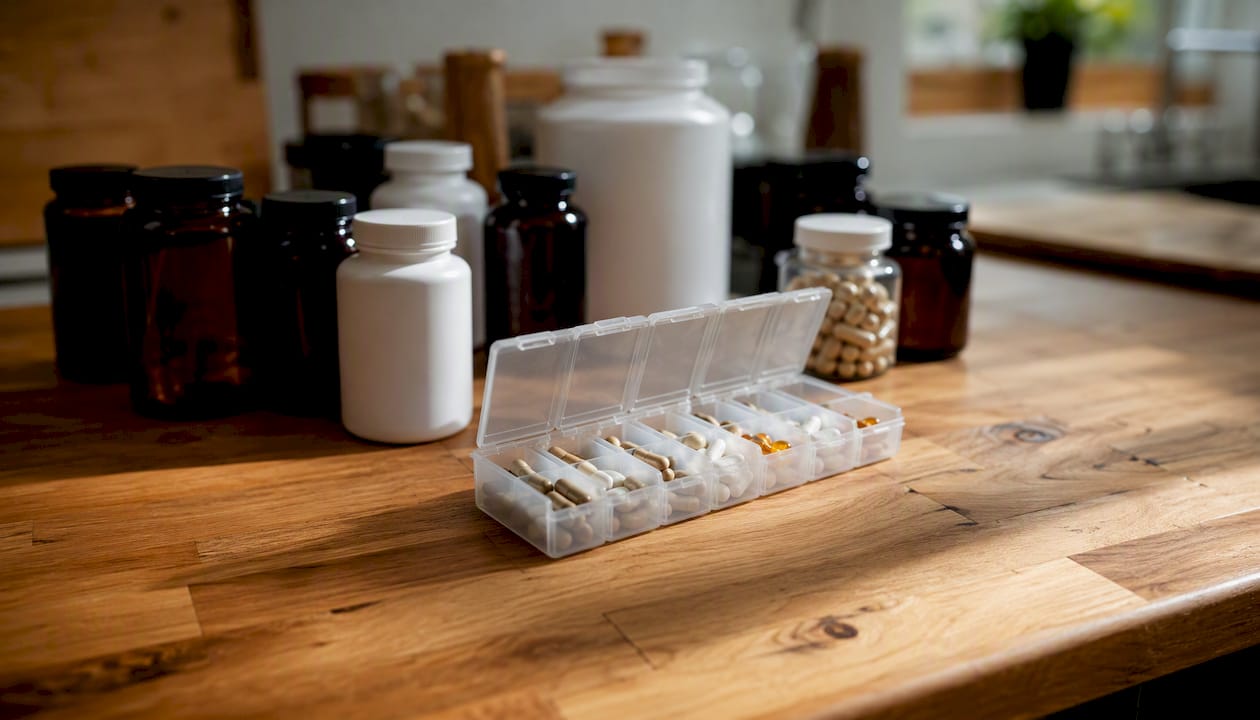
Weekly pill organisers and pillboxes
Retail weekly organisers are the most accessible starting point for daily pill sorting. Most UK pharmacies and supermarkets stock them at low to moderate prices. Look for models with at least two compartments per day (AM and PM) and compartments large enough for large softgels such as fish oil capsules. Organisers with removable daily pods let you carry a single day’s doses without taking the whole box.
Capacity matters more than most buyers expect. A standard compartment holds around 4–6 small tablets, but large fish oil softgels or multi-capsule herbal extracts can fill a slot quickly. Check the internal dimensions before buying, particularly for extra-large capsule formats.
Pros: Low cost, widely available, no subscription, easy to refill weekly.
Cons: No interaction checking, no reminders, relies on manual discipline.
Pharmacy blister-packing and dose administration aids (DAA)
UK pharmacies including Boots and LloydsPharmacy offer Dose Administration Aid (DAA) services, also called blister-packing or Nomad trays. A pharmacist pre-fills a sealed blister pack with your medicines and sometimes supplements, organised by day and time. This service is particularly useful for people on multiple prescriptions, those with dexterity difficulties, or anyone whose regimen is complex enough that DIY packing carries a real risk of error.

DAA services typically require a medicine review and are often available free of charge for eligible patients through NHS-linked pharmacy services. Contact your local pharmacy to check availability and whether supplements can be included alongside prescribed medicines.
Pros: Pharmacist-checked, sealed for safety, strong adherence support.
Cons: Less flexible for supplement-only stacks, requires pharmacy coordination, not all pharmacies include supplements.
Medication and supplement reminder apps
Apps reduce the mental load of efficient supplement management. Medisafe is one of the most widely used medication reminder apps in the UK, offering dose scheduling, interaction warnings, and a caregiver-sharing feature. Stack My Med takes a different approach: it scans supplement labels, catalogues your stack, flags timing conflicts, and generates a clinician-friendly export you can bring to a medicine review appointment.
Pros: Interaction alerts, reminders, exportable lists for pharmacist visits.
Cons: Data privacy varies by app; check the privacy policy before entering prescription details.
Pro Tip: Use a vitamin and supplement tracker alongside a digital app. The physical record gives you a three-month view of adherence that no app notification can replicate.
When to choose a pharmacy service over a DIY organiser
Choose a DAA service if you take four or more prescribed medicines, have dexterity or memory difficulties, or have recently had a prescription change. For supplement-only stacks, a quality weekly organiser plus a reminder app covers most needs. The NHS recommends asking your GP or pharmacist for a medicines use review if you are unsure whether your current regimen is well-managed.
## 5. How to set up a safe weekly fill routine
One weekly session of around 15–20 minutes is all it takes to keep your supplement organisation running reliably. Do it on the same day each week, ideally Sunday evening, so Monday morning starts clean.
Step-by-step weekly fill:
- Clear a clean, dry surface away from direct sunlight and humidity.
- Gather all supplement bottles and your organiser.
- Check expiry dates on every bottle before filling. Discard anything past its date.
- Read the label of any new supplement for special timing or storage instructions.
- Arrange bottles in window order: AM supplements on the left, PM on the right.
- Fill AM compartments first, working left to right across the days of the week.
- Fill PM compartments, keeping calcium and iron in separate windows as planned.
- Use a clean spoon or tongs for any loose capsules; avoid touching multiple capsules with bare hands.
- Leave a small gap in each compartment so capsules do not crush each other.
- Close all lids firmly and store the organiser away from heat, humidity, and direct light.
Weekly safety checks:
- Cross-check any new supplement against your existing stack for interactions (use an app or ask your pharmacist).
- Count remaining pills in each bottle and note what needs reordering before you run out.
- Check that storage conditions are correct: most supplements store best below 25°C, away from bathroom humidity.
- If you use a reminder app, confirm the schedule still matches what you have filled.
Pro Tip: Keep a supplement adherence tracker next to your organiser. Ticking off each window takes two seconds and gives you a clear picture of consistency over weeks, not just days.
For guidance on building tolerance to potent herbal supplements safely, the same weekly-check habit applies: review your dose levels each time you refill.
## 6. When should you ask a pharmacist or GP instead of batching yourself?
Some situations call for professional input before you fill a single compartment. Batching supplements is safe for most people, but the following circumstances change that calculation.
Consult a pharmacist or GP if you:
- Take warfarin, heparin, or any anticoagulant.
- Take levothyroxine or other thyroid medicines.
- Take bisphosphonates (e.g. alendronic acid) for bone health.
- Are on three or more prescribed medicines simultaneously.
- Have recently started a new prescription.
- Are pregnant, breastfeeding, or planning a pregnancy.
- Have a significant chronic condition (kidney disease, liver disease, cardiovascular disease).
- Take high-dose single minerals (zinc above standard dietary levels, iron above standard dietary levels, calcium in large single doses).
What a pharmacist can do for you:
- Run a medicines use review (MUR) or a structured medication review (SMR) through your GP practice.
- Check your full supplement and medicine list for interactions and timing conflicts.
- Set up a DAA/blister-pack service if your regimen is complex.
- Advise on whether a supplement is appropriate given your medical history.
The NHS recommends that anyone taking multiple medicines or supplements asks their pharmacist for a medicines use review. Bring a printed list or an app export of everything you take, including doses and timing. A pharmacist can spot conflicts in minutes that might take you hours to research independently.
Practical next step: export your supplement list from an app like Medisafe or Stack My Med, print it, and bring it to your next pharmacy or GP appointment. Ask specifically for a medicines use review or interaction check.
## 7. What to check before buying a pill organiser or booking a packing service
A quick checklist prevents a wasted purchase. The wrong organiser creates more friction, not less.
For a retail pill organiser:
- Compartment size: Can it fit large softgels (fish oil, evening primrose)? Check internal dimensions, not just the overall box size.
- Compartments per day: You need at least two (AM and PM) for the 2-window method.
- Removable daily pods: Useful if you travel or carry doses to work.
- Locking or snap-shut lids: Prevents accidental spillage in a bag.
- Water and humidity resistance: Avoid storing in a bathroom; choose a box with tight-fitting lids.
- Labelling: Some organisers include writable labels or colour-coded lids; both help when you have multiple supplements per window.
- Material quality: BPA-free plastic or food-grade materials are preferable for direct contact with supplements.
For a pharmacy DAA/blister-packing service:
- Is the service available at your local pharmacy? Not all branches offer it.
- Does the pharmacy include supplements as well as prescribed medicines in the pack?
- Is there a cost? NHS-linked services may be free for eligible patients; private services vary.
- Does the service include a medicines review, or is it packing only?
- What is the collection or delivery arrangement? Weekly or fortnightly?
Storage guidance (applies to both):
- Store below 25°C, away from direct sunlight and humidity.
- Avoid the bathroom cabinet; kitchen or bedroom drawer is better.
- Keep supplements in original bottles until you fill the organiser to preserve expiry information.
## 8. The evidence behind timing rules: why spacing matters
The spacing rules in this guide are not arbitrary. They come from pharmacokinetic research and clinical nutrition science.
Key evidence notes:
- Vitamin C and iron: Vitamin C enhances non-haem iron absorption when taken at the same time. This is an intentional pairing, not a conflict. If you take an iron supplement, adding vitamin C to the same AM window is a practical, evidence-backed choice.
- Calcium and iron: Pharmacokinetic studies support spacing iron and calcium by roughly two hours because calcium inhibits iron absorption at the intestinal level. The effect is dose-dependent but consistent across multiple studies.
- Zinc and copper: High zinc intake can interfere with copper status through competition at the intestinal absorption site. This is a long-term concern rather than an acute one, but it is clinically documented.
- Magnesium interactions: Magnesium supplements can interact with some medicines, including certain antibiotics and diuretics. Timing and dose form both affect how significant the interaction is.
- Fat-soluble vitamins: Fat-soluble vitamins absorb significantly better with a fat-containing meal. Taking vitamin D on an empty stomach reduces its uptake; a dinner with olive oil, avocado, or oily fish is a practical solution.
- Nutrient–drug interactions broadly: A peer-reviewed review of clinically relevant nutrient–drug and nutrient–nutrient interactions confirms that the interactions described above are not theoretical. They are documented in clinical practice and support the spacing guidance given throughout this article.
Earlier pharmacokinetic work has demonstrated that timing and formulation affect nutrient uptake and interactions, which underpins the practical timing rules for batching. The science is consistent: when you separate competing minerals and align fat-soluble vitamins with meals, you are not just following convention. You are working with your body’s absorption mechanisms.
For a deeper read on natural supplement absorption, the principles of meal timing and formulation choice apply directly to every window you fill.
What actually simplifies a complex supplement stack
Most people who struggle with daily supplement organisation are not failing at discipline. They are managing too many bottles for the system they have chosen.
The most consistent shift comes from habit stacking: anchoring your AM window to the act of making breakfast and your PM window to clearing the dinner table. The supplement routine stops being a separate task and becomes part of something you already do every day. That is not a motivational trick. It is how habits form.
The second shift is starting with a Level-1 stack: the two or three supplements that matter most to your health goals. Get those consistent for two to three weeks before adding anything else. Readers who try to batch eight supplements from day one tend to drop the routine entirely within a fortnight. Those who start with three and add gradually tend to maintain it for months.
One thing that often surprises people: a shorter stack is frequently more effective than a longer one. Fewer bottles means fewer interactions to manage, fewer compartments to fill, and a much clearer picture of what is actually working. If you are taking six single-ingredient capsules and finding the routine exhausting, the answer is not a better organiser. It is a more honest audit of what you actually need.
Vitaminb17 single-ingredient extracts: fewer bottles, consistent doses
If you are taking several single-ingredient capsules and finding the weekly fill routine more complex than it needs to be, the issue is often the number of bottles rather than the batching method itself.

Vitaminb17 offers pure, high-potency herbal extract capsules with no fillers, no binders, and no synthetic additives. Each product is standardised for consistent dosing, so you know exactly what you are getting in every capsule. Products like Sea Kelp Extract 5000mg and Celery Seed Extract 8,000mg are single-ingredient by design, which makes them straightforward to slot into an AM or PM window without interaction concerns from added compounds. For anyone building a clean, manageable stack, the benefits of single-ingredient supplements are worth understanding before you buy.
Browse the full range and check product details at Vitaminb17. For complex regimens or questions about specific interactions, consult your pharmacist or GP before adding any new supplement.
Sources
These are the primary references used to build the recommendations in this guide. Each covers a specific area of supplement timing and interaction evidence.
- Vitamin C — Health Professional Fact Sheet (ODS)
- Zinc — Health Professional Fact Sheet (ODS)
- The best time to take vitamins (Cleveland Clinic)
- PMC article (PMC3235461)
- PubMed entry (ID 10999016)
This article provides general information only and is not a substitute for professional medical or pharmaceutical advice. Always consult your pharmacist or GP before changing your supplement or medication routine, particularly if you take prescribed medicines.


